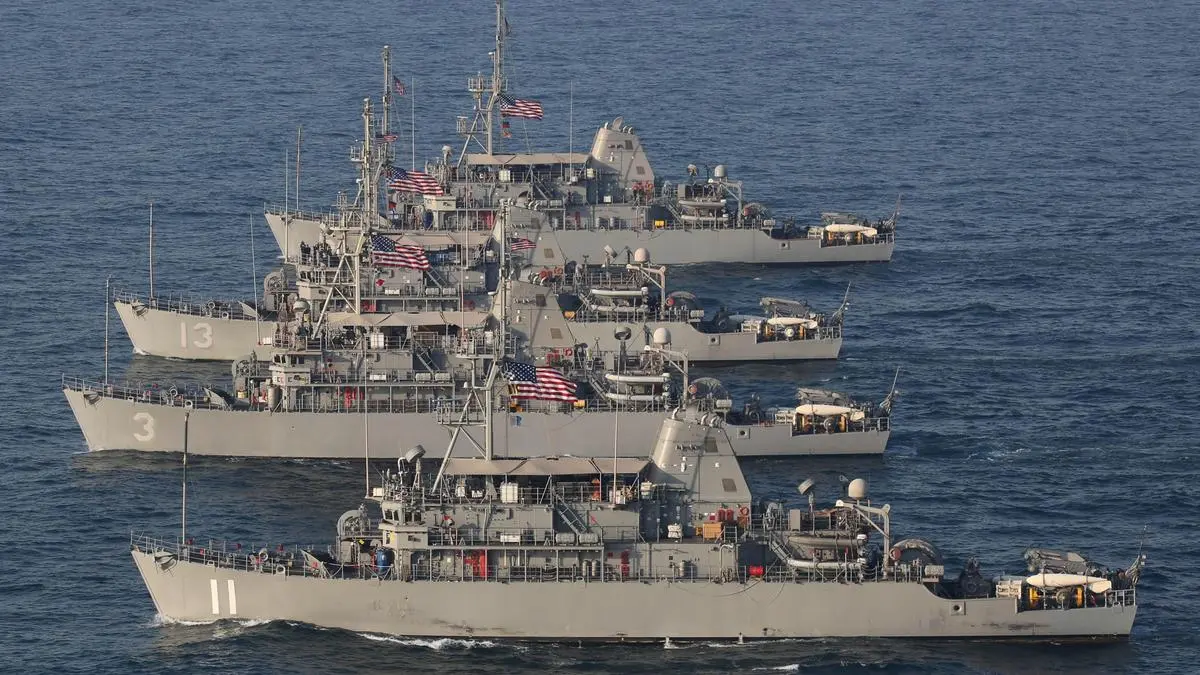
The Pentagon is currently broadcasting a narrative of high-stakes "mine hunting" in the Strait of Hormuz, painting a picture of a heroic, technical struggle against hidden explosives. It is a cinematic story. It is also a fundamental misunderstanding of modern maritime chokepoints.
The media focuses on the hardware—the Mark 18 Mod 2 Kingfish underwater vehicles, the SeaFox clearance rounds, and the sonar sweeps. They want you to believe this is a tactical problem with a technical solution. It isn't. If you think the "hunt" for mines is about clearing a path for tankers, you are missing the entire geopolitical chess board.
The Logistics of the Ghost Threat
Mining a strait isn't about sinking every ship. It is about the insurance premium.
I have watched risk assessment boards at major shipping conglomerates freeze operations not because a mine was found, but because the possibility of a mine existed. You do not need to drop five hundred Soviet-era contact mines to shut down the Strait. You only need to drop two. Or, more effectively, you just need to be seen dropping a couple of empty crates that look like mines.
The current "push" to open the Strait is less about underwater demolition and more about psychological warfare. The Navy isn't just hunting explosives; they are hunting for a way to lower the "War Risk" surcharges that are currently strangling global energy markets.
When the US Navy says they are "hunting," they are performing for the Lloyd’s of London underwriters. They are trying to prove a negative—that the water is safe—which is mathematically and operationally impossible in a body of water that sees 20% of the world's petroleum pass through it daily.
Why Technical Superiority is a Liability
We are obsessed with "high-tech" minesweeping. We deploy autonomous underwater vehicles (AUVs) that cost millions of dollars to find objects that cost five hundred dollars to manufacture.
This is a losing trade.
- Asymmetric Costs: Iran or any local actor can deploy "dumb" mines—simple contact explosives—from a civilian dhow or a speed boat.
- The Clutter Problem: The Persian Gulf is a graveyard of discarded equipment, sunken debris, and trash. Sonar doesn't just see mines; it sees every washing machine and rusted pipe on the seabed.
- The Decoy Effect: For every real mine, a sophisticated adversary drops ten decoys. Our "cutting-edge" sensors spend 90% of their battery life investigating literal garbage.
The "lazy consensus" in defense journalism is that more tech equals more security. In reality, the more complex our detection systems become, the easier they are to spoof. We are bringing a scalpel to a bar fight.
The "Open Strait" Illusion
The term "opening the Strait" suggests a binary state: it is either open or closed. This is the biggest lie in the industry.
The Strait is never truly "closed" by physical barriers. It is closed by uncertainty.
If the US Navy clears a 10-mile corridor today, the adversary can re-seed it tonight with a single drone. The hunt never ends. By framing this as a "push to open" the waterway, the military is setting a goalpost they can never actually cross.
I’ve sat in rooms where naval planners admit that total clearance is a pipe dream. The objective isn't "zero mines." The objective is "acceptable risk." But no politician wants to tell the public that we are sending sailors into a zone where we accept a 5% chance of a catastrophic hull breach. So, they call it a "hunt" and pretend it's a house-cleaning exercise.
Follow the Energy, Not the Explosives
The fixation on the mines themselves ignores the broader shift in energy logistics. While the world watches sonar feeds, the real players are looking at the East-West Pipeline in Saudi Arabia and the Habshan–Fujairah pipeline in the UAE.
The "mine threat" is the ultimate catalyst for the permanent bypass of the Strait of Hormuz.
- Fixed Infrastructure vs. Floating Targets: Every time a mine is "hunted," the argument for multi-billion dollar overland pipelines gets stronger.
- Insurance Hegemony: The US isn't just protecting oil; it is protecting the dominance of the US Dollar in oil transactions. A closed Strait forces a pivot to Eurasian land routes that are harder for the US to police.
- The Drone Diversion: While we look down at the seabed, the real threat is above. Loitering munitions (suicide drones) are cheaper, faster, and more precise than mines.
The Navy is fighting the last war. They are focused on the "mine" because it’s a tangible, solvable problem for a 20th-century Navy. It fits the budget. It justifies the existence of minesweeper fleets that have been neglected for decades.
The Brutal Reality of Clearance Rates
Let’s talk about the math that the Pentagon briefings conveniently omit.
Mine countermeasures (MCM) are notoriously slow. To clear a significant portion of the Strait to a 99% confidence level using current AUV technology would take months, not days.
Imagine a scenario where a single tanker is hit. The "hunt" resets to zero. Every square inch must be re-scanned.
This isn't a "push" to open the Strait; it is a permanent occupation of the seabed. We are entering an era of "Continuous Clearance," where the Navy must perpetually mow the grass in a field that is being re-seeded every night.
The Unconventional Truth
If we actually wanted to secure the Strait, we would stop "hunting" and start "masking."
The future isn't in finding the mine; it's in making the ship immune to it. We should be talking about hull-degaussing advancements, shock-hardened propulsion systems, and automated damage control. But there’s no glory in a "De-risking Initiative." There is glory in a "Mine Hunt."
The current mission is a vanity project designed to project stability where none exists. We are using 21st-century robots to solve a 19th-century problem, while ignoring the 22nd-century reality: the Strait of Hormuz is becoming irrelevant, and the "mine" is just the excuse everyone needs to walk away from it.
Stop looking for the explosives. Look at the shipping rates. Look at the pipeline construction. The mine is a ghost, but the economic shift it triggered is very real.
The Strait isn't being opened. It's being bypassed.


