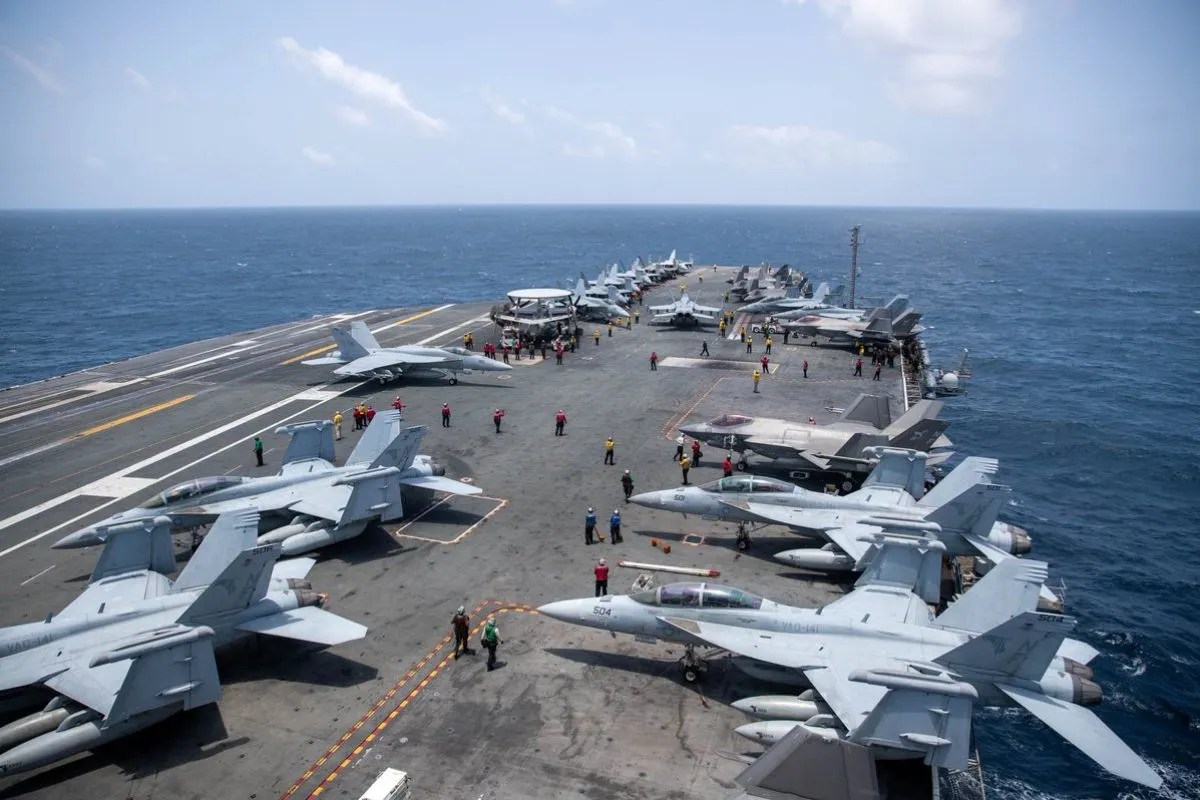
The deployment cycle of a United States Navy Carrier Strike Group (CSG) is governed by the Fleet Response Plan, a rigid operational framework designed to balance global presence with the necessity of maintenance, crew fatigue management, and system upgrades. The return of the USS Abraham Lincoln to its homeport is not a reactive shift in regional policy, but the terminal phase of a pre-planned deployment window.
The Operational Logistics of Carrier Deployment
The CSG functions as an instrument of power projection, requiring massive logistical support. A standard deployment typically spans six to eight months. Extending these durations beyond these parameters introduces non-linear costs: mechanical wear on the nuclear-powered propulsion systems, increased risk of equipment failure, and a significant drop in operational readiness due to crew exhaustion. Also making news recently: Echoes in the Hills Where Freedom Goes to Breathe.
The movement of the USS Abraham Lincoln follows the established rotation cycle designed to maintain continuous presence in the United States Central Command (CENTCOM) area of responsibility. When one carrier strike group exits a theater, it is generally timed to coincide with or immediately precede the arrival of a replacement. The primary constraint is the number of available hull-years; the Navy possesses a finite number of active carriers, and these assets must be distributed across the Pacific, Atlantic, and Indian Oceans.
The Strategic Utility of Carrier Presence
Military presence in the Middle East functions as an area-denial deterrent. The CSG provides three specific capabilities that land-based assets cannot replicate: Additional information regarding the matter are detailed by USA Today.
- Sovereign Airfield Independence: The carrier operates in international waters, eliminating the need for host-nation overflight permissions or base access agreements which are often politically volatile.
- Integrated Strike Capacity: A single CSG carries more firepower than the entire air forces of most sovereign nations. This includes the E-2D Hawkeye for battle management, F/A-18E/F Super Hornets for offensive and defensive sorties, and EA-18G Growlers for electronic warfare suppression.
- Continuous Monitoring: The CSG acts as a mobile intelligence-gathering node, utilizing organic sensors to build a comprehensive picture of maritime and aerial activity within a radius of hundreds of miles.
The decision to return the USS Abraham Lincoln reflects the transition from a heightened state of readiness back into the maintenance and replenishment phase. This shift does not necessarily signal a reduction in regional security commitments. Rather, it highlights the transition of the tactical responsibility to either another incoming carrier group or a different force composition, such as an Amphibious Ready Group or land-based assets, depending on the current threat assessment.
Identifying the Strategic Constraints
The primary risk in rotating naval assets is the "gap" in coverage. When a transition occurs, the incoming unit must achieve combat readiness upon arrival, while the departing unit maintains full operational capability until the final day of its tenure. The Navy mitigates this risk through overlapping mission handovers, where the incoming commander is briefed on the specific baseline of activities, threat vectors, and communication protocols established by their predecessor.
The logistical cost-function is defined by the following variables:
- Hull Age and Maintenance Intervals: Older platforms require more time in dry-dock for reactor core refueling and structural integrity updates.
- Crew Tempo: Long-term deployments negatively impact retention rates. The Navy must balance the requirement for "presence" with the necessity of returning crews to a normalized operational tempo to maintain skill retention and institutional knowledge.
- Theater Requirements: The baseline requirement for CENTCOM is dictated by the current geopolitical climate. If the threat environment escalates, the Navy has the technical ability to extend a deployment, though this is treated as an emergency measure rather than a standard operating procedure due to the long-term degradation of equipment and personnel.
The Dynamics of Force Composition
Observers frequently mistake the rotation of a specific ship for a shift in policy. In reality, the U.S. naval strategy in the Middle East is systemic. The presence of the USS Abraham Lincoln was a response to specific regional tensions, but its departure is a function of the maintenance cycle.
The naval architecture relies on redundancy. If the mission parameters in a specific theater require a constant level of strike power, the rotation is handled by alternating carriers. This ensures that the maintenance schedule of one ship does not jeopardize the global posture of the entire force. The departure of one unit is therefore proof that the global fleet management system is functioning as intended, ensuring that no single asset is driven to the point of structural failure.
Operational Recommendations for Assessing Naval Movements
To properly interpret future naval movements, focus on the following indicators rather than headlines about specific ships:
- Monitor the Carrier Strike Group Rotation Schedule: The U.S. Navy publishes general deployment windows. Deviations from these windows are the only reliable indicators of a policy shift.
- Analyze Fleet Composition Shifts: Look for the movement of auxiliary ships, such as destroyers and guided-missile cruisers, which typically escort the carrier. If the escort ships remain while the carrier departs, the mission parameters may have evolved.
- Track Maintenance Logs and Dry-Dock Schedules: Information regarding when a ship is slated for major repairs is public record. If a carrier is returning at the start of a scheduled overhaul, the movement is purely administrative.
The strategic priority remains the maintenance of regional stability through credible, sustained power projection. Future force posture will be determined not by the departure of a single platform, but by the aggregate ability of the Navy to project combat power while managing the life-cycle of its primary capital ships. The exit of the USS Abraham Lincoln from the immediate theater is an operational necessity required to preserve that very capability for future deployments. Strategic observers should prioritize identifying the arrival of the replacement unit and the maintenance of the existing maritime security architecture, rather than the movement of a single ship within the cycle.