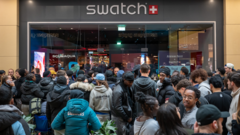
The asphalt outside the London flagship store was still slick with dawn condensation when the first barricade buckled. It wasn't broken by a riotous mob or a political protest, but by several hundred people who desperately wanted to trade two hundred and fifty dollars for a piece of bioceramic plastic.
By noon, the metal gates were locked shut. A hastily printed sign taped to the glass announced that the store would remain closed for a second consecutive day. Similar scenes played out in Tokyo, Singapore, and New York. Security guards stood like sentries outside darkened showrooms, blinking at the leftover sea of crushed coffee cups and discarded thermal blankets. Recently making headlines in this space: The Anatomy of Chokepoint Equilibrium: Quantifying the Hormuz Blockade and Global Supply Destabilization.
We have entered an era where the mechanics of desire have been weaponized by retail. The recent chaos surrounding the MoonSwatch release—a collaboration between luxury titan Omega and street-level giant Swatch—isn't just a story about retail mismanagement or overzealous collectors. It is a symptom of a deeper, more volatile shift in how we assign value to objects, and what happens when the machinery of artificial scarcity grinds gears with human nature.
The Chemistry of the Queue
To understand why thousands of people spent thirty-six hours shivering on concrete sidewalks, you have to look past the product itself. The watch in question is a quartz-powered homage to the Omega Speedmaster, the legendary "Moonwatch" worn by Apollo astronauts. One costs thousands of dollars; the other costs less than a weekend's groceries. Further details on this are explored by The Wall Street Journal.
But the crowd wasn't thinking about quartz movements or manufacturing margins. They were chasing a feeling.
Consider a hypothetical buyer named Marcus. He doesn't particularly care about horology. He doesn't know what a tachymeter scale does. But Marcus understands the language of the modern drop. He knows that in the digital age, owning something that others cannot have is a form of social currency. When the announcement hit Instagram, a chemical reaction occurred in the brains of thousands of Marcuses worldwide.
The physical queue became a crucible. When you stand in line for hours, a psychological shift occurs. The object of the hunt expands in importance. Your brain rationalizes the discomfort: If I am suffering this much to get it, it must be worth everything. When Swatch underestimated this collective fixation, the results were entirely predictable. The retail infrastructure, built for casual foot traffic and occasional holiday rushes, simply collapsed under the weight of internet-fueled urgency.
The Great Democratization Illusion
The marketing campaign was a masterclass in psychological manipulation. It promised democratization—the chance for the average consumer to own a piece of horological history without the luxury price tag. It felt inclusive.
But true inclusivity doesn't require a riot squad.
The strategy relied on a classic corporate paradox. To maintain the prestige of the Omega brand, the watches could not be sold online. They had to be rare enough to spark a frenzy, but cheap enough to be accessible to teenagers with weekend jobs. By limiting the release to select physical boutiques, the brands created a localized pressure cooker.
Step back and look at the broader pattern of modern commerce. This isn't isolated to watches. We see it in the overnight lines for limited-edition sneakers, the virtual waiting rooms for concert tickets that crash within seconds, and the digital scrambles for virtual real estate. The business model of the twenty-first century is no longer about satisfying demand; it is about cultivating a permanent state of unfulfilled yearning.
When the doors stayed shut on day two, the illusion fractured. The anger outside the stores wasn't just about missing out on a watch. It was the realization that the game was rigged. The democratization of luxury had quickly devolved into a Darwinian scramble where the only winners were the professional resellers equipped with hired line-standers and lax security tolerance.
The Human Cost of the Drop
There is a quiet irony in the silence of those shuttered storefronts. Brands spend millions creating a pristine, controlled environment. Every lightbulb is positioned to catch the gleam of a sapphire crystal; every sales associate is trained to speak in hushed, reverent tones.
The crowd outside shattered that curated peace.
Retail workers, usually tasked with polishing glass and gift-wrapping boxes, suddenly found themselves acting as frontline crowd control, facing the brunt of a public that felt cheated by the very supply chain they were celebrating. The corporate offices got their viral marketing victory, but the floor staff got the screaming matches and the safety hazards.
We often talk about the market as an abstract entity governed by charts and quarterly reports. We forget that the market is made of flesh, blood, and frayed nerves. The decision to close the stores for a second day wasn't a marketing stunt; it was a emergency brake pulled by local managers who realized that a plastic watch wasn't worth a broken window or a trampled customer.
The Ephemeral Value of the Real
The frenzy will inevitably fade. The production lines will catch up, or the internet will find a new obsession next week, shifting its collective gaze to a different logo or a new colorway. The secondary market prices, which spiked to absurd thousands in the hours after the shutdown, will drift back down to reality.
But the memory of the empty streets and the locked doors remains.
We live in a world where the physical and digital are locked in a strange dance. A digital post creates a physical crowd; a physical shortage creates a digital fury. In the middle of it all are the empty storefronts, temporary monuments to our collective inability to distinguish between what we actually want and what we are told to crave.
The locked doors of the boutiques aren't just a failure of logistics. They are a mirror reflecting our current cultural moment. We have built an economic engine that runs on the fuel of perpetual dissatisfaction, and every now and then, that engine backfires right on the showroom floor.
Somewhere in a quiet apartment, a single watch sits on a nightstand, its nylon strap smelling faintly of the rain from the sidewalk where its owner waited for two days. The watch ticks quietly in the dark. It keeps perfect time, utterly indifferent to the chaos it took to bring it there.