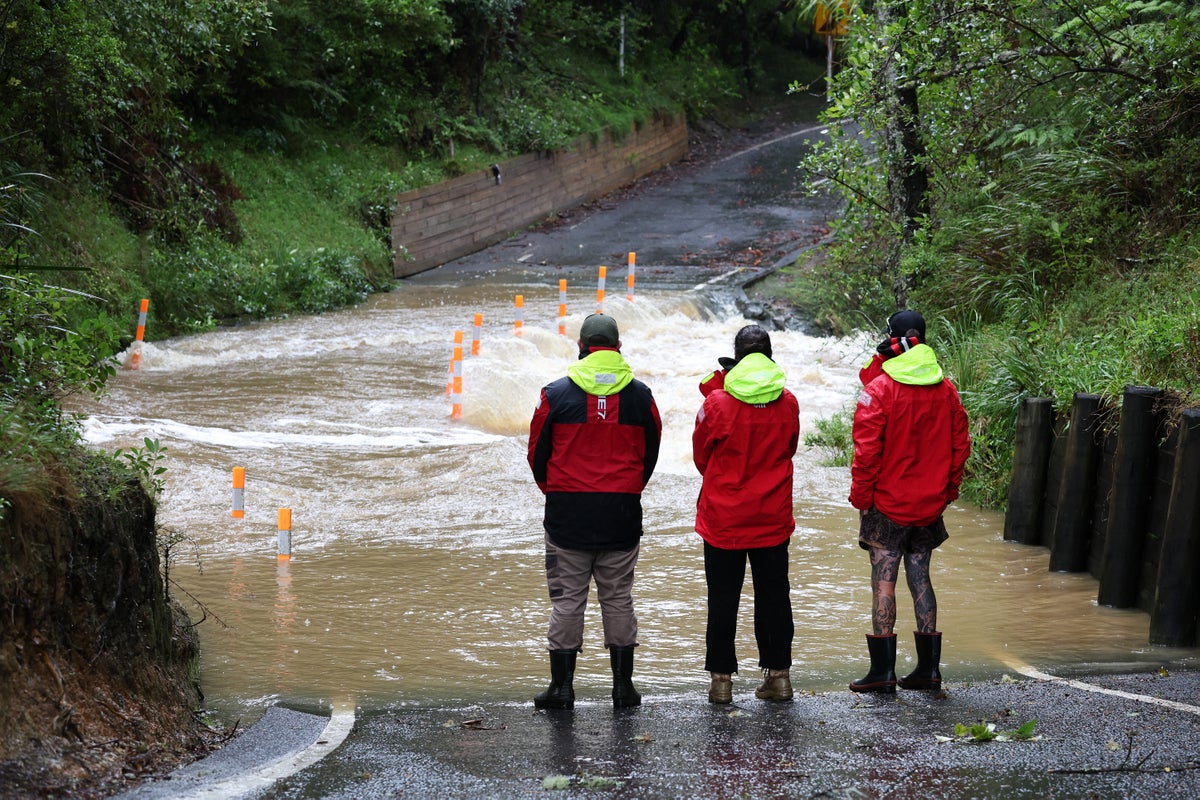
New Zealand’s capital is underwater again, and the media is busy polishing its favorite script: "Unprecedented rain meets heroic cleanup." It’s a comfortable lie. It lets local councils off the hook and allows residents to feel like victims of a fickle god rather than victims of terrible engineering and even worse economics.
The "hardest hit areas" in Wellington and its surrounding regions aren't casualties of a freak weather event. They are predictable outcomes of a systemic failure to treat urban drainage as a high-stakes financial asset rather than a buried-and-forgotten liability. We talk about flash floods like they are spontaneous, but they are actually the math of urbanization catching up with the reality of gravity. If you enjoyed this post, you should check out: this related article.
The Myth of the 100-Year Event
Every time a basement fills with silt in Lower Hutt or a road washes out in Plimmerton, officials reach for the "one-in-a-hundred-year event" label. This is a statistical sleight of hand. Using historical data to predict future risk in an era of shifting weather patterns is like trying to drive a car by looking exclusively in the rearview mirror.
The term "100-year flood" implies we have 99 years of safety left. In reality, it means there is a 1% probability of that event occurring in any given year. When you stack those probabilities over a 30-year mortgage, the chance of seeing your living room turn into a koi pond is actually about 26%. For another angle on this event, refer to the latest update from USA Today.
$P = 1 - (1 - 1/T)^n$
Where $P$ is the probability, $T$ is the return period, and $n$ is the number of years.
I’ve sat in boardrooms where "infrastructure resilience" is discussed as a line item to be trimmed. The consensus is always to do the bare minimum to satisfy current regulations. But regulations are lagging indicators. By the time a building code is updated to reflect new rainfall intensities, the pipes are already twenty years too small. We are building 21st-century cities on 19th-century plumbing and acting shocked when the physics don't work out.
Concrete Is a Clogged Pore
The "cleanup" the media loves to document is a superficial fix. Moving mud from a driveway to a landfill doesn't solve the underlying issue: Wellington has an impermeability problem.
As we densify our suburbs—a move that is economically necessary—we replace grass, gardens, and soil with concrete, asphalt, and "low-maintenance" decking. We have turned our geography into a giant slide. In a natural state, the ground acts as a buffer. It absorbs. It slows the flow. In a modern Kiwi suburb, every square meter of hard surface accelerates the water toward a drainage system that was never designed for this volume.
The "lazy consensus" says we need bigger pipes. I argue that bigger pipes are a fool’s errand. You cannot outrun gravity with a larger diameter of plastic.
Why the "Big Pipe" Strategy Fails:
- Downstream Displacement: Sending water away faster just creates a bigger problem for the person living at the bottom of the hill. You aren't "fixing" a flood; you’re exporting it.
- Maintenance Debt: Local councils are already drowning in billions of dollars of deferred maintenance. Building more massive, buried infrastructure creates a future tax bomb that the current population cannot afford to service.
- Static Capacity: A pipe has a hard limit. Once it's full, the excess water doesn't wait its turn; it follows the path of least resistance, which is usually through your front door.
The Financial Fantasy of Managed Retreat
The conversation is starting to shift toward "managed retreat"—the idea that we will simply move entire neighborhoods away from flood zones. This is the most expensive "solution" ever devised by a bureaucracy.
Who pays? The taxpayer? The insurance companies? The homeowner?
Currently, we are in a state of "unmanaged retreat." Property values in flood-prone areas of the capital aren't dipping because of the water; they are dipping because of the insurability. Once a property becomes uninsurable, its value drops to the price of the bare land, minus the cost of clearing the wreckage. This is a wealth transfer from the middle class to the state and the banking sector that no one wants to talk about.
We need to stop pretending that every piece of land is entitled to be protected. Some areas were never meant for houses. They were wetlands. They were floodplains. We paved them because it was profitable in 1950, and we are paying the interest on that debt now.
Stop Cleaning Up and Start Tearing Up
If we want to stop the cycle of "clean-up and repeat," we have to move toward Sponge Cities. This isn't some "holistic" dream; it’s hard-nosed engineering.
We need to stop funneling water into pipes and start forcing it into the ground. This means:
- Permeable Paving: Mandating that driveways and parking lots allow water to pass through them.
- Daylighting Streams: Taking those historical creeks we buried in concrete pipes decades ago and bringing them back to the surface.
- Mandatory On-Site Detention: Every new build should be required to hold its own rainwater during a peak event, releasing it slowly over 24 hours rather than dumping it into the street instantly.
The cost of this is high. The cost of doing nothing is higher. I’ve watched insurance premiums in parts of New Zealand jump 30% in a single year. That is a "flood tax" that provides zero benefit to the infrastructure. It’s just money burning in the wind.
The Hard Truth About Your Property Value
If you live in a "hardest hit area," the government is not coming to save you. The cleanup crews are a PR exercise to make it look like the situation is under control. It isn't.
The civil defense model is designed for response, not prevention. They are great at handing out sandbags and clearing slips, but they cannot rewrite the topography of a city that was built with a fundamental misunderstanding of water.
We are seeing a divergence in the real estate market. On one side, you have "resilient assets"—homes on high ground with modern, decentralized drainage. On the other, you have "submerged liabilities." The gap between these two is going to widen until the latter becomes a stranded asset.
The media focuses on the mud on the carpets. You should be focusing on the topography of the street. If your property relies on a council pipe to stay dry, you aren't an owner; you’re a tenant of the weather.
The Wrong Questions
People ask: "How quickly can we get the roads open?"
The real question: "Why are we rebuilding a road in a place that has washed away three times in ten years?"
People ask: "Will the government provide disaster relief?"
The real question: "Why are we subsidizing high-risk living with low-risk tax dollars?"
We have a "she'll be right" attitude toward urban planning that is finally hitting a wall. Or rather, a wall of water. The cleanup isn't the start of a recovery; it’s the intermission before the next act.
If you’re waiting for a "pivotal" change in government policy to save your suburb, you’ve already lost. The only real solution is a radical shift in how we value land and how we handle the $H_2O$ that falls on it. Stop looking at the sky and start looking at the drains. The data is there, the physics is settled, and the bill is overdue.
Rip up the concrete or get used to the silt. There is no third option.