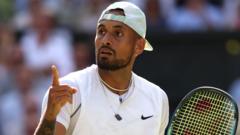
The lazy consensus across the tennis establishment is entirely predictable. Pious columnists and corporate PR machines are hyperventilating over Nick Kyrgios and his positive test for benzoylecgonine at the Mallorca Open, treating it as a Greek tragedy. They write eulogies about wasted talent, broken promises, and the definitive curtain call for a polarizing icon.
They have it backward.
This suspension is not the end of the Kyrgios narrative. It is the absolute best thing that could have happened to him.
For years, the tennis world has tortured itself with a hypothetical question: What if Nick Kyrgios actually cared? What if the fiery Australian traded his Xbox controllers and casual training ethos for obsessive, grinder-style dedication? Analysts look at his 2022 Wimbledon run, his raw shot-making genius, and weep over what might have been. They treat his career as a slow-motion car crash fueled by poor discipline.
That perspective misses the psychological reality of elite athletes trapped in deteriorating bodies. Kyrgios is thirty-one years old. He has spent the last several seasons fighting chronic knee and wrist breakdowns that reduced his output to a handful of matches. When a player whose identity is built entirely on athletic dominance realizes his physical vessel can no longer execute what his brain commands, a profound psychological crisis sets in. He admitted as much himself, noting the crushing weight of feeling helpless and watching the end approach.
Enter the International Tennis Integrity Agency.
The conventional take views a provisional suspension and a potential multi-year ban as a devastating blow. But look at the mechanics of burnout. When an athlete is too proud, too financially secure, or too trapped by external expectations to walk away on their own terms, the universe often intervenes. A suspension provides an enforced, absolute break. It removes the daily torture of grueling rehab sessions for a body that keeps breaking down. It slams the door shut on the agonizing, limp-along comeback trail that ranks a former finalist outside the top nine hundred.
Consider the structural precedent. When Dan Evans tested positive for cocaine in 2017, he served a one-year ban, returned to the tour, and eventually carved out a productive later chapter in his career. But Kyrgios is not Evans. Kyrgios has always treated professional tennis like an abusive relationship—he famously stated that tennis chose him, rather than the other way around. For a decade, he played under the weight of an audience that demanded he fulfill a destiny he never asked for.
By failing this test and accepting the inevitable sanction, Kyrgios has been granted something priceless: permission to stop.
The moralizers love to hyperventilate about the bad example set for children. Let us dispense with that pearl-clutching right now. Elite sports are not finishing schools. They are brutal arenas where hyper-competitive individuals break themselves down for public entertainment. Expecting flawed human beings to act as flawless moral titans is a fool's errand. Kyrgios made a mistake, owned it immediately without hiding behind fake medical excuses, and faced the music. That is more accountability than most public figures manage in a lifetime.
The real narrative is not about a drug; it is about relief.
Imagine a scenario where Kyrgios spends the next three years grinding through Challenger events in obscure corners of Europe, his surgically repaired joints screaming with every step, just to satisfy the morbid curiosity of fans who want one more nostalgic run at SW19. That would be a tragedy. A suspension that keeps him away from the court forces him to confront his life outside of sport, deal with the mental toll of his injuries, and build an identity away from a racket.
The media wants a cautionary tale. They want blood. They want to write the obituary of a career because it fits neatly into a clean, moralistic box.
They fail to understand that for Nick Kyrgios, being forced away from the tour might finally quiet the noise, heal the mind, and let him find peace away from the crushing gravity of professional expectation. The career is over? Good. Now his real life can finally begin.