Ink was drying on expensive parchment thousands of miles away, but Sarah could only hear the hum of her idle conveyor belt.
For months, the workshop had carried a different kind of soundtrack. It was the sharp, rhythmic clatter of panic. Every morning started the same way: check the news, calculate the newest penalty, and stare at a ledger bleeding red. A fifty percent tariff is not just a line item on an accountant's spreadsheet. It is a lead weight dropped onto the chest of an enterprise built over three decades. It is the sudden, terrifying realization that the lumber, the steel, the meticulously crafted components moving between neighbors might suddenly become too expensive to buy, too risky to ship, and too burdensome to sustain.
Sarah represents thousands of manufacturers caught in a geopolitical crossfire. She is a hypothetical compilation of every small-business owner whose livelihood depends on the open, uninterrupted artery of trade running across the northern frontier. When governments posture, factories bleed.
Then, the sudden shift arrived. The United States suspended those punishing fifty percent surtaxes against Canada.
Just like that. An agreement struck. A crisis paused.
But the headline misses the human reality of what that suspension actually means. It is not merely a policy correction. It is a deep, collective exhale felt from the logging camps of British Columbia to the manufacturing floors of Ontario and the shipping docks of Michigan.
The Anatomy of an Invisible Wall
Tariffs are abstract until they hit your pocketbook. Economists talk about protectionism and market corrections with clinical detachment. They use terms like deadweight loss and supply chain friction.
Listen instead to the sound of uncertainty.
When a fifty percent tax is slapped onto cross-border commerce, the immediate casualty is trust. Sarah could not sign long-term contracts. Her American buyers could not guarantee their clients stable pricing. Every shipment felt like a game of Russian roulette played with customs forms.
Consider what happens next: prices climb, margins evaporate, and expansion plans are thrown into the shredder. Workers wonder if next Friday will bring a pink slip instead of a paycheck. The wall built between two historically friendly nations was not made of concrete. It was made of administrative unpredictability.
Trade agreements are rarely celebrated for their poetry. They are dry documents filled with legalistic jargon, tariff codes, and diplomatic footnotes. Yet, beneath those clauses lies a fragile peace. Commerce is ultimately a conversation between human beings who choose to trust one another across a painted line on a map. When that conversation breaks down, the cost is measured in sleepless nights and stalled ambitions.
Behind the Sudden Truce
What forced the hand? Diplomacy is rarely born of sudden affection. It is born of mutual exhaustion.
When the United States implemented those staggering surtaxes, the architects of the policy anticipated domestic triumph. They wanted to shield domestic industries from external pressure. But modern supply chains do not operate in neat, isolated silos. A piece of machinery built in Canada often contains American-made electronics, which are then shipped back south to be installed in vehicles driven by families in Ohio.
Taxing the neighbor is, more often than not, taxing yourself.
As the months dragged on, the friction accumulated. Costs trickled down to consumers already weary of economic volatility. Business leaders on both sides of the border did what they do best: they organized, they lobbied, and they presented hard, unvarnished data showing that economic warfare between neighbors is a zero-sum game played with loaded dice.
The breakthrough agreement did not erase every underlying tension. Trade policy is a living, breathing beast that never truly sleeps. But the suspension of the fifty percent penalty acts as a vital pressure release valve. It acknowledges a fundamental truth. Prosperity requires predictability.
The Weight of the Aftermath
Walk through Sarah's warehouse now, and the atmosphere has shifted. The hum of the conveyor belt is back, steady and reassuring. Orders are moving. The ledger is balancing out.
Yet, the invisible scars remain. Business owners who survived the turbulence are wiser, and perhaps more cautious. They have learned that alliances, no matter how historic or deep, can be tested by the shifting winds of political expediency. They have diversified their risk. They keep emergency reserves they never thought they would need.
The suspension of the surtaxes is a victory, yes. But it is also a reminder of how quickly the architecture of global trade can tremble.
Peace between trading partners is not a static destination. It is a tightrope walk performed every single day, requiring constant balance, clear communication, and an unwavering commitment to mutual survival. The pen may have stopped the bleeding for now, but the true test will be whether both nations can remember how close they came to the edge.
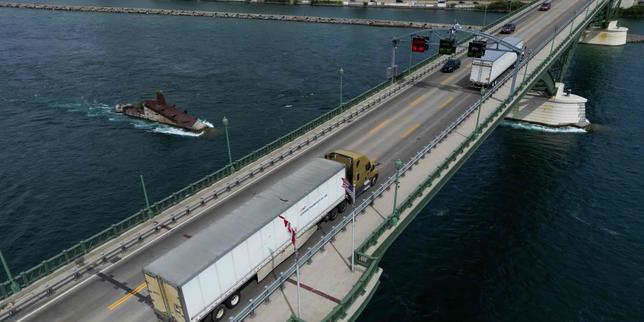
Out on the highway, a transport truck loaded with timber crosses the border at dawn, the frost catching the early morning light as the wheels roll smoothly over the asphalt, unchallenged and unhindered.


.jpg)
