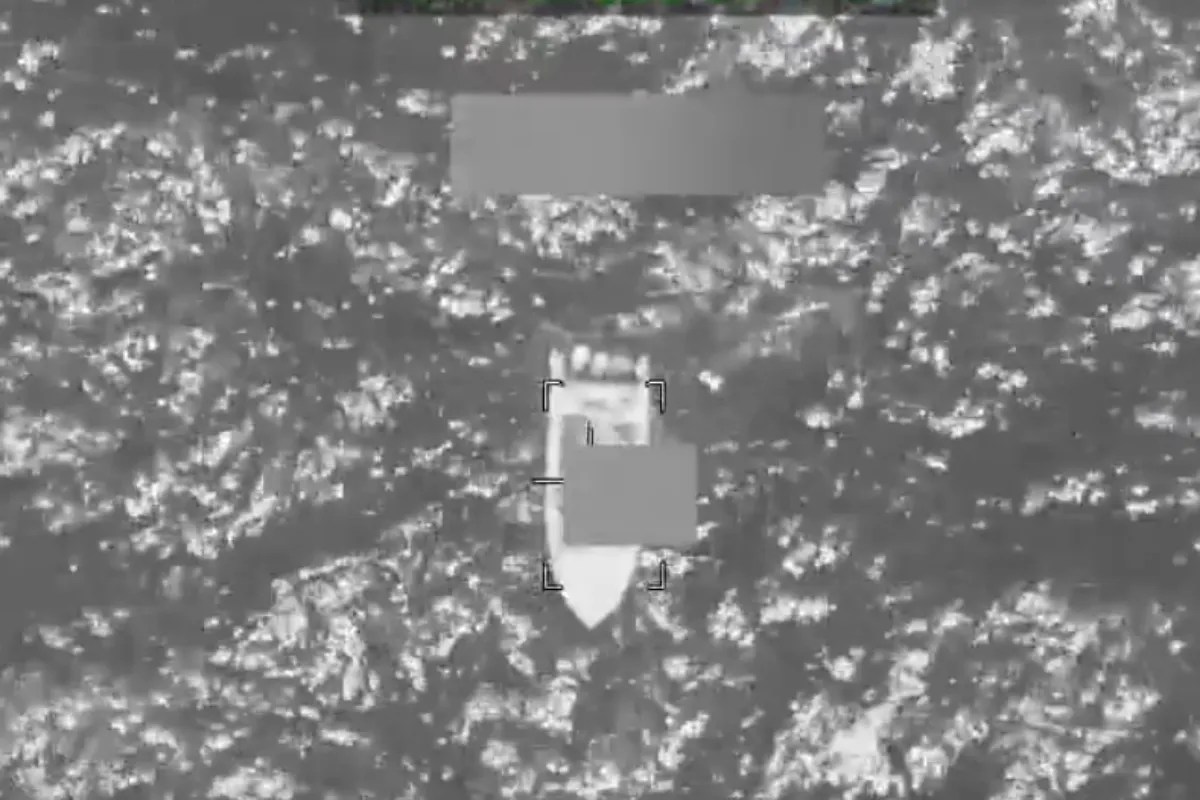
The Caribbean at night is usually a void of velvet blue and absolute silence, broken only by the rhythmic slap of salt water against a hull. But for the four men aboard a nameless, low-profile vessel slicing through those international waters, the silence was a lie. They lived in the deafening roar of their own heartbeats. They were shadows moving through a liquid graveyard, carrying a cargo that possessed the power to ruin thousands of lives—or end four of them in a heartbeat.
That heartbeat stopped at the exact moment a kinetic flash of American steel met the fiberglass deck.
There was no negotiation. No sirens willed them to pull over. In the high-stakes chess match of international drug interdiction, the U.S. military doesn't always play for arrests. Sometimes, they play for total erasure. When the missile struck, the explosion wasn't just a result of the warhead; it was the volatile chemistry of the cargo itself reacting to the heat of justice. For a few seconds, the dark horizon looked like a sun had been born on the waves. Then, as quickly as the light appeared, it vanished, leaving nothing but the smell of burnt ozone and the weight of four missing souls.
The Ghost Fleet of the Silk Road
To understand why a multi-million dollar missile is used to sink a makeshift boat, you have to understand the invisible war happening every night just outside our line of sight. These aren't the cigarette boats of the 1980s, flashy and loud. Modern narco-subs and low-profile vessels are engineering marvels of desperation. They are painted the color of a bruise to blend with the waves. They sit so low in the water that they are virtually invisible to traditional radar.
Imagine standing on a pier in a coastal village, watching a father and son weld together a hull in a hidden mangrove swamp. They aren't engineers; they are ghosts. They build these "coffin ships" with one goal: to be disposable. The men who pilot them are often not the kingpins or the "movie villains" we see on screen. They are frequently desperate men from impoverished coastal towns, promised a life-changing sum of money to sit in a cramped, fume-filled box for ten days.
They know the risks. They know that if the engine fails, they drift until they starve. If the hull leaks, they drown in a metal tomb. And if the gray ships of the U.S. Navy appear on the horizon, their journey ends in a fireball.
The Geometry of a Strike
The decision to fire a missile isn't made by a computer. It is a calculated, heavy choice made by commanders who have seen the poison these boats carry reach their own neighborhoods. When the U.S. forces identified this specific vessel, they weren't just looking at a boat; they were looking at a delivery system for chaos.
The physics of the encounter are brutal.
A low-profile vessel, heavily laden with narcotics, is a floating bomb. The high-density chemicals used in the processing of these drugs are often flammable. When a precision-guided munition connects, the kinetic energy $E = \frac{1}{2}mv^2$ is only the beginning. The secondary explosion—the " जोर का धमाका" reported in the local dispatches—is the sound of the supply chain snapping.
It is a violent, terminal math.
Four lives were traded for the countless lives that would have been dismantled by the contents of those waterproof bales. Is it a fair trade? The families of the four men will say no. The parents of a teenager who didn't overdose this weekend because that shipment never arrived will never even know they owe their child’s life to a missile strike in the middle of the ocean.
The Human Cost of the Invisible Border
We often talk about "border security" as if it’s a fence in the desert. In reality, the border is fluid. It moves with the currents. It exists in the infrared sensors of a hovering drone and the steady hands of a technician in a dark room thousands of miles away.
There is a profound, haunting loneliness to this type of warfare. There are no cheering crowds. There is no traditional battlefield. There is only a blip on a screen that disappears.
Consider the perspective of the U.S. personnel involved. There is no joy in the destruction. There is a grim realization that the war on drugs is less like a boxing match and more like trying to stop the tide with a sieve. Every boat destroyed is a victory, but every boat destroyed also represents a failure of the global social fabric—a sign that the demand for these substances is so ravenous that men will voluntarily climb into a fiberglass box and wait for a missile to find them.
The debris from the strike didn't stay afloat for long. In the deep waters of the Caribbean, the evidence of our greatest failures and our most violent solutions sinks quickly. By dawn, the water was flat and blue again. The birds returned to dive for fish. The salt air smelled like nothing but salt.
Somewhere in a South American village, a phone didn't ring. A mother or a wife waited for a signal that the journey was over, that the money was coming, that the risk had paid off. But the signal never came. The silence of the ocean had finally won.
The war continues, not because we love the fight, but because we haven't learned how to stop the hunger that fuels the boats. Until then, the horizon will continue to catch fire in the middle of the night, a brief and blinding reminder of the price we pay for a peace we can't quite seem to hold onto.
The sea is very good at keeping secrets, but the scorched air always tells the truth.