The studio lights are blindingly bright, but the room is cold. In the basement of Hollywood Masonic Temple, a writer stares at a glowing monitor, trying to find a joke in a stack of international nuclear treaties. Outside, the traffic on Hollywood Boulevard hums a mindless baseline. Inside, the challenge is absurdly high. How do you take the Joint Comprehensive Plan of Action—a dense, multi-party bureaucratic labyrinth designed to prevent the enrichment of weapons-grade uranium—and make a tourist from Toledo laugh at 11:35 PM?
You don't talk about uranium. You talk about getting fooled.
Late-night television has long ceased to be just a place where celebrities plug their latest movies. It has transformed into an unofficial town hall, an arena where complex, terrifying global architectures are distilled into three-minute monologues. When Jimmy Kimmel stepped up to his monologue mark to address the United States withdrawing from the Iran nuclear deal, he wasn't reading a policy brief. He was translating geopolitical anxiety into the language of the American living room.
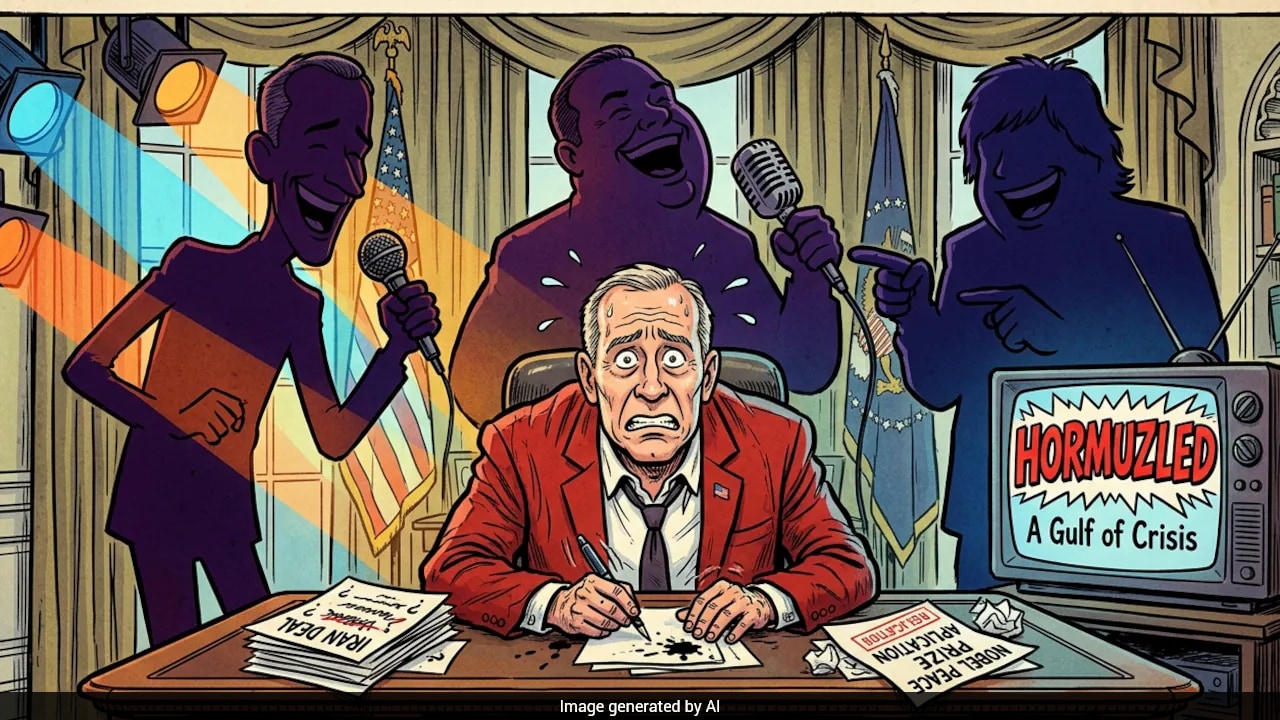
The administration had just torn up the landmark 2015 agreement, claiming it was a terrible deal. The counterargument from diplomats was long, technical, and largely invisible to the public. Enter Kimmel. With a smirk and a well-timed graphic, he summed up the entire high-stakes standoff with a single, ridiculous, fabricated word.
"Dagnabbit, we got Hormuzled."
It was a play on the Strait of Hormuz, the narrow, volatile maritime chokepoint through which a fifth of the world’s petroleum passes. To the policy experts in Washington, the Strait is a hyper-strategic flashpoint where naval destroyers play a dangerous game of chicken. To Kimmel's audience, it became the punchline of a cosmic con job.
Consider what happens when we reduce massive structural shifts to late-night satire. It is a defense mechanism. The human brain is not wired to process the abstract terror of nuclear proliferation while brushing its teeth before bed. We cannot easily grasp the mechanics of centrifugal enrichment cascades. But we understand what it feels like to get cheated at a used car lot. By framing the withdrawal as a bad business deal where America got swindled—or "Hormuzled"—Kimmel bridged the gap between the terrifyingly complex and the deeply human.
The real power of that monologue didn't lie in its policy analysis. It lay in its vulnerability. Behind the laughter was a collective, uneasy recognition that the rules of global stability were being rewritten on the fly, dictated not by decades of diplomatic precedent, but by the instincts of a reality television veteran turned Commander-in-Chief. Kimmel prodded the presidency not because he was a scholar of Middle Eastern relations, but because he was playing the role of the bewildered citizen. He was all of us, sitting on the couch, watching the evening news, wondering if anyone actually knew where the brakes were.
Satire like this works because it exposes the fragility of our grandest institutions. We like to imagine that international treaties are forged by infallible giants in oak-paneled rooms. The truth is far messier. They are built by tired humans, maintained by fragile political willpower, and can be dismantled with a single stroke of a Sharpie. When the monologue ended and the house band kicked in, the audience laughed and clapped, but the underlying tension remained. The joke was funny, but the reality was lingering.
Long after the studio audience went home and the stage lights were cut to black, the word remained hanging in the cultural ether. A silly, made-up term that captured a very real, very human fear: the suspicion that in the grand game of global chess, the people at the table are just making it up as they go along.