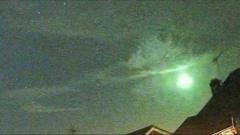
A streak of magnesium-white light tore through the atmosphere over the English Channel on Monday night, turning the Kent countryside from pitch black to surgical blue for a fraction of a second. Thousands of residents from Dover to Dartford witnessed the fireball, commonly known as a bolide, as it incinerated upon entry. While social media feeds immediately filled with low-resolution doorbell camera footage and breathless accounts of "alien encounters," the reality is both more common and more technically significant than a simple light show. This wasn't just a random rock; it was a high-velocity data point in a growing global effort to track near-Earth objects before they hit the ground.
The Mechanics Of Incineration
Most people see a "shooting star" and think of a pebble. The object that crossed the Kent coast was likely closer to the size of a microwave oven, traveling at a velocity that makes a rifle bullet look like it is standing still. When a meteoroid enters the atmosphere at speeds exceeding 30,000 miles per hour, it doesn't just "burn up" due to friction. It undergoes a process called adiabatic compression. Expanding on this idea, you can also read: The Naval Squeeze on Tehran and the High Cost of Enforced Silence.
The air in front of the rock cannot move out of the way fast enough. It becomes violently compressed, and as any student of thermodynamics knows, compressed gas generates intense heat. This creates a shock front of plasma. The glow you saw from your back garden in Maidstone was actually a sheath of superheated, ionized gas surrounding the solid core. As the pressure builds, the structural integrity of the rock fails. It shatters. That final "flash" witnessed by onlookers was the moment of fragmentation, where the surface area increased exponentially, causing a sudden, massive release of light and kinetic energy.
Why Tracking Systems Missed the Kent Bolide
There is a persistent myth that international space agencies have a "radar" for every rock headed our way. This is false. While NASA’s Planetary Defense Coordination Office and the European Space Agency track over 90% of "Planet Killers"—objects larger than one kilometer—the smaller ones remain almost entirely invisible until they hit the upper atmosphere. Experts at Al Jazeera have also weighed in on this trend.
The Kent meteor was too small to reflect enough sunlight for survey telescopes to detect it while it was still in deep space. We are currently operating in a blind spot. If an object is coming from the direction of the sun, our optical sensors are useless. We only knew the Kent meteor existed because it had already begun to die.
The Infrastructure Of Detection
The data we do have comes from a disorganized but effective patchwork of sensors.
- Infrasound Monitors: Originally designed to detect secret nuclear tests, these sensitive microphones pick up the low-frequency rumble of a meteor exploding in the high atmosphere.
- All-Sky Cameras: Amateur astronomical societies across the UK maintain "meteor nets" that triangulate the path of a fireball to determine if any meteorites—the actual rocks—survived the fall to reach the soil.
- Satellite IR Sensors: Military hardware looking for missile launches often detects these flashes first, though the data is rarely shared in real-time with the public.
The Hunt For Space Cargo
The real story isn't the light in the sky, but what might be sitting in a field near Ashford or buried in the silt of the Channel. Meteorites are time capsules. They contain the original chemistry of the solar system, frozen for four billion years.
When a fireball of this magnitude occurs, the race begins to find fragments before they are contaminated by Earth’s oxygen and moisture. A "fresh" fall is worth more to a laboratory than its weight in gold. Scientists look for carbonaceous chondrites, rare stones that contain organic compounds and amino acids—the building blocks of life. If the Kent meteor left a "strewn field," the geographic area where fragments land, it represents a massive opportunity for UK planetary science.
However, finding these fragments is a nightmare. To the untrained eye, a meteorite looks like a common road stone. It requires a specific set of characteristics: a fusion crust (a thin, black, glassy skin formed during entry), a lack of internal holes or "vesicles," and often a high iron content that makes it slightly magnetic.
The Threat Of Small Scale Events
We have a tendency to dismiss these events because "nothing happened." No buildings fell. No one was hurt. But the Kent meteor is a reminder of the Chelyabinsk event in 2013. That rock was roughly 20 meters wide. It exploded with the force of 30 Hiroshima bombs. The damage wasn't caused by the rock hitting the ground, but by the atmospheric shockwave that shattered windows and knocked people off their feet.
The Kent fireball was smaller, but it occupied the same orbital space as our communication satellites. We are increasingly launching "mega-constellations" of satellites into Low Earth Orbit (LEO). A meteor of this size hitting a satellite would create a cloud of debris that could trigger a chain reaction, effectively blinding our global GPS and communication networks. We are playing a game of cosmic billiards where we can't see most of the balls on the table.
The Geometry Of The Fall
To understand where the Kent meteor came from, we look at its radiant. By analyzing the parallax from different camera angles—comparing a video from London to one from Brighton—ballistics experts can backtrack the trajectory.
$$V_{avg} = \frac{d}{t}$$
By calculating the distance between the first appearance and the final fragmentation point over the time elapsed, we determine the entry angle. A shallow angle means the meteor spends more time in the atmosphere, making it more likely to burn up completely. A steep, vertical entry is more likely to drop significant mass on the ground. Initial reports suggest the Kent object had a relatively shallow trajectory, which explains why the light trail was visible for several seconds across multiple counties.
Amateur Footage Is The New Frontier
In previous decades, a meteor over Kent would have been a fleeting memory, recorded only in the notebooks of a few astronomers. Today, every street has a doorbell camera. Every car has a dashcam. This has fundamentally changed how we do "citizen science."
The sheer volume of video data allows for high-precision triangulation that was impossible twenty years ago. Organizations like the UK Fireball Network (UKFN) rely on the public to upload this footage. This isn't just for curiosity; it's about refining our models of how objects behave when they hit the "thick" part of our atmosphere. Every video of the Kent fireball helps us predict the path of the next one, which might not be so harmless.
The Cost Of Planetary Defense
There is a budget for this, and it is remarkably small. Compared to the billions spent on traditional defense, the amount allocated to finding and "characterizing" near-Earth objects is a rounding error. The Kent event should serve as a wake-up call for the UK Space Agency.
While we cannot stop a meteor once it enters the atmosphere, we can improve our "Early Warning" systems. This involves launching dedicated space-based infrared telescopes that sit between the Earth and the Sun, looking back toward us to catch the rocks we currently can't see. Until that happens, we remain dependent on luck and the occasional doorbell camera.
Distinguishing Fact From Viral Fiction
In the hours following the flash, rumors of a "crashed plane" or "satellite de-orbit" spread through local Kent forums. These are the standard byproduct of atmospheric events. A plane crash does not travel at Mach 50. A satellite reentry is much slower and usually characterized by multiple trailing sparks as the solar panels and antennas break off.
The Kent event was a singular, solid body. It was a fragment of an asteroid, likely from the belt between Mars and Jupiter, that had been nudged out of its orbit millions of years ago. It spent eons in the cold vacuum, only to end its journey in a spectacular burst of physics over a quiet English county.
The search for fragments continues along the predicted flight path. If you find a stone that feels unusually heavy for its size and looks like it has been scorched by a blowtorch, do not wash it. Do not put a magnet on it, as that wipes the internal magnetic record of its journey. Wrap it in aluminum foil and contact a university geology department. You aren't just holding a rock; you're holding the only physical evidence of a high-speed kinetic event that the world's most advanced sensors didn't see coming.
The light show is over, but the data is just beginning to be processed. We are living in a shooting gallery, and Kent just saw the bullet pass by.