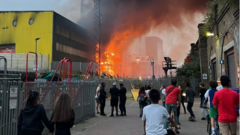
The Shadow on the Horizon
The Persian Gulf at three in the morning is a void. It is a place where the humidity clings to your skin like a wet wool blanket, and the only sound is the rhythmic, mechanical pulse of a ship’s engine—a heartbeat made of steel and diesel. Out here, the geopolitical maps drawn in air-conditioned rooms in Washington and Tehran don’t look like lines on paper. They look like the flickering green lights of a radar screen.
For the crews aboard two Iranian-flagged vessels gliding through these waters, the night was supposed to be a routine exercise in tension. They have lived in this friction for years. It is a slow-motion dance of provocation and posturing. But tonight, the air changed. The silent sky suddenly tore open.
The U.S. strikes didn’t come as a roar from the distance. They arrived as precise, clinical bursts of light that turned the dark water into a mirror of fire. In an instant, the abstract concept of "regional escalation" became a visceral reality of twisted metal and the smell of ozone. These weren't just targets on a coordinate grid. They were the physical manifestations of a ceasefire that was breathing its last, ragged breath.
The Invisible Strings of a Fragile Peace
To understand why these ships were burning, you have to look past the hull plating and into the labyrinth of the Middle East’s current power struggle. For weeks, the world held its breath, hoping a fragile ceasefire in Gaza would act as a universal coolant for the entire region. The logic was simple: if the guns went silent in one corner, the sparks would stop flying in the others.
It was a beautiful theory. It was also wrong.
Consider a hypothetical merchant sailor named Elias, working a neutral freighter just a few miles away. He sees the flash on the horizon. He doesn’t think about the National Security Council or the ideological purity of the Islamic Revolutionary Guard Corps. He thinks about the sheer volatility of the water he is floating on. He knows that in this part of the world, peace isn't a state of being; it’s a temporary pause in a conversation held through ballistics.
The U.S. military’s decision to engage these vessels wasn't a random act of aggression. It was a calculated response to a series of shadow-moves. Iranian-backed groups had been testing the fences, using the cover of the ceasefire to reposition, to resupply, and to remind the West that their reach hadn't shortened. The strikes were a "kinetic" way of saying that the pause button on one conflict does not grant a free pass for another.
The Anatomy of a Strike
When a missile hits a ship, the physics are indifferent to politics. The kinetic energy of a precision-guided munition traveling at supersonic speeds creates a pressure wave that can liquify internal bulkheads.
- The detection phase: High-altitude drones or satellite arrays pick up a heat signature or a specific radio frequency.
- The verification: Analysts in Nevada or Qatar cross-reference the vessel's path with intelligence reports.
- The engagement: A command is sent. A pilot, perhaps thousands of miles away or circling in a cockpit nearby, feels the slight lurch as the weight of the wing shifts.
The U.S. Central Command later described the targets as threats to "freedom of navigation." It’s a sanitized phrase. What it really means is that these two ships were perceived as mobile chess pieces intended to choke the world’s most vital oil artery. If those ships stayed operational, the cost of gas in a small town in Ohio might tick up five cents. If they stayed operational, a naval destroyer might have to dodge a drone attack three days later.
The strikes were meant to be a surgical removal of capability. But in the messy world of maritime warfare, surgery often leaves massive scars.
Why the Ceasefire Failed to Be a Shield
The most jarring aspect of this event is the timing. We are told that diplomacy is the antidote to violence. Yet, here we have a scenario where the diplomatic channels were wide open, and the missiles were still flying.
It’s because the "ceasefire" was never a singular event. It was a fragmented, fragile thing. While the headlines focused on the exchange of prisoners and the delivery of aid trucks, the "Gray Zone"—that murky area between total war and uneasy peace—remained hyperactive. Iran’s strategy has long relied on these proxies and flagged vessels to exert pressure without triggering a full-scale invasion.
The U.S., by striking these ships, effectively signaled that the Gray Zone is no longer a safe place to hide. They chose to punch through the ambiguity.
Imagine the tension in a command center. You have reports of a ceasefire holding in the North, but your sensors show a direct threat emerging from the South. Do you hold fire to preserve the "vibe" of peace, or do you strike to prevent a future catastrophe? The choice was made. The ships were hit. The message was sent: a ceasefire is not a vacuum.
The Human Cost of Strategic Math
We often talk about these events in terms of "assets" and "platforms." We say "two vessels were neutralized." We rarely talk about the frantic shouting in Farsi as the fire suppression systems failed. We don't talk about the American sailors who spent the next forty-eight hours at general quarters, caffeine-jittery and staring at screens, wondering if a retaliatory swarm was already in the air.
This is the psychological tax of living in a perpetual state of "almost war."
The ripples of these two ships sinking or being disabled extend far beyond the Persian Gulf. They move through the insurance markets in London, where the cost of shipping a container spikes. They move through the halls of Parliament and Congress, where hawks use the fire as proof that diplomacy is a weakness, and doves use it as proof that we are sliding into an avoidable quagmire.
The Looming Specter
The fire on the water eventually goes out, leaving only charred husks and a slick of oil that will eventually disperse. But the heat remains.
The real danger isn't the loss of two ships. Iran can replace ships. The U.S. can replace missiles. The real danger is the erosion of the "off-ramp." Every time a strike like this occurs during a period of supposed de-escalation, the value of a promise drops. If you can’t trust a ceasefire to provide actual security, why bother with the next one?
The sea is quiet again for now. The green dots on the radar continue their slow, hypnotic crawl. But the crews on every ship in the region are looking at the horizon with a new kind of intensity. They know that the darkness isn't just empty space anymore. It’s a pressurized chamber, waiting for the next spark to turn the night into noon.
The ships are gone, but the ghost of the conflict they represented is more visible than ever, haunting the waves and waiting for the wind to shift.