The coffee hadn't even finished brewing when the world above the Statue of Liberty turned a violent, electric shade of neon green. It was a Tuesday morning, 11:17 AM. Most people in the Northeast were hunched over laptops, navigating the mundane bureaucracy of a work week, or perhaps staring out a train window at the blurring Jersey marshes. Then, the sky broke.
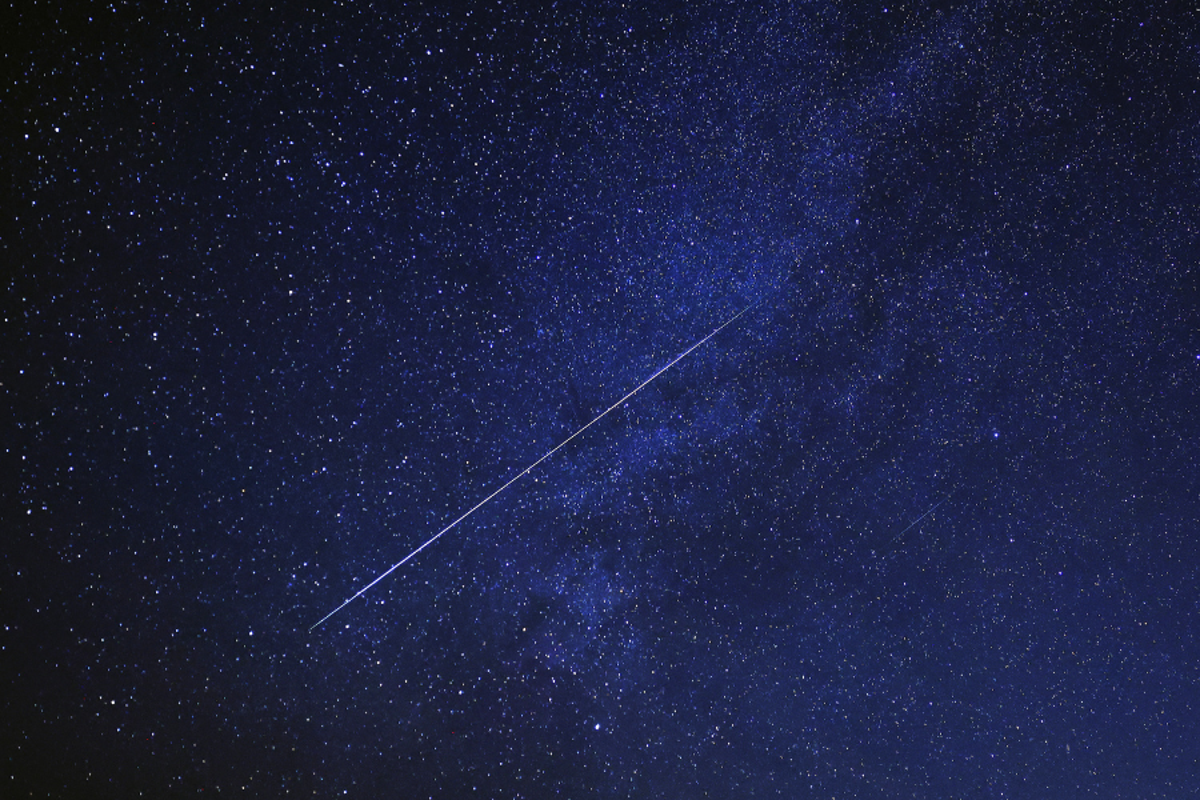
Tens of thousands of people across New York, New Jersey, and Connecticut looked up to see a streak of fire tearing through the blue. It wasn't the slow, heavy arc of a plane or the flickering blink of a satellite. This was something ancient. Something moving at thirty-eight thousand miles per hour.
We tend to think of the sky as a ceiling—a fixed, protective barrier that keeps the "out there" from reaching the "in here." But that morning, the ceiling felt paper-thin.
The Ghost of a Rock
NASA’s Meteoroid Environments Office eventually caught up with the panic. They tracked the data, crunched the trajectories, and gave us the cold, hard numbers. They told us the fireball was a small asteroid, likely no more than a foot wide. It entered the atmosphere directly over New York City, heading west toward New Jersey. It began its visible death spiral about forty-nine miles above the Upper Bay and finally disintegrated twenty-nine miles over the town of Mountainside.
But data is a poor substitute for the visceral shock of seeing the sun lose its monopoly on the daylight.
Imagine you are standing on a pier in Hoboken. For a fraction of a second, the shadows on the ground don't just shift; they sharpen. The air feels charged. You hear a low rumble—a sound that feels more like a vibration in your teeth than a noise in your ears. This isn't a "fireball" in the sense of a campfire. It is a kinetic punch.
To understand why this happened, we have to look at the mechanics of atmospheric friction. When a rock the size of a beach ball hits our atmosphere at speeds that defy human intuition, it doesn't just "fall." It collides with air molecules so violently that the air can't move out of the way fast enough. The air compresses. It heats up to thousands of degrees. The rock doesn't burn so much as it turns into plasma.
The light we saw wasn't the rock itself. It was the air around the rock screaming.
The Invisible Stakes of a Foot-Wide Stone
There is a terrifying fragility in the realization that we missed it. No telescope saw this coming. No early warning system pinged a frantic notification to our phones.
We often obsess over the "dinosaur killers"—the massive, miles-wide rocks that show up in summer blockbusters. We feel safe because we have programs like Sentry and ATLAS tracking the big ones. We tell ourselves that we’ve mapped the neighborhood. But the universe is messy. It is filled with gravel.
This specific visitor was too small to be picked up by deep-space surveys. It lived in the blind spot of our planetary defense. If it had been slightly larger, or made of denser iron instead of crumbly stone, the "rumble" reported by residents wouldn't have been a curiosity; it would have been a shockwave capable of shattering windows across three boroughs.
Consider the 2013 Chelyabinsk event in Russia. That rock was roughly sixty feet wide. It exploded with the force of thirty Hiroshima bombs. It wasn't the impact that hurt people; it was the air blast. Thousands of windows disintegrated simultaneously, showering people in glass while they stood at their windows wondering what that bright light was.
The Northeast fireball was a gentle reminder. A warning shot fired with a silencer.
Why the Ground Didn't Shake
Many people reported feeling a tremor, but the United States Geological Survey confirmed there was no earthquake. The "boom" was a sonic transition.
When an object travels faster than the speed of sound—which, for the record, is only about seven hundred sixty miles per hour—it creates a pressure wave. This meteor was traveling fifty times that speed. As it disintegrated, it released its energy in a series of pulses.
This is where the human element gets complicated. Our brains are not wired to process 11:00 AM celestial events. We look for the familiar. People called 911 reporting a plane crash. Others thought it was a military exercise. Some feared something far more terrestrial and man-made.
In an era of heightened anxiety and constant connectivity, a streak of light isn't just a physical event. It’s a Rorschach test for our collective fears. We see what we are already afraid of.
The Logistics of the Deep Dark
NASA confirmed that no meteorites—the actual physical fragments—were likely to have hit the ground. The rock was too fragile. The heat was too intense. It turned to dust and gas before it could ever touch New Jersey soil.
Yet, the event remains significant because of the "why." Why now? Why there?
The truth is that this happens every single day. The Earth is under constant bombardment. We are a target moving through a shooting gallery of cosmic debris. Most of it hits the oceans. Most of it happens while we sleep. Most of it is so small it looks like nothing more than a "shooting star" that a child makes a wish on before it vanishes.
The only difference this time was the timing and the zip code. It happened over one of the most densely populated corridors on the planet during a time when everyone had their eyes open.
It forces a shift in perspective. We spend our lives worrying about interest rates, traffic on the Lincoln Tunnel, and whether we remembered to respond to that email from three days ago. We treat the ground beneath us as the ultimate reality. But for a few seconds on a Tuesday, the residents of the Northeast were reminded that we are actually riding a wet rock through a vacuum, protected only by a thin veil of nitrogen and oxygen.
The Silence After the Flash
By noon, the streak had dissipated. The green glow was gone, replaced by the standard, smoggy haze of a humid morning. The reports stopped flooding the American Meteor Society’s website. The experts went back to their monitors, and the commuters went back to their desks.
But for those who saw it, the day felt different.
There is a specific kind of silence that follows a moment of awe. It’s the silence of realizing how small we are. We aren't the masters of the environment; we are its guests. The fireball wasn't an "explained phenomenon" as much as it was a visitor from the deep past—a piece of the solar system's construction debris that had been drifting in the dark for four billion years, only to end its journey over a Starbucks in Manhattan.
We look at the sky and see a void. But that void is crowded. It is heavy with history and motion.
The next time you walk outside, don't just look at the horizon. Look up. Not because there is something to fear, but because there is something to acknowledge. The ceiling is thinner than you think, and the universe has a way of making itself known when you least expect it.
The fireball is gone, but the sky is still there, waiting for the next piece of the dark to come screaming into the light.