The pump clicked. It is a sound most of us hear once a week, a mechanical finality that signals the end of a transaction. But for Sarah, a home-health nurse in rural Pennsylvania, that click sounded like a door slamming shut. She looked at the digital display. The numbers had climbed with a dizzying, frantic speed, settling on a total that meant her grocery budget for the next three days had just vanished into a rusted fuel tank.
Half a world away, the gears of war and the levers of global diplomacy were grinding.
Following a significant military escalation involving Iran, the global oil market reacted with its usual, cold-blooded efficiency. Prices spiked. The ticker on the news crawl read $92 a barrel. To the architects of policy and the titans of industry, that number is a metric, a data point on a graph that reflects geopolitical tension and supply-chain resilience. To them, $92 is a sign of stability in a world that could be much worse.
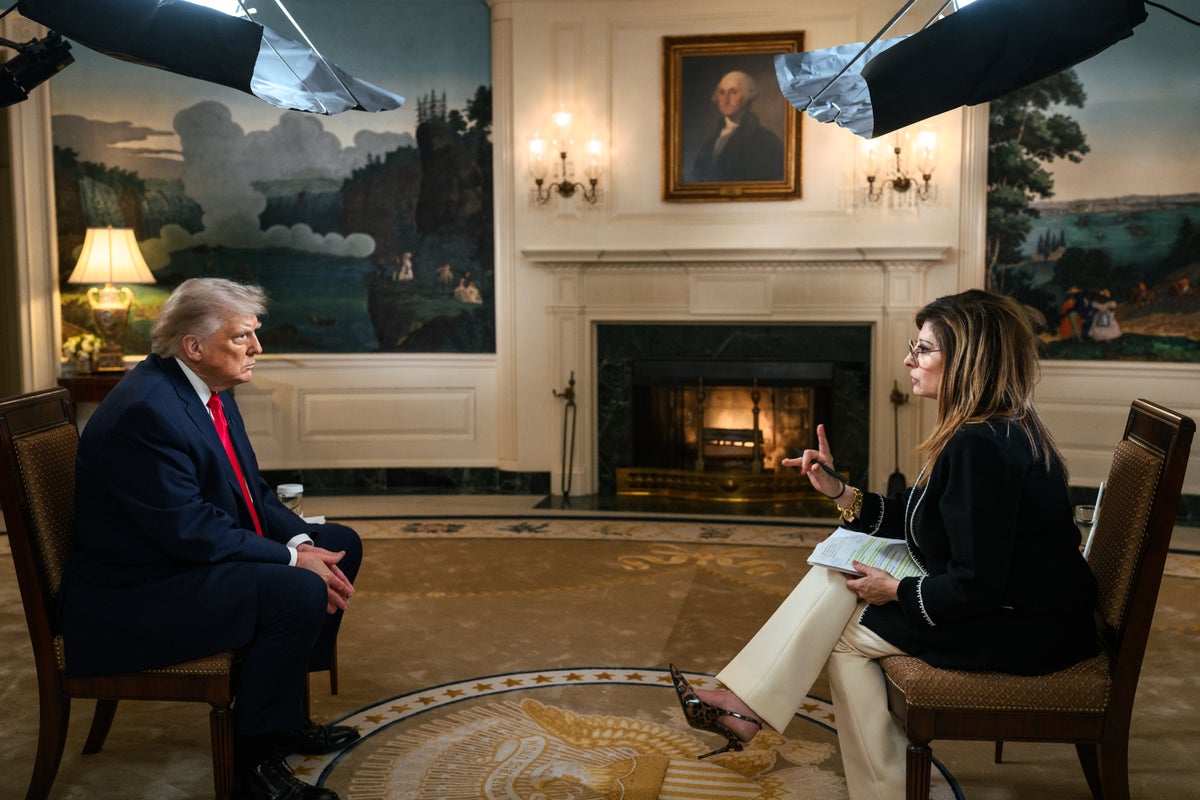
Donald Trump looked at that same number and saw a victory. He dismissed the anxieties of the Sarahs of the world, remarking that he was "happy" the price sat at only $92, considering the scale of the conflict. In the rarefied air of high-level politics, happiness is relative. When you are looking at the board from thirty thousand feet, $92 looks like a manageable fever. When you are standing at the pump in the rain, it feels like a terminal illness.
The disconnect is not just about money. It is about the distance between the podium and the pavement.
The Anatomy of the Barrel
To understand why a leader might feel "happy" about a price that crushes a middle-class family, you have to look at the invisible architecture of the barrel. An oil barrel is not just a container of crude; it is a pressurized vessel of global influence.
When war breaks out in the Middle East, the immediate fear is the "spike." This is the vertical line on a chart that represents total chaos—the kind of surge that pushes oil toward $150 or $200. In that scenario, the global economy does not just slow down; it seizes. Logistics networks crumble. Food prices, which are inextricably linked to the diesel that moves them, skyrocket.
From a strategic perspective, keeping the price at $92 after an Iranian conflict is a feat of containment. It suggests that the markets believe the "big one" has been avoided. It signals that the flow is maintained, the straits are open, and the world will keep turning.
But markets do not buy eggs. People do.
Consider the hypothetical case of a small-scale trucking company owner named Marcus. Marcus operates three rigs out of Ohio. For Marcus, the difference between $75 a barrel and $92 a barrel isn’t a theoretical nuance. It is the difference between replacing a bald tire and praying it doesn't blow on the I-80.
A barrel of oil contains 42 gallons. Once refined, it yields about 19 to 20 gallons of motor gasoline and about 11 to 12 gallons of distillate fuel oil, most of which is diesel. When that barrel price moves from $70 to $92, the ripple effect is a physical weight. It is a surcharge on every pallet Marcus moves. It is a tax on the very act of existing in a modern society.
The Psychology of "Only"
Language is a weapon in politics, and the word "only" is a double-edged blade.
When the former president says he is happy it is "only" $92, he is attempting to reset the baseline of reality. It is a psychological tactic designed to make the listener feel grateful for a burden. By framing $92 as a reprieve from a hypothetical $150, the pain of the current price is rebranded as a form of luck.
It is a difficult sell to a public that remembers $2 gas.
There is a visceral memory attached to the price of fuel. It is one of the few commodities where the price is broadcast in six-foot-tall glowing numbers on every street corner. You don't see the price of milk or bread displayed on a pylon as you drive to work. You see the price of gas. It becomes the pulse of the nation’s economic anxiety.
The political gamble here is that the public will prioritize "stability" over "affordability." If the narrative becomes about preventing a global meltdown, then $92 is a hero's number. But if the narrative remains about the cost of a commute, $92 is a villain.
The invisible stakes are found in the margins. Economic data often ignores the "substitution effect" in a human way. When gas goes up, people don't just stop driving—they have to get to work. Instead, they stop doing other things. They stop the Tuesday night pizza. They cancel the streaming service. They delay the dentist visit.
The "happiness" at $92 is built on the backs of these tiny, silent sacrifices.
The Geopolitical Mirage
There is a darker irony in the celebration of a $92 barrel. For years, the conversation around energy was about independence—the idea that we could insulate ourselves from the tremors of the Middle East.
We were told that domestic production would be our shield. We are currently producing more oil than at almost any point in history, yet the price Sarah pays in Pennsylvania is still dictated by a drone strike in the Persian Gulf. This is the great frustration of the modern era: we are a nation of producers who are still subjects of a global empire of pricing.
The market is a ghost that haunts every gas station. It is fueled by "futures"—contracts based on what traders think might happen two months from now. When a war starts, these traders aren't looking at Sarah’s bank account. They are hedging against the possibility of a closed Strait of Hormuz.
If the oil stops flowing there, $92 will look like a dream.
This creates a perverse incentive for leaders. To maintain a sense of control, they must embrace the high price as a sign of "success" because the alternative is admitting that they are at the mercy of forces they cannot fully dictate. By saying he is happy with $92, Trump is attempting to project a sense of mastery over the chaos. He is claiming the number. He is saying, I have kept the beast in its cage.
But the beast is still eating.
The Weight of the Invisible
We often talk about "the economy" as if it is a weather system, something that happens to us, impersonal and vast. But the economy is just a collection of human decisions and their consequences.
The $92 barrel is a decision. It is the result of a world that has decided to remain addicted to a single, volatile resource while refusing to build the infrastructure that would allow Sarah to ignore the news from Iran.
When Sarah finally drove away from the pump, her car felt heavier. Not because of the fuel, but because of the mental math she was performing. She was calculating the distance between her next paycheck and the bottom of the tank. She wasn't thinking about the war. She wasn't thinking about the strategic reserves or the nuances of Brent Crude versus West Texas Intermediate.
She was thinking about the fact that she had worked forty hours this week and was somehow poorer than when she started.
There is a profound danger in a leadership that finds happiness in a number that causes widespread quiet desperation. It suggests a belief that the "macro" is all that matters—that as long as the stock market doesn't crash and the tankers keep moving, the country is healthy.
But health is measured in the homes, not the headlines.
A nation can survive a $92 barrel of oil. It has done so before and will likely do so again. What it may not survive is the growing chasm between those who see that price as a manageable statistic and those who see it as a barrier to a decent life.
The real spike isn't on the chart. It's in the resentment that builds when the people at the top tell the people at the bottom that they should be happy for the privilege of struggling.
Sarah turned the key. The engine turned over, consuming the liquid that cost her a day's worth of meals. She pulled out into traffic, just another light in a long line of commuters, all of them burning their futures just to get through the day, while the men in the high offices looked at the glowing red numbers on their screens and smiled at how much worse it could have been.