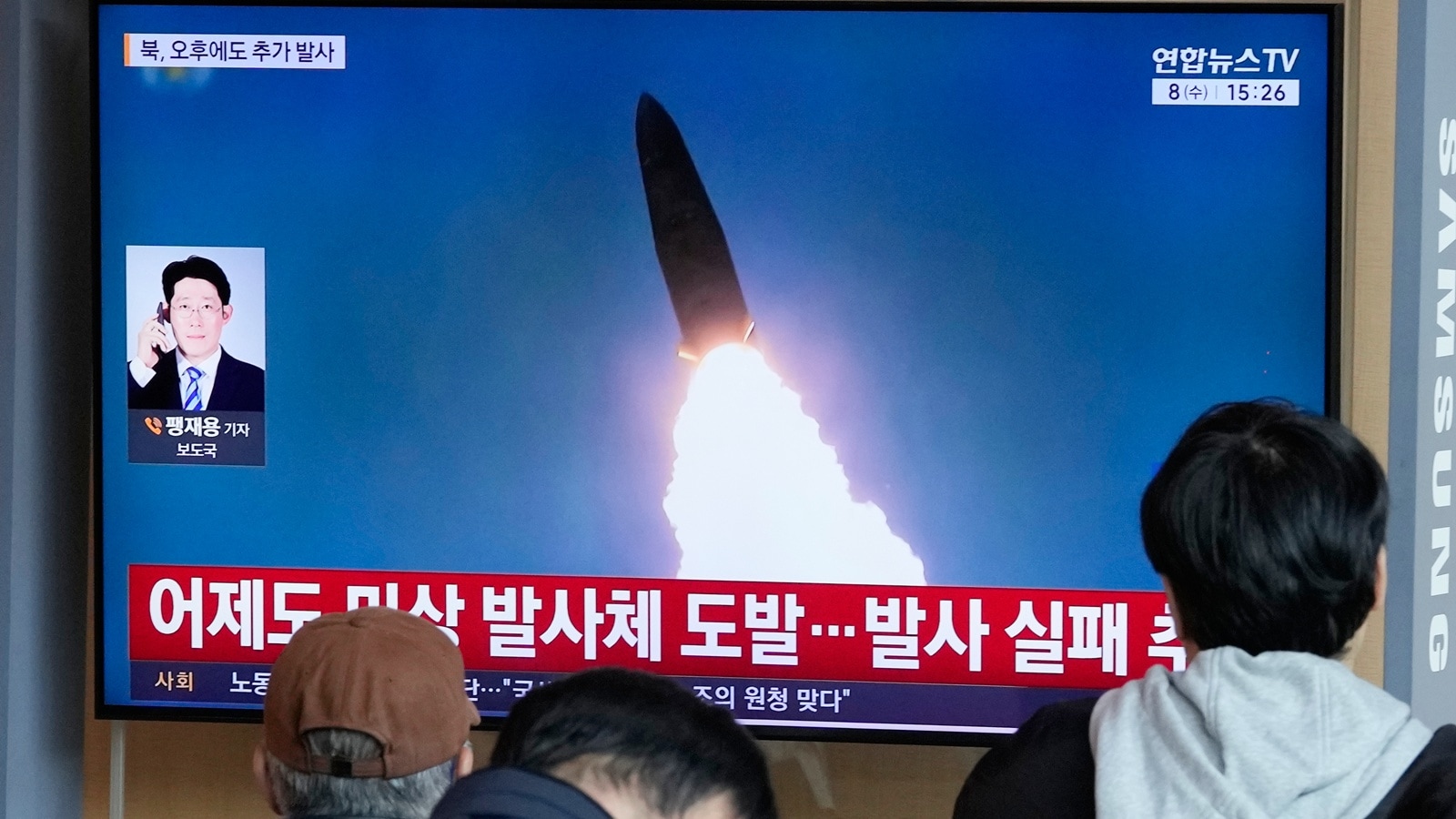
The media remains trapped in a 1994 loop. Every time a plume of smoke rises from a launchpad in Wonsan, newsrooms scramble to find a retired general to talk about "provocations" and "regional instability." They treat these launches like erratic temper tantrums from a rogue state desperate for attention. They are wrong.
Pyongyang isn't crying for help. It’s running a global showroom.
The tired narrative that Kim Jong Un fires missiles because he's "dismissing diplomacy" is a fundamental misunderstanding of the regime's business model. Diplomacy with Seoul is a side quest; the main quest is the industrialization of the North Korean defense sector into a high-tech export engine. If you want to understand why these missiles are flying, stop looking at the DMZ and start looking at the battlefields of Eastern Europe and the Middle East.
The Myth of the Irrational Actor
The "madman with a button" trope is the laziest consensus in modern geopolitics. It persists because it relieves analysts of the hard work of tracking supply chains and testing data.
In reality, the North Korean missile program is the most successful R&D pivot of the 21st century. While Western observers obsess over the "threat" to Tokyo, the regime is perfecting the solid-fuel technology that makes their systems mobile, survivable, and—most importantly—marketable.
Solid-fuel engines don't require the lengthy, visible fueling process of liquid-fuel rockets. You can hide them in a tunnel, drive them out on a Transporter Erector Launcher (TEL), and fire within minutes.
When North Korea tests these systems, they aren't just checking if the bolt stays on the fuselage. They are conducting live-fire demonstrations for potential buyers who want cheap, reliable, and "un-interceptable" theater-level weapons. The "hope for diplomacy" from Seoul is a distraction. Pyongyang has realized that a seat at the table is worth far less than a stack of hard currency from state actors looking for a workaround to Western sanctions.
Missiles as Minimum Viable Products
In Silicon Valley, founders talk about the MVP—the Minimum Viable Product. Pyongyang lives it.
Every failed launch is a data point. Every successful atmospheric reentry is a marketing brochure. We see a "failed" missile that tumbled into the Sea of Japan; they see a telemetry report that tells them exactly how to adjust the gimbal for the next iteration.
The Western press focuses on the intent of the launch (to scare us). The actual function of the launch is iterative engineering. They are moving at a speed that traditional defense contractors in the West can’t touch because they don't have to worry about OSHA, environmental impact reports, or taxpayer accountability.
The Hwasong-11 (KN-23) is a perfect example. It looks like a Russian Iskander. It flies like an Iskander. But it’s being produced in a quantity and at a price point that makes it the "Android" of the missile world—open-source-adjacent, mass-produced, and terrifyingly effective in saturated environments.
The Russia-Ukraine Feedback Loop
If you want to see the future of North Korean "diplomacy," look at the debris fields in Kharkiv.
For the first time in history, North Korean ballistic missiles are being used in a high-intensity, peer-to-peer conflict against Western-supplied air defense systems like the Patriot. This is the ultimate "battle-testing" that every arms manufacturer dreams of.
- Real-time Performance Data: Pyongyang now knows exactly how their guidance systems perform against American-made interceptors.
- Industrial Scaling: They aren't just building these for their own silos anymore. They are building a production line for a global conflict.
- The Barter Economy: In exchange for these "provocations," North Korea isn't getting "food aid" or "diplomatic recognition." They are getting high-end aerospace tech, satellite data, and raw materials from Moscow.
The idea that Seoul can offer enough "incentives" to stop this is laughable. What is a "diplomatic opening" compared to a direct pipeline into the Russian military-industrial complex?
Stop Asking "When Will They Stop?"
People always ask the same flawed questions:
- "When will North Korea return to the negotiating table?"
- "How can we tighten sanctions to stop the launches?"
These questions assume the regime wants to be part of the global community. It doesn't. It wants to be the primary hardware provider for the "Axis of Resistance" and any other state that finds itself on the wrong side of a G7 communiqué.
Sanctions don't work because the missile program is the workaround. It is the only high-value export they have that cannot be easily blocked by a sea's blockade. You can’t stop a digital transfer of missile schematics, and you can’t easily stop a cargo plane flying from Sunan to a buyer in a conflict zone.
The Tactical Error of "Hoping for Peace"
The South Korean government, and by extension the US State Department, continues to treat North Korea like a wayward child that can be coaxed back into the house with the right combination of "pressure and dialogue."
This is not a behavioral problem; it is a structural reality. The Kim regime has correctly identified that in a fragmented, multipolar world, a robust missile inventory is more than just a deterrent—it is a liquid asset.
We are witnessing the birth of a "Mercenary State" that uses its sovereign territory as a massive laboratory. Every time a missile splashes down, the price of the next shipment goes up.
The Hard Truth About Denuclearization
Denuclearization is dead. It has been dead for a decade. The persistent belief that it’s a reachable goal is the single biggest "lazy consensus" in foreign policy.
To North Korea, giving up the missiles is like Boeing giving up the 737. It’s not just their defense; it’s their entire economic future. They have spent forty years and billions of dollars (much of it stolen via Lazarus Group crypto-heists) to build this infrastructure. They aren't going to trade it for a trade deal or a removal of sanctions that could be reinstated by a different US administration in four years.
They have chosen the path of the "Fortress Economy." They produce what they need, steal what they don't have, and sell the excess to whoever has the cash or the oil.
The Reality of the "Threat"
Is there a threat to the US or Seoul? Of course. But it’s not the threat of a random nuclear first strike. That would be suicide, and if there’s one thing the Kim family is good at, it’s staying alive.
The real threat is the democratization of precision-strike capability.
North Korea is proving that you don't need a trillion-dollar budget to build a missile force that can give a superpower pause. They are providing the blueprint for every mid-tier power to bypass traditional military spending and go straight to asymmetrical dominance.
While we wait for the "next round of talks," they are perfecting the manufacturing processes for the Hwasong-18. While we debate "diplomatic hopes," they are shipping containers of shells and short-range ballistic missiles (SRBMs) across the border.
The New Rules of the Game
If you want to understand the Korean Peninsula, stop reading the official statements from the Blue House or the State Department. They are reading from a script written in the 1990s.
Instead, look at the price of steel, the frequency of Russian cargo flights to Pyongyang, and the success rate of North Korean cyber-attacks on decentralized finance (DeFi) protocols. That is where the real "diplomacy" is happening.
The launches will continue. They will get faster, more accurate, and harder to detect. Not because Kim is "angry" or "dismissive," but because business is booming.
Stop looking for a "solution" to the North Korean missile problem. There isn't one. There is only the management of a new reality where a hermit kingdom has successfully transformed itself into a global arms dealer for the 21st century.
The missiles aren't a message to Washington. They are a "Coming Soon" teaser for the rest of the world.