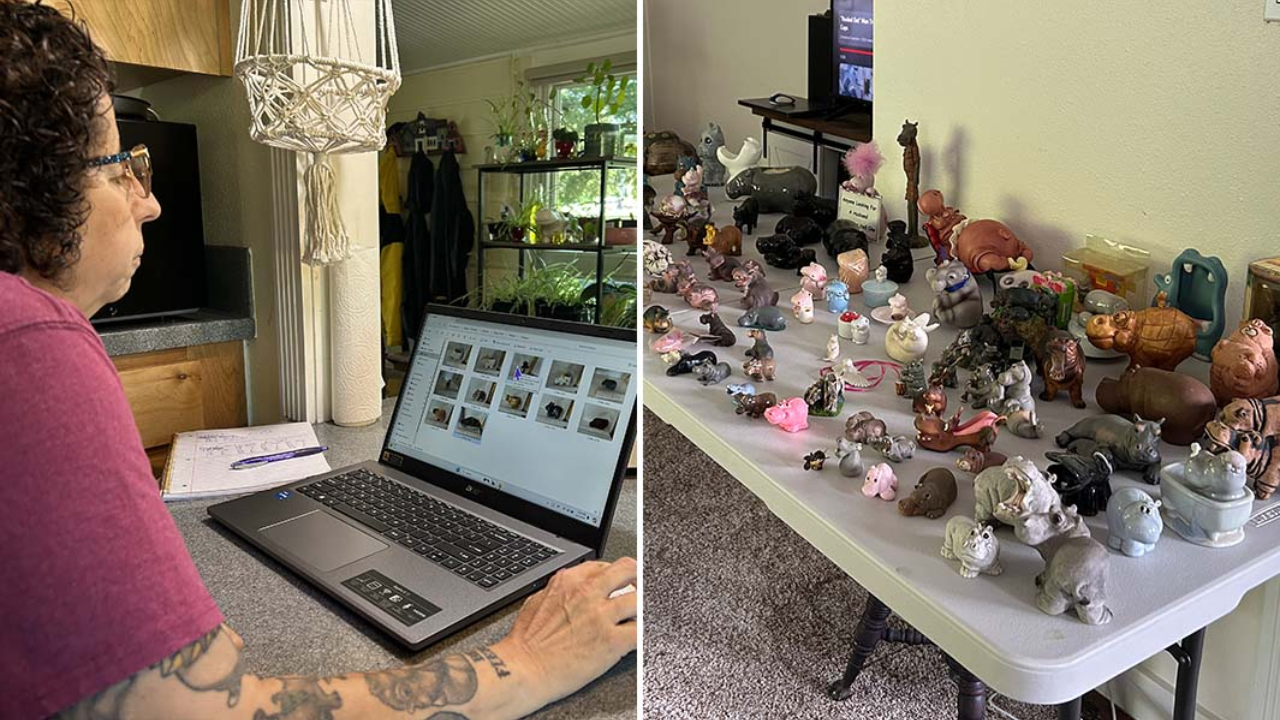
Sheri Lynch holds a Guinness World Record for the largest collection of hippopotamus-related items, totaling 1,086 individual pieces. While the headline focuses on the sheer volume of her hoard, the real story is not about the count. It is about the psychological architecture of high-level collecting. What begins as a sentimental anchor—a grey plush hippo gifted on a fourteenth birthday—often evolves into a systematic, lifelong pursuit that blurs the line between hobby and identity.
Most casual observers view such a collection as a display of whimsical excess. They see the ironwood carvings, the porcelain figurines, and the custom-felted oddities that crowd Lynch’s home in Gold Hill, Oregon, and they define it as "fun". This misses the granular, logistical reality of managing 1,086 unique assets. Maintaining a record-breaking collection requires a rigid internal logic. Without a formal database, the collection would effectively cease to exist as a record, dissolving into a disorganized pile of clutter.
The transition from a passive collection to an obsession is marked by the shift from receiving gifts to actively sourcing items. Lynch’s method eschews the convenience of digital marketplaces, favoring the tactile hunt of flea markets, estate sales, and antique malls. This is not an accidental process. It is a strategic deployment of time and focus. By insisting on physical discovery, she turns every errand into a reconnaissance mission. This is the hallmark of the true collector: the belief that the "right" object is out there, waiting in a specific, physical space that must be visited to be claimed.
This behavior highlights a fascinating aspect of human acquisition. In a digital economy where almost any item can be synthesized or shipped from a global warehouse, the thrill of the "lucky find" becomes a primary psychological reward. When Lynch speaks of the hippos "finding her," she is describing the cognitive bias known as frequency illusion. Once the brain is primed to recognize a specific pattern—in this case, the rounded silhouette and smushy snout of a hippopotamus—the world suddenly appears full of them.
The logistics of housing these items also demand a level of dedication that is rarely discussed in human-interest profiles. A collection of over a thousand items is, for all intents and purposes, a private museum. It requires curation, cleaning, and maintenance. There is also the inevitable confrontation with space constraints. When a physical home reaches capacity, the collector must make choices. Do they purge? Do they expand? Or do they begin to value items based on their size and material composition to maximize spatial efficiency?
Hypothetically, consider a collector who exclusively gathers vintage mechanical watches. If they hit a limit on display space, they might pivot toward smaller, thinner calibers to maintain their volume growth. In Lynch's case, the variety of materials—metal, wood, plastic, glass—suggests that the goal was never thematic purity, but total capture. She has turned her living space into a testament to the versatility of a single image.
There is a dark undercurrent to this obsession that Lynch acknowledges with a touch of irony: the hippopotamus is one of the most dangerous animals on earth. The juxtaposition of a "cuddly" toy representing a creature known for territorial aggression is not lost on her. It serves as a grounded, somewhat grim reminder that the objects we collect are often projections of traits we find compelling, whether that is the perceived cuteness of a stuffed animal or the lethal ferocity of the real thing.
What happens when the record is no longer the goal? Lynch has stated she intends to collect until her "dying day". This removes the pressure of the pursuit and shifts it back toward the act of acquisition itself. The record was merely a validation point, a signal to the outside world that the years of "Hippo-Palooza" were not in vain.
The most successful collectors eventually stop trying to acquire everything and start looking for the "rare" or the "unusual." They move from quantity to quality. Yet, in this specific case, the record suggests that the volume itself is the point. One thousand, eighty-six items is not a hobby; it is a monument. It is a physical manifestation of four decades of focused attention.
To understand why someone pours their life into a single category of object, you have to stop looking at the objects and start looking at the gaps. Every empty shelf in a house is a vacuum waiting to be filled. For the collector, the world is not a collection of places to be, but a series of locations where a piece might be found. The hunt is the heartbeat. The item is merely the trophy.
As the collection grows, the owner begins to function as an archivist of a very specific, narrow history. A single hippo mug purchased at a fair in 1995 is no longer just a mug; it is a data point in a timeline. It is a marker of a specific time, a specific trip, and a specific version of the collector who was present to find it. This is why collectors are rarely satisfied. They are not just collecting objects; they are collecting versions of their own history.
Eventually, the accumulation reaches a saturation point where it dictates the environment. The house becomes a repository. The furniture, the walls, and the shelves are all subservient to the collection. It is a radical way to live, prioritizing the presence of the inanimate over the open space of a standard home.
If you are thinking of starting a journey of this scale, consider the weight of the objects you choose. Consider how they will look when multiplied by a thousand. More importantly, consider if you are prepared for the moment when your home is no longer yours, but rather the residence of your collection. There is no off-switch once the momentum takes hold. The search becomes an extension of the self.
The record is a number. The reality is a life defined by the persistent, unyielding search for the next grey silhouette.
Inside the world of a record-breaking collector
This video provides an authentic look at the physical scale of the collection and the intense documentation process required to verify such an immense volume of objects.
http://googleusercontent.com/youtube_content/1