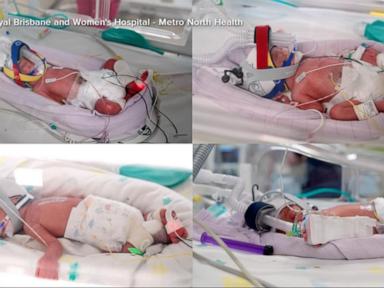
Imagine going for a routine ultrasound while still nursing your youngest child, expecting to hear a single heartbeat, and leaving the clinic with news that you're carrying four babies. Not just any four, but four identical girls conceived completely naturally from a single egg, sharing a single placenta.
That's the reality for 34-year-old Jenitar Na'amoana and her husband Jortham from Queensland, Australia. On July 14, 2026, Jenitar gave birth to Emily, Harriet, Catherine, and Alexa at the Royal Brisbane and Women's Hospital. Before this, the couple already had four kids aged between one and ten. They literally doubled their family size in a single morning. Learn more on a similar topic: this related article.
Medical experts estimate the chance of naturally conceiving identical quadruplets at roughly one in 15 million. But when you factor in all four sharing a single placenta—a monochorionic quadruplet pregnancy—the odds plunge into territory so rare that specialists call it virtually unprecedented.
The Wild Science Behind Single Egg Quadruplets
Most multiple births involve distinct eggs. Fraternal twins happen when a woman releases two eggs, and both get fertilized. Fraternal quads require four separate eggs fertilized by four separate sperm. That's unusual, but it happens, especially with fertility treatments that stimulate ovulation. Further reporting by WebMD explores similar views on the subject.
Identical quads are an entirely different animal.
It starts with one single sperm fertilizing one single egg. Normally, that fertilized egg (a zygote) develops into one embryo. In rare instances, the egg splits into two separate embryos early in development, creating identical twins.
For identical quadruplets to happen, that initial egg has to split, and then those splits have to split again.
Single Fertilized Egg
       │
       ├──► Split 1 ──► Embryo A ──► Split 3 ──► Twin A1 & Twin A2
       │
       └──► Split 2 ──► Embryo B ──► Split 4 ──► Twin B1 & Twin B2
When this splitting happens spontaneously without IVF or fertility drugs, it is a biological lottery win. Because all four babies originate from the exact same genetic blueprint, they're always the same sex, share identical blood types, and look nearly indistinguishable.
The Placenta Problem and What Makes This Birth Unheard Of
Spontaneous splitting is only half the story. The real hurdle in a monozygotic pregnancy comes down to the inner mechanics of the uterus: how the babies share space, oxygen, and nutrients.
In most multiple pregnancies, each fetus develops its own placenta or at least shares distinct vascular networks. When four embryos share one placenta, it creates an enormous biological balancing act.
Understanding Placentation in Multiples
- Dichorionic/Trichorionic: Babies have separate or partially combined placentas. Blood supply is segregated, lowering individual risk.
- Monochorionic: Babies share one single placenta. They tap into a shared pool of blood vessels, which brings massive risks of unequal vascular distribution.
Dr. Alexa Bendall, a maternal-fetal medicine specialist at Royal Brisbane and Women's Hospital who cared for Jenitar throughout her pregnancy, noted that carrying four monozygotic babies on a single placenta is something doctors almost never see in their careers.
When embryos share one placenta, they are at extreme risk for conditions like Twin-to-Twin Transfusion Syndrome (TTTS) or, in this case, Quadruplet-to-Quadruplet Transfusion Syndrome. Abnormal vessel connections in the placenta can cause one baby to receive too much blood and fluid while another receives far too little. This can cause heart strain in one baby and severe anemia or growth restriction in another.
Managing these vascular connections requires intense monitoring. Jenitar was admitted as an inpatient at 25 weeks so specialists could run constant ultrasounds and scans to track fetal growth and blood flow.
Dodging the Odds to Reach 28 Weeks
Carrying a single baby to full term takes about 40 weeks. With quadruplets, reaching 40 weeks isn't just unrealistic—it's dangerous. The uterus simply runs out of physical space, and the risk of placental failure skyrockets.
For high-risk quadruplet pregnancies, reaching 28 weeks is considered a major victory. At 28 weeks, a baby's lungs and vital organs are developed enough that survival rates in a modern Neonatal Intensive Care Unit (NICU) climb past 90 percent.
Jenitar managed to dodge every major complication—no severe transfusion syndrome, no sudden onset preeclampsia, and no early placental failure. Her care team delivered the four girls via C-section at 28 weeks and four days.
The newborns were named Emily, Harriet, Catherine, and Alexa. Baby Alexa was named as a tribute to Dr. Bendall, who guided the family through the high-stakes delivery.
Realities of Premature Quadruplet Care in the NICU
Delivering the babies safely is only phase one. Born at just over 28 weeks, the babies are significantly premature and weigh a fraction of a full-term infant.
The girls are receiving care at the Royal Brisbane and Women's Hospital NICU, where they'll stay until closer to their original due date.
What NICU Care Looks Like for 28-Week Quads
- Respiratory Support: Premature lungs lack sufficient surfactant, a compound that keeps air sacs open. The girls rely on CPAP (Continuous Positive Airway Pressure) or temporary ventilators to assist breathing.
- Temperature Control: Lacking subcutaneous fat, premature infants cannot regulate their own body temperature and must stay in specialized incubators.
- Nutritional Support: Their digestive systems aren't ready to handle full oral feeds yet. They receive nutrients through intravenous lines and tiny nasogastric tubes delivering expressed breast milk.
- Brain and Heart Monitoring: Doctors perform regular cranial ultrasounds and echocardiograms to monitor for intraventricular hemorrhage (bleeding in the brain) and patent ductus arteriosus (a heart valve issue common in preemies).
Despite these hurdles, medical staff report that all four girls are thriving and meeting crucial developmental milestones daily.
The Practical Side of Going from Four Kids to Eight
It's easy to focus on the medical miracle and forget the wild practical reality waiting at home. The Na'amoana family went from a household of six to a household of ten overnight.
Na'amoana Household Growth
┌─────────────────────────┬─────────────────────────┐
│ BEFORE                  │ AFTER                   │
├─────────────────────────┼─────────────────────────┤
│ 2 Adults                │ 2 Adults                │
│ 4 Children (Ages 1–10)  │ 4 Children (Ages 1–10)  │
│                         │ 4 Newborn Quadruplets   │
│ Total: 6 Family Members │ Total: 10 Family Members│
└─────────────────────────┴─────────────────────────┘
The logistical demands of four newborns alongside four young children are staggering:
- Diaper Logistics: Four newborns go through roughly 30 to 40 diapers a day. That's over 1,000 diapers a month just for the infants.
- Feeding Schedules: Newborns feed every two to three hours. With four babies, by the time you finish feeding, burping, and changing the fourth baby, it's almost time to start feeding the first one again.
- Transportation: A standard five-seater or seven-seater SUV simply won't work anymore. The family needs a commercial passenger van or 12-seater vehicle just to fit all eight car seats and parents for a routine doctor visit.
To help manage the sudden financial shift, family supporters launched a GoFundMe to assist with everyday supplies, medical equipment, and a vehicle large enough to hold all ten family members.
Practical Steps for High-Risk Multiple Pregnancies
While a 1-in-15-million pregnancy is extraordinarily rare, twin and triplet pregnancies are increasingly common. If you or someone you know is carrying high-risk multiples, standard prenatal care won't cut it.
- Seek a Maternal-Fetal Medicine (MFM) Specialist: Standard obstetricians are great for low-risk births, but higher-order multiples (triplets or quads) require an MFM specialist trained specifically in complex, high-risk fetal care.
- Map Out NICU Facilities Early: Ensure your delivery hospital has a Level 3 or Level 4 NICU. These facilities are equipped with the specialized equipment and pediatric subspecialists needed for infants born before 30 weeks.
- Track Chorionicity Immediately: Demand an early ultrasound (ideally before 12 weeks) to determine whether the babies share a placenta (monochorionic) or have separate ones (dichorionic). Chorionicity is the single biggest factor in determining pregnancy risk.
- Build a Support Network Before Delivery: Don't wait for the birth to arrange help. Organize meal trains, childcare for older siblings, and nighttime support shifts well before your target delivery week.