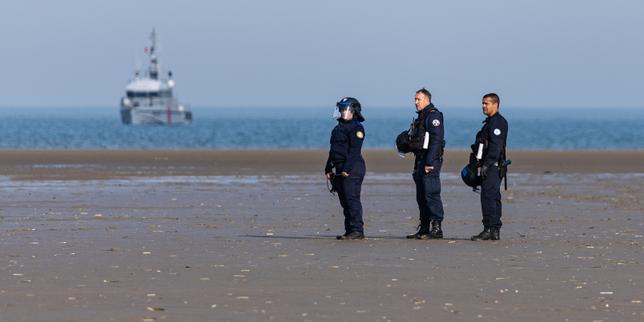
The shift in maritime migration tactics from beach launches to "taxi-boat" maneuvers represents a fundamental evolution in the logistics of illegal Channel crossings. By moving the embarkation point from the shoreline to the open sea, smuggling networks have effectively disrupted the traditional "intercept-on-land" strategy employed by French security forces. This operational pivot forces a transition from static coastal surveillance to dynamic maritime interdiction, a space where the risk-to-reward ratio for both the authorities and the migrant vessel changes significantly.
The Structural Mechanics of the Taxi Boat System
The taxi-boat model functions on a principle of decentralized risk. In a traditional launch, the entire group of migrants and the vessel are vulnerable on the beach, where physical geography limits escape routes. The taxi-boat system decouples these elements through three specific phases: In similar developments, we also covered: The Mechanics of Symbolic Reputation Management and the Weaponization of Public Sentiment.
- The Staging Phase: Empty or lightly loaded vessels are launched from various points along the coastline, often under the guise of legitimate maritime activity or at high-speed intervals that stretch surveillance resources.
- The Rendezvous: The vessel navigates to a predetermined coordinate just off the coast. Simultaneously, groups of migrants are moved to the shoreline via land-based logistics.
- The Rapid Load: Small shuttle boats or direct wading transfers move people onto the larger vessel in a compressed timeframe.
This sequence minimizes the "exposure window"—the time during which a large group of people and a vessel are stationary and vulnerable to land-based detection. By the time authorities identify the gathering, the vessel is often already under power in the water, where the legal and physical thresholds for intervention are drastically higher.
The Physics of Interdiction and the Risk Gradient
Interfering with a vessel at sea involves a complex calculation of kinetic energy and stability. Migrant vessels, frequently over-encumbered and structurally compromised, exist in a state of precarious equilibrium. French authorities must navigate a "Risk Gradient" where every action intended to stop the vessel increases the probability of a mass casualty event. Associated Press has also covered this critical topic in extensive detail.
Stability Variables in Overloaded Vessels
The primary technical challenge is the Metacentric Height (GM). As more individuals are loaded onto a rubberized or low-quality rigid-hulled inflatable boat (RHIB), the center of gravity rises. When an interdiction vessel approaches:
- Wake Turbulence: Even low-speed maneuvers by a patrol ship can create waves that cause a high-center-of-gravity vessel to roll.
- Panic Shifting: The most dangerous variable is the "human ballast" effect. If passengers move toward or away from an approaching authority vessel simultaneously, the sudden shift in weight can exceed the vessel's righting lever, leading to an immediate capsize.
- Structural Integrity: These boats are not designed for the tensile stress of being towed or pushed while heavily loaded.
Because of these variables, "interception" in the Channel rarely looks like a physical blockade. It is instead a psychological and tactical engagement designed to force the pilot to yield without requiring physical contact.
The Tactical Response Framework
French authorities are currently experimenting with active interception techniques that prioritize the "Disruption of Momentum" over physical boarding. This strategy is built on four operational pillars.
Persistent Aerial Surveillance
The use of drones and fixed-wing aircraft provides a continuous data stream that land-based units lack. This allows authorities to track the "taxi" vessel from its point of origin. By identifying the vessel before the load-out occurs, the objective shifts from stopping a loaded boat to preventing the rendezvous. Tracking the empty vessel is a low-risk operation; stopping the loaded vessel is a high-risk operation.
The Buffer Zone Maneuver
When a taxi-boat is identified in transit to a load-out point, maritime units attempt to occupy the physical space between the boat and the shoreline. This "spatial denial" forces the smuggling vessel to either abort the rendezvous or move further out to sea, where the logistics of loading migrants via shuttle becomes exponentially more difficult and dangerous.
Engine Disruption and Propeller Fouling
A specific technical intervention involves the use of specialized lines or nets designed to foul the outboard motors of the migrant vessels. This is a non-kinetic method of stopping the craft. However, the effectiveness of this tactic is limited by the sea state and the proximity required to deploy such measures. A disabled, heavily loaded boat in a high-traffic shipping lane creates a secondary search-and-rescue (SAR) crisis, which often forces the authorities to transition from enforcement back to rescue.
Legal and Jurisdictional Bottlenecks
The legal framework governing the English Channel is a patchwork of the United Nations Convention on the Law of the Sea (UNCLOS) and bilateral agreements between France and the UK. Under UNCLOS, the "Right of Visit" and the "Duty to Render Assistance" often conflict. If an interdiction maneuver is perceived to put lives at risk, the maritime commander is legally obligated to prioritize the safety of life at sea over border enforcement. Smuggling networks exploit this by intentionally creating "controlled instability"—making the boat look more precarious than it is to deter aggressive intervention.
Economic and Supply Chain Pressures
The move to taxi-boats is also a response to the increased seizure of boats on land. As French police have become more adept at finding and destroying caches of inflatable boats in dunes and forests, the smuggling syndicates have treated the vessels as more valuable assets.
In the taxi-boat model, the boat does not sit on a beach for hours. It stays in the water, moving. This creates a higher utilization rate for the equipment. If a boat can successfully drop one group or evade a single patrol, it remains a viable asset for a future run. This "circular logistics" model increases the potential ROI for the smugglers, allowing them to offset the higher costs of fuel and maritime-capable pilots.
The Failure of Static Metrics
Standard metrics for success—such as the number of boats stopped or the number of people detained—fail to account for the "displacement effect." When one sector of the coast becomes too difficult for a taxi-boat rendezvous, the network simply shifts ten miles east or west.
Success must be measured by the Unit Cost of Crossing for the smuggler. If the taxi-boat model requires more sophisticated engines, more fuel for sea-waiting, and more specialized pilots to handle the loading maneuvers, the price of the crossing rises. At a certain threshold, the business model faces a "liquidity crunch" where the risk of losing a high-value vessel outweighs the potential fees from the migrants.
Strategic Forecast and Operational Adjustment
The experimentation with taxi-boat interceptions marks the end of the "land-centric" border policy. The Channel is no longer just a barrier; it is an active theater of operations.
The next evolution in this conflict will likely involve the deployment of automated maritime barriers and acoustic deterrents. However, as long as the "Duty to Rescue" remains the primary legal obligation, the smuggling networks will continue to use human vulnerability as a shield against technical interdiction. The most effective tactical move is the disruption of the maritime supply chain—specifically the illicit import of high-horsepower outboard motors and the industrial-grade PVC used for these vessels—rather than the attempt to catch the boats once they are in the water.
Authorities must now prioritize the "pre-launch" phase by treating the maritime equipment as a regulated munition. Without the specialized propulsion systems required to fight the Channel's currents while heavily laden, the taxi-boat model becomes physically impossible. The focus shifts from the shoreline to the global supply chain.