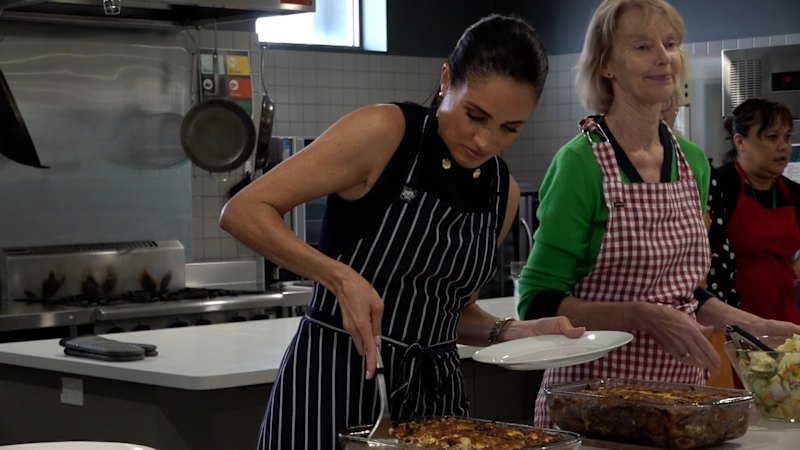
The efficacy of high-profile humanitarian interventions is frequently obscured by narrative-driven media coverage that prioritizes individual optics over operational mechanics. When public figures, such as the Duchess of Sussex, participate in grassroots service like food distribution, the event functions as a intersection of resource allocation, social signaling, and logistical deployment. To understand the true impact of these engagements, one must look past the sentiment and analyze the structural variables: the scalability of the service model, the conversion of social capital into tangible community assets, and the friction between symbolic presence and functional efficiency.
The Architecture of Grassroots Food Distribution
Community-based food service operates within a rigid set of constraints. Unlike large-scale industrial aid, grassroots initiatives rely on high-velocity turnover of perishable goods and localized volunteer labor. The presence of a high-profile figure introduces a distinct set of operational variables that can either enhance or disrupt this equilibrium.
The Surge Capacity Factor
In a standard community kitchen environment, output is limited by three primary bottlenecks:
- The Preparation Throughput: The speed at which raw ingredients are converted into consumable meals.
- The Distribution Radius: The physical area or demographic reach serviced by the site.
- The Labor Efficiency: The ratio of volunteer hours to meals served.
A visit from a high-profile individual acts as a temporary catalyst for these variables. The immediate effect is a surge in "attention equity." This equity, if managed correctly, translates into an influx of short-term labor and financial donations. However, a failure to integrate this surge into a long-term operational framework results in a "decay curve" where the organization returns to its baseline capacity within 72 hours of the event.
Resource Allocation vs. Symbolic Labor
There is a fundamental distinction between technical labor and symbolic labor. Technical labor involves the literal preparation and delivery of food—actions that directly satisfy the mission's requirements. Symbolic labor involves the act of being seen performing the service, which aims to validate the cause and attract external resources.
The strategic risk in celebrity-led service is the displacement of technical efficiency. If security protocols, media staging, and choreographed interactions consume more time than the actual service provides, the net gain to the community is negative in the short term. The value proposition, therefore, rests entirely on the secondary effects: the long-tail influence of the publicity generated.
The Social Capital Exchange Mechanism
High-profile humanitarianism is a form of value exchange. The public figure provides "prestige lending" to the organization, while the organization provides "authenticity anchoring" to the public figure. This exchange is governed by the perceived alignment between the figure’s established brand and the organization’s mission.
Validation Density
The "Meghan effect" in this context is best defined as the density of validation provided to a specific demographic. By focusing on women-led community service, the engagement targets a specific social infrastructure. Women in localized humanitarian roles often operate in an "under-capitalized" state, where their labor is high-impact but low-visibility.
Structural validation occurs when the public figure’s presence acts as a signal to institutional donors. This signaling reduces the "trust friction" that often prevents large-scale philanthropic entities from investing in smaller, community-led projects. The presence of a global figure serves as a de facto audit, suggesting that the organization is stable enough to manage high-level scrutiny.
The Risk of Displacement
A critical failure point in this model is the "Over-Shadowing Threshold." If the narrative focus shifts entirely to the individual's attire, demeanor, or personal history, the organization's mission suffers from information dilution. The "Attention-to-Impact Ratio" (AIR) measures how much of the resulting media coverage actually mentions the organization’s specific needs (e.g., funding gaps, specific food shortages, or volunteer requirements).
- High AIR: Coverage includes links to donation pages, discusses systemic hunger issues, and names the local organizers.
- Low AIR: Coverage focuses exclusively on the celebrity's fashion choices and biographical updates.
Structural Interventions in Humanitarian Visibility
To move beyond the limitations of "drop-in" service, the strategy must transition from episodic engagement to systemic integration. This requires a move away from the "server-at-the-counter" model toward a "systemic-investor" model.
Moving from Service to Infrastructure
The most significant bottleneck for community kitchens is rarely a lack of volunteers; it is a lack of infrastructure. This includes cold storage, reliable logistics for "last-mile" delivery, and procurement software. When high-profile figures engage, the highest-leverage move is not the act of serving food, but the act of highlighting these structural gaps.
For instance, if a visit results in the donation of a commercial-grade walk-in freezer, the long-term meal capacity increases by a quantifiable percentage (often 15-20% due to reduced waste). This creates a permanent shift in the organization’s production frontier, whereas the act of serving 100 meals provides only a one-time relief.
The Feedback Loop of Narrative Philanthropy
Narrative philanthropy relies on the "Story-to-Action Pipeline." The sequence is as follows:
- The Event: A visual demonstration of engagement (e.g., the Duchess serving food).
- The Amplification: Media dissemination across diverse demographics.
- The Activation: The conversion of viewers into donors or advocates.
- The Sustainability Phase: The retention of these new stakeholders after the initial news cycle ends.
The second and third stages are where the most friction occurs. Most viewers do not convert. To optimize this pipeline, the event must be framed not as a conclusion, but as an entry point into a larger systemic problem.
Analyzing the Impact on Women-Led Service Models
The focus on women-led service is not merely a social preference; it is a recognition of the "Multiplier Effect" in community development. Data consistently indicates that resources directed toward women at the community level have a higher rate of reinvestment into local education, health, and nutrition.
The Burden of Emotional Labor
While high-profile visits provide visibility, they also impose a tax of "emotional labor" on the regular staff. The organization must pivot from its core mission to manage the logistics of a high-security visit. This temporary pivot can lead to operational fatigue if not properly supported by the visiting team’s own logistics staff.
Successful engagements are those where the visiting team operates as a "net-zero" footprint entity—providing their own security, transportation, and media management so as not to deplete the organization’s existing resources.
The Quantification of "Soft" Influence
How do we measure the success of a Duchess-level visit to a community center?
- Digital Footprint Expansion: Tracking the growth in the organization’s social media following and website traffic in the 30 days post-event.
- Donor Acquisition Cost (DAC): Comparing the cost of the event (if any) to the value of new donations received.
- Partnership Inquiries: Measuring the number of corporate or institutional outreach attempts triggered by the visibility.
Strategic Recommendation for Long-Term Value
The current model of episodic service visits has reached a saturation point in terms of public perception. To elevate the impact of these engagements, a shift in the tactical playbook is required.
The organization and the public figure should prioritize "The Infrastructure Narrative." Instead of the primary visual being the act of manual labor, the focus should shift to the "Systems Behind the Service." Documenting the challenges of the supply chain, the necessity of specialized equipment, and the training required for community leaders provides a more sophisticated and actionable story for the public.
Future engagements should be structured as "Multi-Phase Deployments."
- Phase 1: Private consultation to identify specific capital expenditure (CapEx) needs.
- Phase 2: The public engagement event designed to drive a specific, time-bound fundraising goal for that CapEx need.
- Phase 3: A follow-up (digital or physical) demonstrating the new equipment or system in action.
This three-stage approach replaces the "one-off" news story with a progress-oriented narrative that incentivizes sustained public interest and provides a clear, measurable outcome for the community. The goal is to move from being a guest in the kitchen to being an architect of the kitchen’s expansion.