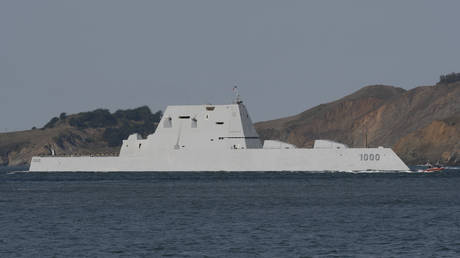
The fire aboard the USS Zumwalt (DDG 1000) represents more than a localized thermal event; it is a diagnostic indicator of the systemic fragility inherent in first-in-class naval engineering. At an estimated program cost exceeding $8 billion per hull, the Zumwalt is a concentrated node of risk where experimental power distribution systems, unconventional hull geometry, and high-density automation converge. When an incident occurs within this environment, the traditional damage control calculus is disrupted by the vessel's unique Integrated Power System (IPS) and its reduced manning requirements.
The Integrated Power System as a Primary Failure Vector
The USS Zumwalt utilizes an Integrated Power System (IPS) capable of generating approximately 78 megawatts of electricity. Unlike legacy destroyers where the propulsion and ship service power are distinct, the IPS pools all generated energy into a common grid. This architecture enables the ship to redirect massive amounts of energy to future directed-energy weapons or electromagnetic railguns. However, this total integration creates a high-stakes dependency on the Advanced Induction Motors (AIM).
The failure mode of such a system is binary. In a traditional mechanical drive ship, a fire in an auxiliary generator might not impede propulsion. In an IPS-driven hull, a thermal event within the power distribution bus or the central switching gear threatens the entire operational profile. The complexity of the cabling—required to move megawatts of power through a stealth-optimized, composite-heavy superstructure—increases the potential for electrical arcing and cable jacket combustion. The heat signature of such a fire is significantly intensified by the density of the electronic components, which act as heat sinks and fuel sources simultaneously.
Thermal Dynamics of Composite Superstructures
The Zumwalt’s superstructure is constructed primarily of carbon fiber and balsa wood core composites to minimize radar cross-section (RCS). While these materials offer superior strength-to-weight ratios and stealth characteristics, they behave fundamentally differently from steel under thermal stress.
- Pyrolysis and Off-gassing: Unlike steel, which loses structural integrity at high temperatures but does not contribute fuel to a fire, composites can undergo pyrolysis. This process releases toxic, flammable gases that can lead to rapid fire spread in enclosed compartments.
- Structural Delamination: Excessive heat weakens the resin bond within the composite panels. Even if the fire is suppressed, the structural rigidity of the deckhouses may be permanently compromised, necessitating expensive and complex repairs that cannot be performed at sea.
- Conductivity Challenges: Carbon fiber is electrically conductive. In the event of a fire caused by an electrical fault, the structure itself can become a secondary path for current, complicating the efforts of damage control teams to isolate the power source.
The intersection of these factors means that a "minor" fire on a Zumwalt-class ship carries a disproportionate risk of total hull loss compared to an Arleigh Burke-class destroyer.
The Damage Control Paradox of Reduced Manning
The Navy designed the Zumwalt class to operate with a crew of approximately 175 personnel—roughly half that of its predecessors. This efficiency is achieved through the Autonomic Fire Suppression System (AFSS) and the Damage Control Management System (DCMS).
The reliance on automation creates a bottleneck during high-intensity incidents. Automated systems are programmed to address "known-physics" scenarios—standard fire types in predictable locations. They struggle with cascading failures where a fire might damage the very sensors required to trigger the suppression system. When the automation fails or is overwhelmed, the burden falls on a skeleton crew.
The physical labor required to move heavy firefighting equipment, conduct search and rescue, and manually override valves is constant, regardless of how "smart" the ship is. A reduced crew size means that sustained damage control operations quickly lead to physical exhaustion, reducing the probability of successful hull recovery. This creates a "fragility threshold": the ship is highly capable until a certain level of damage is reached, at which point its ability to recover collapses faster than that of a traditionally manned vessel.
Strategic Cost Concentration and Geometric Vulnerability
The $8 billion price tag per vessel creates a strategic "too big to fail" scenario. Losing a single Zumwalt represents the loss of 33% of the class's total capacity, given that only three hulls were produced. This concentration of value makes the platform a high-value target for both kinetic strikes and accidental loss.
The tumblehome hull design—where the sides slope inward above the waterline—adds a layer of stability risk during damage control. If a fire leads to significant water ingress from firefighting efforts (free surface effect), the tumblehome hull's righting arm behaves differently than a flared hull. As the ship heels, its stability can decrease more rapidly, making the management of firewater just as critical as the suppression of the flames themselves.
Power Density and Thermal Management Bottlenecks
The Zumwalt's internal environment is a masterpiece of spatial optimization, but this density leaves little room for thermal dissipation. The ship’s "Total Ship Computing Environment" (TSCE) consists of over 160 nodes and millions of lines of code, all housed in Electronic Modular Enclosures (EMEs).
Each EME is a concentrated heat source. When an external fire occurs, the ambient temperature rise can trigger thermal shutdowns in nearby computing clusters. Because the ship's sensors, weapons, and navigation are all routed through these EMEs, a localized fire can effectively "blind" the ship even if the fire never reaches the bridge or the Combat Information Center (CIC). This creates a decoupled failure state where the ship is physically intact but operationally dead.
Operational Recommendation for Platform Survival
To mitigate the inherent risks of the Zumwalt's design, the Navy must shift from a "suppression-first" to a "segregation-first" damage control philosophy. This requires:
- Hardened Power Nodes: Retrofitting the IPS with localized, solid-state circuit breakers that can isolate faults at the millisecond level, preventing the common-bus failure.
- Augmented Reality (AR) Damage Control: Providing the reduced crew with AR overlays of the ship's internal schematics to compensate for the lack of personnel. This allows a single sailor to locate valves and junctions that would normally require a full team to identify in a smoke-filled environment.
- Thermal Kinetic Partitioning: Installing passive, high-temperature ceramic barriers between the composite superstructure and the primary electrical trunks.
The USS Zumwalt is a prototype masquerading as a frontline combatant. The recent fire is a reminder that in the pursuit of stealth and automation, the fundamental laws of maritime survival—manpower, structural resilience, and power redundancy—cannot be fully programmed away. The path forward involves acknowledging that high-density technology requires high-density protection, or the Navy risks losing its most expensive assets to the very complexity intended to save them.