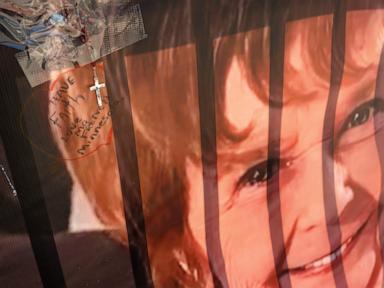
The ink on a ransom note is never just ink. To the untrained eye, it is a demanding scrawl on a torn sheet of paper, a crude instrument of terror meant to extort money. But to those who study the architecture of fear, it is a psychological fingerprint. It carries the weight of a voice, the cadence of a threat, and the heavy, suffocating silence of a room where someone is missing.
For decades, federal investigators have stared at these scraps of paper. They analyze the specific fiber of the wood pulp. They measure the microscopic pressure points left by a ballpoint pen. They dissect the syntax, looking for the subtle regional dialects or nervous tics of the writer. In the heartbreaking disappearance of Nancy Guthrie, these fragile pieces of evidence have become the epicenter of a quiet, enduring storm.
The FBI recently confirmed something that many feared had been lost to the relentless march of time: the ransom notes received in the wake of Guthrie’s disappearance are still being actively, rigorously investigated as legitimate.
This is not a cold case gathering dust in a forgotten basement. It is a living, breathing puzzle. Every word on those pages is still being interrogated, because in the grim reality of kidnapping investigations, a validated ransom note is more than a demand. It is a horrific, vital proof of life—or at least, a proof of presence.
The Anatomy of a Threat
When a loved one vanishes, reality fractures. For the family left behind, the world shrinks down to the space immediately surrounding the telephone or the front door. Minutes stretch into agonizing, unyielding epochs. Then, the note arrives.
Imagine the sheer physical impact of holding that paper. It is a tactile connection to the monster in the dark. Your hands shake. The words blur. The demands are often absurd, calculated to induce panic, yet rigidly specific.
In forensic science, a ransom note is treated with the same reverence and meticulous care as a biological sample. Investigators look at the "how" just as much as the "what." Did the writer use block letters to disguise their handwriting? Did they cut words out of a magazine, a technique popularized by old Hollywood but still occasionally used by those desperate to detach their identity from the crime?
Every choice the perpetrator makes is an admission.
Consider the psychology of the act. Writing a ransom note requires time. It requires deliberation. A person committing a crime of passion rarely sits down to compose a multi-paragraph demand. The existence of a note implies a plan, a structure, and a motive that extends beyond mere violence. It is an economic transaction forced upon a victim at the highest possible stakes. By maintaining that the Guthrie notes are legitimate leads, federal agents are signaling that the underlying logic of the abduction still holds together. The trail has not gone entirely cold; it has just become incredibly narrow.
The Science Behind the Scrawl
To understand why the FBI refuses to let these notes go, we have to look at the massive evolution in forensic technology over the last few years. A piece of paper that yielded nothing in the past can today become a goldmine of data.
There is a quiet revolution happening in the labs.
We are no longer just looking at handwriting analysis, which, while useful, carries a degree of subjective interpretation. Today, behavioral linguists can map the exact geographic origin of a writer based on their choice of prepositions or the way they structure a conditional sentence. A phrase like "wait by the old mill" vs "wait near the old mill" can pinpoint a suspect's childhood home or current residence with shocking accuracy.
Then there is the physical material itself.
Advanced spectroscopy allows scientists to identify the exact batch of ink used, tracing it back to a specific manufacturer, a specific store, and sometimes a specific window of sale. Indented writing analysis—using electrostatic detection apparatus—can reveal what was written on the page above the ransom note on a legal pad, exposing shopping lists, names, or addresses that the criminal thought they had torn away and destroyed.
This is why the Bureau keeps digging. They are waiting for the technology to catch up to the evidence. A microscopic speck of touch DNA, completely unrecoverable a decade ago, can now be amplified and run through familial databases. The paper hasn't changed, but our ability to hear what it’s screaming has.
The Invisible Stakes
It is easy to look at true crime headlines as abstract entertainment, a series of plot points to be consumed on a morning commute. But there is a profound, exhausting human cost to an ongoing investigation of this magnitude.
Every time the FBI releases a statement, every time a spokesperson confirms that the notes are still deemed authentic, a shockwave hits those who knew and loved Nancy Guthrie. It is a cruel double-edged sword. On one hand, it offers a fragile, flickering ember of hope—the reassurance that the authorities have not given up, that the case has not been relegated to the archives of unsolved mysteries. On the other hand, it rips open the wound entirely, forcing the family to relive the initial terror of the day the world stopped turning.
The uncertainty is a unique kind of torture. It is an ambient trauma that settles into the bones.
When a person dies, there is a funeral. There is a grave. There is a definitive, agonizing period where the mind must accept the finality of loss. But when the primary evidence consists of active ransom notes, the narrative remains stubbornly, agonizingly open-ended. The mind plays cruel tricks. It imagines scenarios of survival, of hidden rooms, of long-overdue homecomings, juxtaposed against the darkest, most terrifying possibilities.
The investigators themselves carry a heavy burden. They are acutely aware that every decision they make, every lead they pursue or publicly comment on, has a direct, emotional consequence for real people. They are not just analyzing paper and ink; they are managing human grief.
The Long Shadows
The investigation into the Nancy Guthrie case reminds us that some crimes cast shadows that span generations. A community is altered by an unsolved abduction. Trust erodes. Parents hold their children a little tighter; neighbors look at each other with a faint, subconscious layer of suspicion. The unresolved nature of the crime creates a permanent vulnerability in the social fabric.
But the persistence of the FBI also sends a powerful, definitive message to whoever authored those notes, wherever they are right now.
It tells them that time is not their ally.
The criminal who wrote those demands might think they got away with it. They might think that because years have passed, the danger has receded. They might have built a new life, hidden behind a facade of normalcy, believing that the scraps of paper they dropped off or mailed have long since lost their potency.
They are wrong.
The files remain open. The lights in the laboratory stay on. Every single day, the collective intelligence of federal law enforcement is looking for the one crack in the armor, the one technological breakthrough, or the one tip from a witness that will match the handwriting, the ink, or the DNA on those notes to a name.
The paper is waiting. And it never forgets.


