Winning the Champions League is supposed to be the ultimate moment of football euphoria. But in France, it’s increasingly becoming synonymous with urban warfare.
When Paris Saint-Germain defeated Arsenal in a tense penalty shootout in Budapest, the initial reaction across the French capital was pure elation. After a nerve-wracking 1-1 draw, Gabriel blazed his penalty over the crossbar, handing PSG their second consecutive European title.
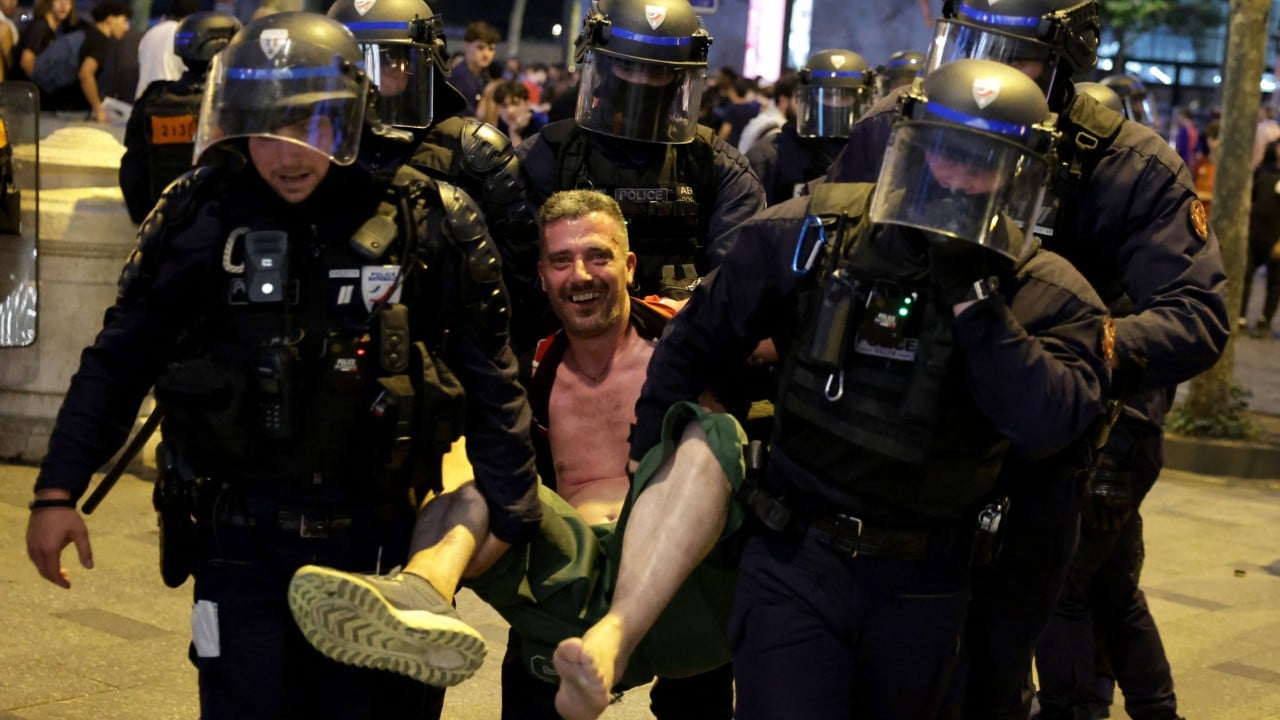
Then the streets erupted. What should have been a night of historic sporting pride quickly degenerated into systematic violence. By Sunday morning, French Interior Minister Laurent Nuñez confirmed a staggering 780 arrests nationwide, with 480 of those takedowns happening in the Paris area alone.
This isn't an isolated incident or a case of a few bad apples ruining the party. It's part of a dangerous, predictable pattern that raises a serious question. Why can’t Paris celebrate a football trophy without tearing itself apart?
The Anatomy of a Night Under Siege
French authorities knew trouble was brewing. They deployed 22,000 police officers across the country, including 8,000 in the capital alone. It didn't matter. The sheer scale of the chaos overwhelmed localized security measures almost immediately after the final whistle.
While 20,000 fans gathered peacefully on the Champs-Élysées, smaller, highly coordinated groups weaponized the crowds. They didn't just light traditional flares. They launched commercial-grade fireworks directly at police lines.
The Paris prosecutors' office reported that 306 people were formally placed in custody, including 81 minors. The charges tell you everything you need to know about how the night went down:
- Assaulting law enforcement officers
- Vandalism and arson
- Theft and coordinated looting
- Possession of illegal weapons
The violence wasn't contained to standard street scuffles. In the affluent 8th arrondissement, a mob actually attempted to storm a local police station before riot police drove them back with tear gas. On the streets, self-service Lime electric bicycles were piled up and set ablaze, creating toxic bonfires that choked the avenues.
The Human Cost of Soccer Riots
We need to stop looking at these post-match riots as mere property damage. The human toll from Saturday night is grim.
A 24-year-old man died on the Boulevard Périphérique, the major ring road encircling Paris. In an effort to keep fans from blockading the highway, city services had erected concrete barriers near Porte Maillot. The young man, riding a motocross bike, slammed into the barriers and died at the scene.
Elsewhere, a knife attack linked to a street robbery left another young man fighting for his life. A driver lost control of a vehicle and plowed directly into a restaurant terrace, leaving two people injured, one critically.
By the time the sun came up, 57 police officers were wounded. Nationwide, 219 participants were injured, including eight who remain in serious condition. This isn't sports fandom. It’s criminality hiding behind a club crest.
A Growing Trend of Festive Violence
If this feels familiar, it's because it happened just last year. When PSG won their first Champions League title in May 2025, the aftermath saw 500 arrests and more than 200 injuries.
Instead of fixing the problem, the metrics got worse. This year's 780 arrests mark a 32 percent increase in detentions compared to last year's title run. The geographic footprint expanded too. Serious disturbances hit 71 different municipalities across France, with looting and vandalism reported in 15 different cities, including Lyon and Marseille.
Politicians are predictably furious. French President Emmanuel Macron, who hosted the team at the Élysée Palace on Sunday, didn't hold back during the reception.
"I don't want us to get used to it," Macron said. "This is not soccer, this is not sport, this is not what we love. We will be uncompromising with those who have been caught. It's over. We've had enough."
But statements don't fix broken shop windows or heal injured cops.
The Zero Gatherings Dilemma
The political fallout has reignited a fierce debate over how to police major sporting events in France. Catherine Lécuyer, the mayor of Paris’s 8th arrondissement, immediately called for a complete rethink of public gatherings. She argued that the Champs-Élysées has stopped being a place of celebration and has turned into an arena of "urban guerrilla warfare." Her solution? A strict "zero gatherings" doctrine for high-risk matches.
Interior Minister Laurent Nuñez flatly rejected the idea. He called it a "false good idea." From a tactical perspective, he’s right. If you ban fans from the Champs-Élysées, you don't stop them from gathering. You just scatter them into dozens of residential neighborhoods, spreading police resources dangerously thin.
The current strategy relies on massive containment. Police corralled roughly 1,000 fans near the Parc des Princes stadium in the 16th arrondissement, systematically clearing improvised barricades made of bicycles and trash bins. But containment is a reactive strategy. It manages the chaos instead of preventing it.
What Needs to Change Before the Next Match
The French government cannot keep burning through millions of euros in police overtime every time a football club wins a trophy. If you plan on attending a major public screening or victory parade in Paris anytime soon, you need to understand that the security landscape has changed permanently. Expect harsher pre-entry checkpoints, immediate use of tear gas at the first sign of projectile throwing, and swift, pre-emptive closures of public transit and ring roads.
For ordinary fans who just want to sing and celebrate, the advice is simple but frustrating. Avoid the immediate radius of the Arc de Triomphe and the Parc des Princes once night falls. Stick to organized, daylight events like the official team presentation at the Champ-de-Mars, which saw 100,000 people gather peacefully under heavy security on Sunday. Until the French judicial system starts handing out severe, mandatory prison sentences for those using football matches as an excuse for riots, the streets of Paris will remain a hazard on championship night.