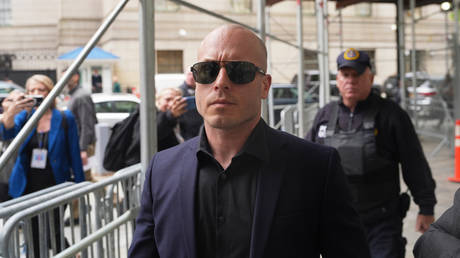
The intersection of military discipline and geopolitical gambling is usually a quiet place. It is a space where careers end and investigations begin. Recently, the spotlight turned toward a United States soldier caught in the crosshairs of allegations involving a high-stakes wager on the removal of Venezuelan leader Nicolás Maduro. While the surface-level story suggests a simple denial of a bizarre betting scandal, the underlying reality reveals a dangerous blurring of lines between private citizen actions and the heavy weight of the American uniform.
A video surfaced appearing to show a service member engaging with the idea of Maduro’s downfall, potentially through the lens of a financial or speculative bet. The soldier has since denied these claims, but the damage to the optics of neutrality is already done. For the Department of Defense, this isn't just about a potential violation of gambling regulations. It is about how the digital footprint of a single individual can be weaponized by a foreign regime to validate their narrative of "Yankee interventionism."
The Mechanics of the Denial
The denial itself follows a predictable pattern. In the era of viral clips and fragmented context, the soldier argues that the footage does not represent a literal financial stake in a foreign coup or political shift. This defense hinges on the idea of "social banter" or a misunderstanding of intent. However, military investigators rarely care about intent when the outcome creates a diplomatic headache.
Under the Uniform Code of Military Justice (UCMJ), service members are held to standards that extend far beyond their 9-to-5 duties. Engaging in speculative markets regarding the stability of a foreign government—especially one that the U.S. has sanctioned and labeled as illegitimate—is a fast track to an administrative discharge or worse. Even if no money changed hands, the mere suggestion that a U.S. asset is "rooting" for a specific outcome in a volatile region provides fuel for the Maduro administration’s propaganda machine.
Why Maduro Seizes These Moments
Caracas has a long history of taking minor incidents involving Americans and inflating them into grand conspiracies. We have seen this with the "Silvercorp" disaster, where a poorly planned incursion by former Green Berets was used to portray the U.S. as a bumbling but persistent aggressor. When a current soldier is even tangentially linked to a "bet" on the regime's collapse, it allows Maduro to point the finger at Washington and claim that every American in uniform is a mercenary in disguise.
The reality of the situation is often much more mundane. Soldiers are people. They use the internet, they follow the news, and they sometimes make incredibly poor decisions on camera. But in the context of Venezuela, there is no such thing as a mundane mistake. The U.S. has a standing $15 million bounty on Maduro for drug trafficking charges. To an outsider, the line between a government-issued bounty and a private wager on his removal is a distinction without a difference.
The Problem with Prediction Markets
We are seeing a rise in the popularity of decentralized prediction markets. These platforms allow users to bet on everything from election results to the timing of a CEO’s resignation. For a member of the military, participating in these markets is a legal minefield.
- Conflict of Interest: Does the soldier have access to non-public information that could influence the "market"?
- Conduct Unbecoming: Does betting on the death or removal of a head of state reflect poorly on the service?
- Operational Security: Does the soldier's activity reveal their location or their unit's focus?
If a soldier bets on Maduro's removal and then finds themselves deployed to a Southcom mission, the ethical conflict is immediate. The military expects a level of stoicism that is increasingly at odds with a culture that encourages everyone to have a "take" on every global event.
Beyond the Video
The investigation into this specific soldier will likely look at bank records and digital wallets. In the modern age, a denial is only as good as your blockchain history. If investigators find a link to a "PolyMarket" or "Augur" account, the "it was just a joke" defense will crumble. The Pentagon has been tightening its grip on how troops use social media and financial apps, precisely because these tiny leaks can lead to massive intelligence breaches.
What the competitor reports often miss is the psychological toll this takes on the rank-and-file. Most soldiers are just trying to do their jobs. When one individual decides to play "geopolitical analyst" on a recorded line, it creates a ripple effect of increased scrutiny and restricted freedoms for everyone else in the unit. The "bet" isn't just on Maduro’s future; it is a bet on whether the military’s leadership will tolerate a new age of digital indiscretion.
The Geopolitical Blowback
Venezuela is currently in a state of suspended animation. The 2024 election cycle was marred by claims of fraud, and the opposition remains in a precarious position. In this environment, any "proof" of American military interest in the internal affairs of the country is gold for the PSUV (United Socialist Party of Venezuela). They don't need a formal declaration of war from the White House when they can find a TikTok video or a leaked chat that suggests a soldier is looking to profit from their misery.
This isn't about the soldier's right to free speech. The moment you put on the uniform, your speech is curated by the interests of the state. Betting on a foreign leader’s demise is essentially betting against the diplomatic efforts of the State Department, which, despite the rhetoric, often prefers managed transitions over chaotic collapses that lead to refugee crises.
The Intelligence Gap
There is also the possibility that this wasn't a "bet" in the traditional sense, but an attempt at "clout-chasing." The digital economy thrives on shock value. If a soldier thinks they can gain followers by pretending to have "inside info" on a coup, they might record a video that looks like a confession of a wager. This is the new reality of intelligence: sorting through the noise of people pretending to be more important than they are.
The military's counter-intelligence wings are now forced to spend thousands of man-hours debunking the claims of their own personnel. It is an exhausting, circular process that detracts from actual threats. While we focus on a soldier’s potential gambling habit, real actors are moving pieces on the board in Caracas, Moscow, and Tehran.
The Cost of Indiscretion
If the soldier is found to have lied, the consequences will be swift. The military does not take kindly to being embarrassed on the international stage. But even if the denial is 100% truthful, the event serves as a warning. The barrier between a private thought and a public diplomatic incident has vanished.
Every service member is now a walking camera and a potential liability. The Maduro administration will continue to use this footage to justify their crackdown on domestic dissent, claiming that "foreign agents" are literally gambling with the lives of Venezuelans. It is a powerful, if dishonest, narrative that works on a population that feels under siege.
Discipline in the Digital Age
The Pentagon needs to move beyond simple "don't post that" briefings. They need to address the reality of the speculative economy. Soldiers are often young, have disposable income, and are drawn to high-risk financial moves. When those moves overlap with their professional theater of operations, the result is a train wreck.
The investigation will conclude, the news cycle will move on, and Maduro will remain in the Miraflores Palace for now. But the next time a video like this surfaces, the questions won't just be about whether a bet was placed. They will be about why the American military hasn't yet figured out how to keep its personnel from becoming unwitting pawns in a foreign dictator's PR strategy.
The soldier denied the bet, but the house always wins when it comes to propaganda. In the high-stakes world of international relations, there is no such thing as a casual remark, and there is certainly no such thing as a private gamble. Every word caught on camera is a contract with the consequences of the future.
Check your privacy settings before you check your odds.