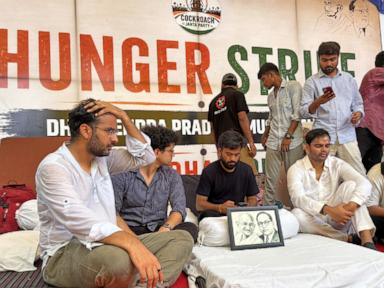
The media loves a predictable script. When news broke that Indian police moved in to hospitalize a fasting Cockroach Party activist, the headlines practically wrote themselves. "Forced hospitalization." "Crackdown on dissent." "State overreach."
It is a comfortable, lazy narrative that positions the state as a brutal monolith and the fasting activist as a pure, tragic figure of resistance. But anyone who has spent time analyzing political strategy in South Asia knows this interpretation is completely wrong. Building on this topic, you can also read: The Evolving Reality of India-Saudi Ties Beyond the Riyadh Diplomatic Circuit.
The mainstream press is covering a sophisticated piece of political theater and treating it like a human rights crisis. Moving a fasting activist to a medical facility is not an act of autocracy; it is the inevitable, mutually agreed-upon climax of a modern hunger strike. It is time to look past the melodrama and understand the cold mechanics of political leverage.
The Calculated Math of Self-Starvation
A hunger strike is never a solitary act of desperation. It is a high-stakes negotiation tool that relies entirely on a compliant media and an predictable state response. Analysts at NBC News have shared their thoughts on this situation.
To understand why the "forced hospitalization" narrative is flawed, you have to understand the legal and operational framework of the state. Under Indian law, specifically Section 309 of the Indian Penal Code (and its subsequent interpretations alongside the Mental Healthcare Act of 2017), the state has a legal obligation to prevent suicide and preserve life.
Political strategists know this. They count on it.
Imagine a scenario where an activist goes on a hunger strike and the government simply ignores them. No cameras. No police. No medical bulletins. The protest completely fails. The efficacy of the hunger strike relies entirely on the state intervening. The intervention is the validation of the activist's power. By forcing the state to step in and administer intravenous fluids, the activist achieves a series of critical tactical victories:
- Optics of Martydom: The image of police officers moving a weakened individual into an ambulance creates an instant, emotionally charged visual that fills front pages.
- Risk Mitigation: The activist forces the government to assume the liability for their health, effectively ending the physical risk of the strike without having to officially back down or admit defeat.
- Negotiation Leverage: The hospitalization creates a fresh news cycle, buying the political party more time to negotiate behind closed doors while maintaining a public stance of absolute defiance.
I have watched political campaigns spend millions trying to engineer the kind of authentic public sympathy that a single, well-timed medical intervention generates for free. Calling this a "crackdown" misses the entire point. It is a orchestrated handoff from the street to the ward.
Dismantling the PAA: Is a Hunger Strike Actually Effective?
If you look at modern political data, the answer is a resounding no. The premise of the public's question is fundamentally outdated, relying on historical echoes of Mahatma Gandhi or Potti Sreeramulu.
In the 21st century, the saturation of the media ecosystem has fundamentally broken the mechanics of the hunger strike.
[Traditional Fast] -> High Moral Weight -> Public Pressure -> Policy Change
[Modern Fast]      -> Media Spectacle   -> Algorithmic Fatigue -> State Intervention
When Irom Chanu Sharmila engaged in a historic 16-year fast in Manipur, the longest hunger strike in human history, the state adapted by nasally force-feeding her through a tube. When she finally ended her fast to enter mainstream politics, the electorate completely rejected her at the ballot box—she received just 90 votes in the 2017 assembly elections.
The harsh reality is that modern audiences suffer from rapid algorithmic fatigue. A fast that dominates the news cycle on Monday is buried by a new scandal by Thursday. The state knows this. The activists know this. Therefore, the goal is no longer to fast until policy changes; the goal is to fast until the police arrive, claim a moral victory, and pivot to the next campaign strategy.
The Logistics of State Bureaucracy
Let's look at the mechanics from the perspective of the district administration. When a high-profile activist stops eating, the local bureaucracy enters a highly standardized operational protocol.
Local intelligence units monitor the activist's vitals daily. Government doctors perform regular checkups. When ketone levels in the urine spike and blood sugar drops below a critical threshold, the chief medical officer issues a directive. If the administration fails to act and the activist slips into a coma or dies, the resulting riots and administrative inquiries would destroy the careers of every official involved.
The police do not arrive with batons because they hate dissent; they arrive with stretchers because their operational checklists demand it. Labeling this process as "brutal suppression" is a fundamental misunderstanding of bureaucratic self-preservation. It is administrative risk management masquerading as political drama.
The Dangerous Upside of Exposing the Playbook
There is an obvious downside to looking at these events with cold realism. By stripping away the romanticism of the hunger strike, we risk growing cynical about legitimate grievances. When a community has no options left, putting one's body on the line feels like the ultimate form of agency.
But continuing to buy into the mainstream media's superficial narrative does a disservice to political analysis. It allows political parties to use human bodies as renewable energy sources for news cycles without ever delivering actual policy results for their constituents.
The Cockroach Party activist got exactly what the strategy demanded: headlines, a ride to the hospital, and a platform. Stop viewing these events through the lens of victimization. Start viewing them as a masterclass in asymmetric political warfare. The state didn't crush a protest; they executed their cue in a play that both sides have been rehearsing for decades.