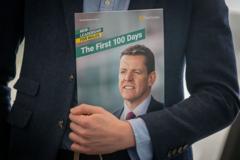
The political honeymoon is a manufactured fiction, and no group understands this better than Plaid Cymru as they mark their first one hundred days steering the Welsh Government. When the cabinet first convened under this new banner, the rhetoric was thick with promises of transformation, structural overhaul, and a decisive break from decades of institutional stagnation. Yet, looking closely at the machinery of governance after three months in office, a familiar pattern emerges. Momentum has routinely been traded for procedural theater. Critics from across the political spectrum point to an administration heavy on task forces, audits, and committee announcements, but light on tangible metrics that alter daily life for ordinary citizens.
Governance is rarely decided by the grand manifestos published ahead of an election. It is ground down by the unglamorous realities of public sector delivery, budgetary constraints, and the immense inertia of civil service bureaucracy. Plaid Cymru took power with a mandate for systemic change, promising everything from rapid healthcare stabilization to an expanded childcare rollout. Two specific hurdles immediately tested their administrative discipline: the persistent structural deficits inside the National Health Service and the fraught fiscal relationship with Westminster.
The Anatomy of Political Delay
Ask any veteran observer of parliamentary politics about the first hundred days of a new administration, and they will tell you it is traditionally used to push through unpalatable choices while political capital is highest. Cabinets usually spend this window enacting hard policies before the gravity of public dissatisfaction catches up. Plaid Cymru chose a different path, opting heavily for structural preparation over immediate disruption.
The creation of a digitally enabled Welsh Cabinet Office and the appointment of specialized data teams were heralded as modernizing steps. From an operational perspective, setting up better internal architecture makes theoretical sense. However, to a populace dealing with the immediate pinch of the cost-of-living squeeze and strained public services, internal administrative plumbing feels cold and distant.
Opposition parties have seized on this gap between strategy and execution. Accusations that ministers are substituting genuine delivery with endless rounds of reviews are difficult for the government to brush aside. For instance, while proponents celebrate the initiation of a comprehensive skills audit and early-stage frameworks for a ten-year cancer strategy, waiting lists for clinical care refuse to shrink at a matching pace.
Where Rhetoric Collides With Reality
There are distinct areas where concrete progress has been logged, complicating any blanket narrative of failure. The expansion of free school meals and the early rollout phases of structured childcare provisions demonstrate that administrative machinery can move quickly when political priority aligns with existing institutional pathways. Every local authority is reportedly tracking toward delivering twelve and a half hours of free childcare for eligible two-year-olds.
These milestones are genuine victories for families who feel the financial relief immediately. Yet, they sit uneasily alongside parallel initiatives that critics label as ideological distractions. The establishment of a standing National Commission on the Constitution and ongoing debates surrounding regional autonomy draw considerable administrative energy.
When a government spends its early political capital on constitutional machinery rather than localized economic stimulus, it reveals its underlying priorities. For a party long defined by its nationalist identity, structural assertion against Westminster remains a core article of faith. Whether that serves a nurse working extra shifts in Cardiff or a small business owner struggling with commercial rates in rural Gwynedd is an entirely different question.
The Trap of Institutional Inertia
Political newcomers routinely underestimate how quickly they are absorbed by the very state apparatus they vowed to reform. The civil service does not transform simply because a new set of ministers occupies the corner offices. It adapts, absorbs, and often redirects ambitious political agendas into safer, slower bureaucratic channels.
Plaid Cymru ministers arrived with high-energy proposals designed to signal a clean break from the previous administration's twenty-seven-year tenure. But structural inertia is a powerful preservative. Committees multiply. Consultation periods stretch out to avoid legal challenges or union pushback. Before long, the bold manifesto pledge has been diluted into a consultative green paper.
This dynamic is not unique to this specific administration, but it highlights the perennial tension between political activism and executive management. Governing requires choosing what to neglect. By spreading their initial focus across constitutional redesign, extensive environmental planning documents, and social care reform, ministers risk diluting their impact where it matters most to the electorate.
Looking Past the Milestone
The arbitrary marker of one hundred days is largely a media construct, designed to force narrative summaries onto chaotic political processes. Real institutional change takes years of grueling, unheralded administrative friction.
The true test for Plaid Cymru will not be found in the completion reports of their newly minted cabinet office or the initial press releases of their specialized task forces. It will rest entirely on whether they possess the institutional ruthlessness to cut through red tape when popular policies face bureaucratic resistance. If they spend the remainder of their term managing optics and commissioning reports, history will record this administration not as an era of renewal, but as a missed opportunity disguised as meticulous planning.
The machinery of government is now fully in their hands, steering the daily realities of citizens who care far less about who holds power than how effectively that power changes their actual circumstances.