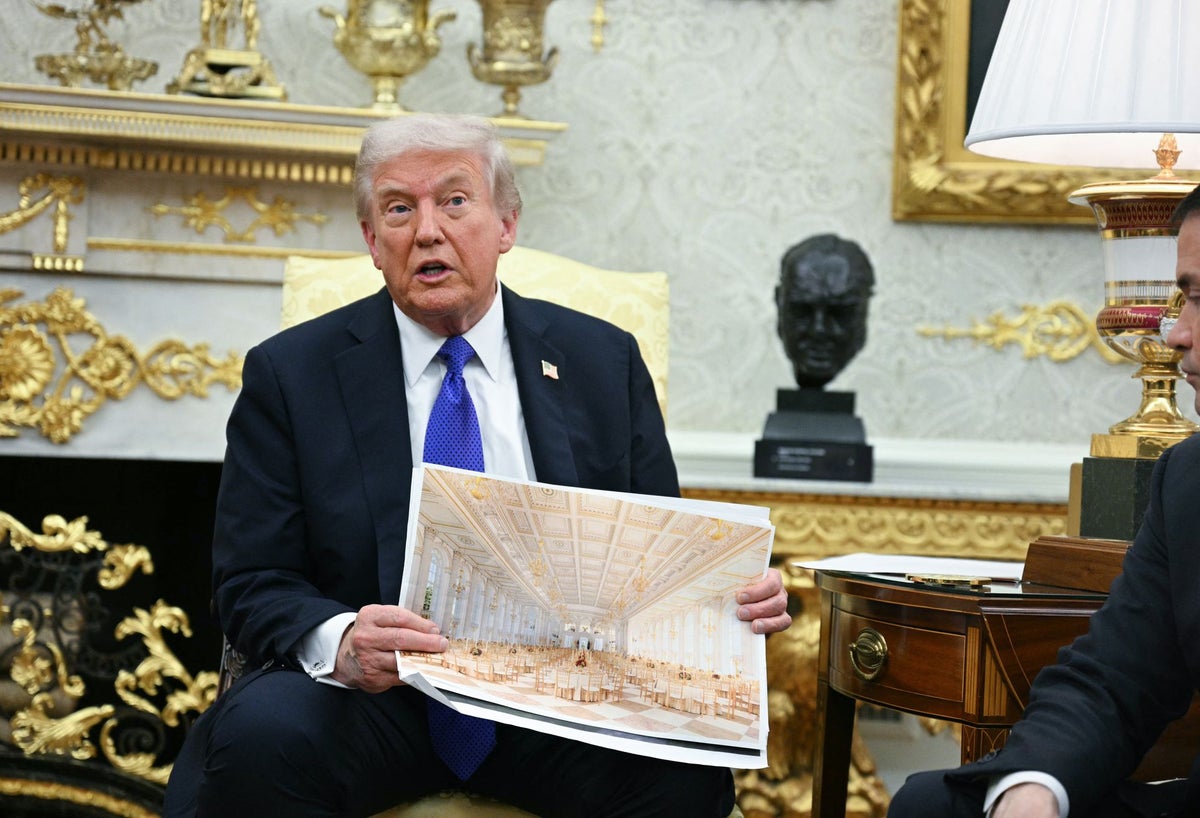
Donald Trump’s preference for gold-leafed, neo-Baroque interior design represents more than a personal eccentric choice; it is a calculated deployment of "Power Aesthetics" designed to signal stability, wealth, and historical continuity to a specific populist base while simultaneously alienating the sensibilities of the coastal managerial class. This divergence in taste functions as a visible proxy for the broader socio-economic schism in the United States. To understand why "the rest of America" often recoils from this style, one must analyze the competing value systems of Minimalist Professionalism versus Populist Maximalism.
The Taxonomy of Presidential Space
The physical environment of a political leader serves as a non-verbal communication channel. Most modern American political figures adhere to "Democratic Modesty," a design philosophy rooted in Shaker-influenced simplicity, clean lines, and mid-century modernism. This aesthetic signals transparency, efficiency, and a focus on the future.
In contrast, the Trump aesthetic—characterized by heavy gilding, marble, and 18th-century French ornamentation—utilizes a "High-Status Legacy" framework. This framework relies on three specific psychological levers:
- Veblenian Signaling: The overt display of "wasteful" luxury to prove the possession of resources that exceed functional requirements.
- Historical Anchoring: Using visual cues from eras of absolute monarchy to suggest a leadership style that is unyielding and permanent.
- Visual Overload: A maximalist approach intended to overwhelm the viewer, creating a sensory barrier that emphasizes the distance between the leader and the led.
The Friction of Architectural Classism
The tension between Trump’s ballroom aesthetic and the broader American public is driven by the "Aesthetic Displacement Effect." For the educated professional class, luxury is defined by "Quiet Luxury"—high-quality materials that are intentionally understated. To this demographic, the ballroom style feels "camp" or "inauthentic" because it violates the contemporary norm of functionalism.
However, for a significant portion of the electorate, "Quiet Luxury" is indistinguishable from standard institutional design. It feels cold, corporate, and exclusionary. The ballroom, despite its ostentation, utilizes a visual language of "Success" that is universally recognizable. It is the aesthetic of the "Self-Made Winner" in the tradition of the Gilded Age, which resonates with voters who feel the modern corporate world has become sterile and deceptive.
The Cost Function of Maintenance and Perception
The logistical reality of maintaining a gilded environment creates a specific perception of labor. A minimalist office suggests a lean operation; a ballroom suggests an entourage.
- Resource Allocation: The upkeep of marble and gold requires specialized manual labor, signaling a return to a patronage-based economy.
- Thermal and Acoustic Properties: Large ballrooms are notoriously difficult to heat and have poor acoustic dampening. These "inefficiencies" are precisely what make them high-status; they are spaces built for ceremony rather than utility.
The Divergence in Spatial Utility
Modern American residential trends have moved toward "The Great Room"—a singular, multi-functional space that merges the kitchen, living, and dining areas. This reflects a cultural shift toward informalism and familial transparency. The Trump ballroom represents the antithesis of this trend. It is a "Segmented Formalist" space.
Segmented Formalism creates a hierarchy of movement. You do not "live" in a ballroom; you "appear" in it. This distinction is where the majority of the American public feels the greatest disconnect. The average American home has evolved to prioritize comfort and adaptability. The ballroom prioritizes the "Image of Power" over the "Experience of Living." This creates a semiotic gap: the public sees a cold museum, while the occupant sees a stage.
The Psychology of the Gilded Populist
There is a logical paradox in a populist leader favoring the aesthetic of the ultra-elite. This is resolved through the "Proxy Wealth Theory." Supporters do not view the ballroom as proof that the leader is "not like them." Instead, they view it as proof that "their guy" has successfully infiltrated and conquered the spaces of the elite.
The gold leaf acts as a visual weapon. It is a deliberate thumb in the eye of the "Beige and Gray" aesthetic favored by bureaucratic institutions. This creates a powerful feedback loop:
- The leader builds a ballroom.
- The media/elite class criticizes the ballroom as "tacky."
- The base views this criticism as an attack on the leader’s success and, by extension, their own aspirations.
- The ballroom becomes a symbol of defiance rather than just a room.
Structural Limitations of the Aesthetic
While effective as a branding tool, the ballroom aesthetic suffers from "Contextual Inflexibility." It is a rigid design system that does not scale or adapt well to different functions.
- Digital Translation: In a 16:9 vertical video world, high-detail Baroque environments often "shimmer" or create visual noise on mobile screens, making the subject look dated.
- Psychological Fatigue: Constant exposure to high-contrast, high-glimmer environments increases cognitive load. This can lead to shorter durations of engagement from neutral observers who find the environment taxing to process visually.
The divergence is not merely a matter of "good" or "bad" taste. It is a conflict between two distinct definitions of American identity: one that views the nation as a sleek, evolving technology company, and another that views it as a grand, historical estate that must be restored to its most ornate era.
The strategic play for any entity operating within this polarized aesthetic environment is to identify which "Visual Currency" is being traded. If the goal is to project stability and "Conquest," the maximalist ballroom serves as a durable, if polarizing, asset. If the goal is to project "Agility" and "Inclusivity," the ballroom becomes a liability that signals stagnation. The "rest of America" isn't rejecting the gold; they are rejecting the rigid, hierarchical social structure that the gold represents. Future political branding must choose between the "Open-Source Office" or the "Gilded Fortress," as there is no longer a middle ground in the American spatial imagination.