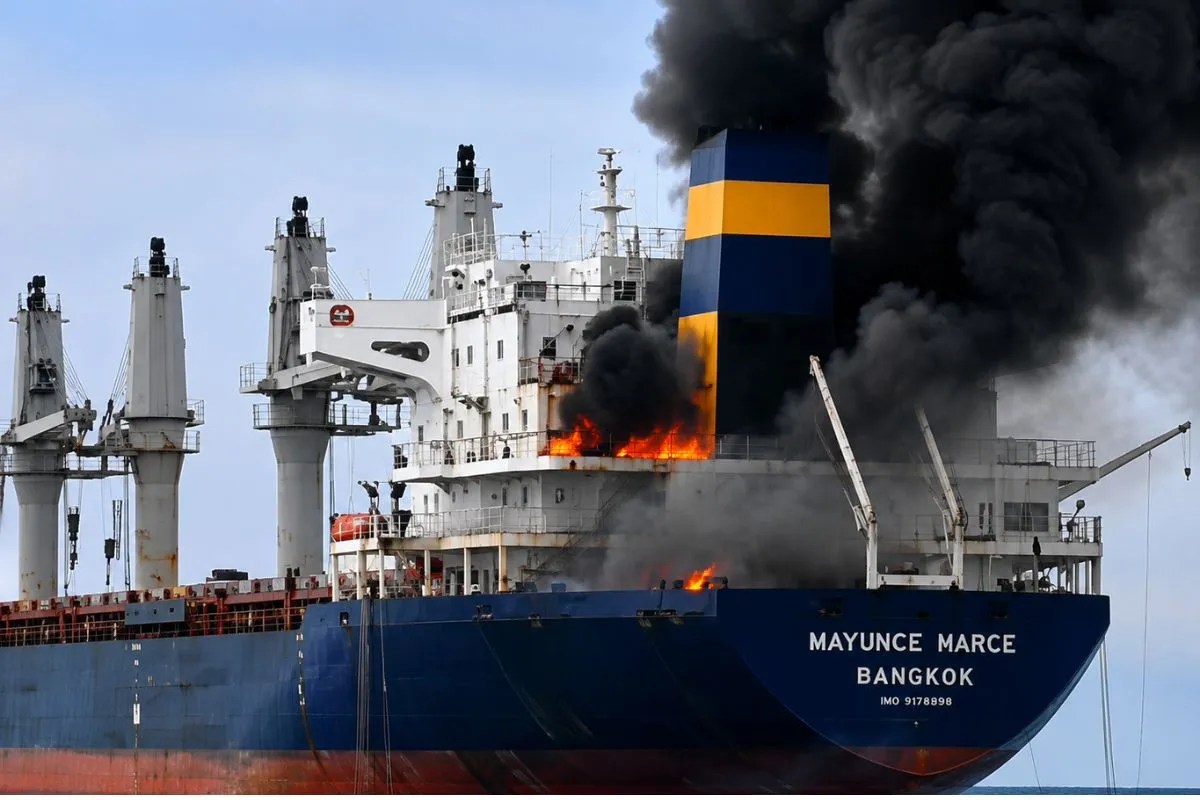
The sea does not care about foreign policy. To the young men who scrub the decks and monitor the pressure valves of the world’s massive oil tankers, the ocean is simply a workplace with a horizon. It is a place of endless gray-blue, smelling of salt, hot diesel, and stale galley tea.
For Ashwin, a twenty-four-year-old third mate from a quiet coastal town in Kerala, the voyage through the Persian Gulf was supposed to be just another line on his resume. He was saving for his sister’s wedding and a down payment on a small concrete house. But on a Tuesday afternoon, near the narrow neck of the Strait of Hormuz, the quiet routine of his watch was shattered by a sound that belongs in a war zone, not on a commercial vessel.
A flash. The deafening screech of metal tearing under high-velocity impact.
By the time the smoke cleared, a young Indian life had ended on a foreign deck, thousands of miles from home. His death was not the result of a storm or a mechanical failure. He was collateral damage in a shadow war he had no part in making.
When the news reached New Delhi, the reaction was not the usual dry statement of diplomatic concern. Something shifted. The polite mask of strategic patience slipped, revealing cold, hard anger. For years, India has walked a tightrope in the Middle East, balancing its energy needs, its massive diaspora, and its complex geopolitical friendships. But the death of an Indian citizen on the high seas crossed a line.
The summoning of the Iranian diplomat to South Block was not a mere formality. It was an ultimatum.
The Carotid Artery of Global Trade
To understand why a single death in these waters can shake the halls of power in New Delhi, one must understand the geography of the Strait of Hormuz.
It is a geographical bottleneck. At its narrowest point, the shipping lanes are only two miles wide. Through this tiny passage flows nearly a fifth of the world’s petroleum. If global trade has a carotid artery, this is it. A blockage here sends stroke-like tremors through stock markets, gas stations, and government cabinets worldwide.
Merchant ships transiting this corridor are behemoths, some longer than three football fields, carrying millions of barrels of crude oil or liquefied natural gas. They are slow. They are vulnerable. And, crucially, they are manned largely by invisible labor.
India provides a massive portion of the global seafaring workforce. Nearly ten percent of all merchant mariners worldwide are Indian nationals. They are the engine of global trade, yet they remain largely unseen until tragedy strikes. When regional powers exchange threats, drone strikes, and commando raids, it is these merchant sailors who stand on the exposed bridge.
The attack that claimed an Indian life was not an isolated incident. It was part of a escalating pattern of maritime harassment, drone deployments, and ship seizures that have turned the Gulf of Oman and the Red Sea into a shooting gallery.
For the longest time, New Delhi maintained a calculated silence. India’s relationship with Iran is deep, historical, and vital. There is the strategic port of Chabahar, India’s gateway to Central Asia that bypasses Pakistan. There are long-standing energy ties and a shared wariness of Western overreach. But a nation’s sovereignty is ultimately measured by its ability to protect its people.
When a citizen is killed while simply doing their job on a commercial vessel, strategic patience becomes indistinguishable from weakness.
Behind the Closed Doors of South Block
The summoning of a foreign ambassador or high-ranking diplomat is the theater of international relations. It is a carefully choreographed dance where every gesture, every word, and even the temperature of the room is calibrated to send a message.
On the day the Iranian diplomat was called to the Ministry of External Affairs, there were no warm handshakes for the cameras. No platitudes about civilizational ties.
The air in the room was heavy.
Consider what happens in these meetings. The Indian officials did not offer the standard diplomatic tea. Instead, they presented a dossier. They demanded not just an explanation, but immediate, actionable accountability. The message was clear: India’s strategic partnership with Iran is not a blank check.
For decades, India’s foreign policy was characterized by a cautious, non-aligned reluctance to take hard stances in Middle Eastern conflicts. But the India of today is different. It is a rising economic giant with a global footprint and a diaspora that expects its government to stand up for them.
The shift is palpable. Delhi is no longer content to merely express "deep concern" from the sidelines.
The demand for answers was sharp. Who authorized the attack? What measures will be taken to ensure Indian crew members are not targeted or caught in the crossfire again? How will the families be compensated?
This was not just anger; it was a calculated demonstration of India’s growing willingness to use its geopolitical weight. India is one of the largest buyers of Middle Eastern energy and a crucial partner for Iran as it seeks to break its international isolation. Delhi knows its leverage. And for the first time in a long while, it chose to pull the lever.
The Invisible Stakes of the Seafarer
We live in a world of instant gratification. We click a button, and a package arrives at our door. We turn a key, and our cars hum to life. We rarely think about the human chain that makes this possible.
The maritime industry is plagued by a "out of sight, out of mind" reality. Seafarers spend months at a time isolated from their families, facing grueling shift work, extreme weather, and now, the very real threat of modern piracy and state-sponsored warfare.
When a drone hits a ship, the headlines focus on the disruption to oil prices. The tickers at the bottom of the television screen worry about the cost per barrel. The cargo is insured. The hull is insured.
The sailor is not so easily replaced.
For the family of the deceased Indian mariner, the geopolitical calculations of Delhi and Tehran are meaningless abstractions. They are left with a quiet house, an unfinished dream, and a knock on the door that every seafaring family dreads.
The anger that erupted in India following the attack was fueled by this stark human reality. It highlighted a systemic vulnerability: Indian nationals are disproportionately bearing the risk of global maritime tension. Whether in the Red Sea dealing with Houthi rebels or in the Strait of Hormuz dealing with Iranian forces, Indian crew members are on the front lines of conflicts they did not start.
This reality has forced a reassessment in New Delhi. The protection of sea lanes is no longer just an economic necessity; it is a domestic political imperative.
A New Era of Maritime Assertion
The diplomatic confrontation over the Hormuz incident marks a turning point.
For years, Western naval coalitions have patrolled these troubled waters, often asking India to join their structured alliances. India has consistently demurred, preferring to operate independently, wary of being seen as a junior partner in Western-led military campaigns.
But independence does not mean inaction.
In response to the growing threats, the Indian Navy has quietly but dramatically increased its footprint in the Arabian Sea and the Gulf of Aden. Indian warships are now actively escorting merchant vessels, conducting anti-piracy operations, and launching daring rescue missions to save crews of various nationalities from hijacked ships.
This is the actions of a confident power.
By demanding a direct, unambiguous response from Iran, India is signaling that it will protect its own, using both the velvet glove of diplomacy and, if necessary, the iron fist of naval power. The message is directed not just at Tehran, but to any regional actor who views merchant shipping as an easy target for asymmetric warfare.
The tragedy in the Strait of Hormuz has forced India to define its red lines. It has shown that while trade routes are negotiable and strategic partnerships are flexible, the lives of Indian citizens are not.
The ocean remains wide, dark, and indifferent. But as Indian warships patrol the shipping lanes and Indian diplomats hold foreign powers to account, the sailors on those lonely decks might finally feel a little less invisible.
The next time a merchant vessel steers into the narrow, shadow-filled waters of Hormuz, the crew will still watch the radar with tense eyes. But they will also know that behind them stands a nation no longer willing to look the other way.

