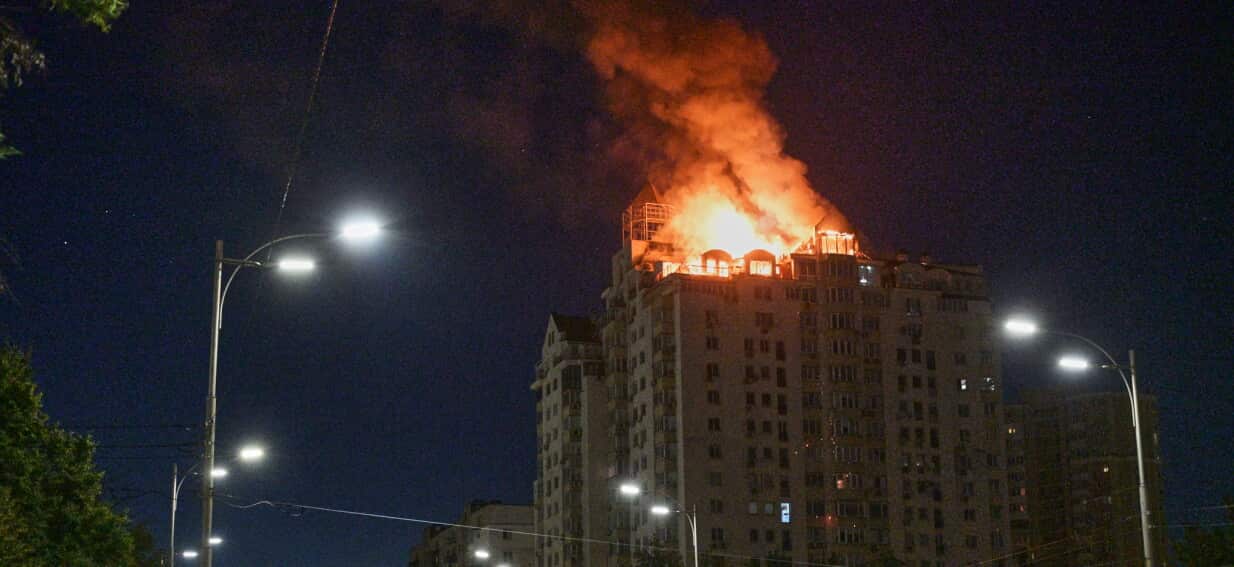
The air inside a military hangar during a desert deployment never truly cools down. It carries a specific, heavy aroma: a mixture of vaporized aviation fuel, scorched rubber, and the metallic tang of heated aluminum. For the ground crews of the Italian Aeronautica Militare stationed in the periphery of the Middle Eastern theater, that smell was the backdrop to an illusion. They were there to observe, to secure, and to maintain a posture of careful neutrality.
Then the shrapnel tore through the roof. For a deeper dive into this area, we suggest: this related article.
War has a way of dissolving diplomatic nuance. For months, Rome had walked a razor-thin tightrope as tensions between regional coalitions and Iran erupted into open conflict. Italy was not a primary combatant. It did not seek the spotlight of frontline engagement. Yet, when the smoke cleared from a series of devastating long-range strikes, the ledger of loss told a different story. Severely damaged Eurofighter Typhoons. An MQ-9A Reaper drone reduced to a blackened skeleton of carbon fiber and melted wiring.
It was a stark wake-up call for a nation that believed geography and careful rhetoric could shield its assets from the chaos of modern, saturated warfare. The incident shattered a quiet assumption held by many European capitals: that you can sit on the edge of a conflagration without getting burned. For further context on this development, detailed coverage can also be found on Associated Press.
The Illusion of the Safe Distance
Consider the mechanics of modern air defense. When a military deploys forward-operating bases, it builds a perimeter based on intent. You protect your assets from the enemies you expect to fight. But what happens when the sky fills with low-cost loitering munitions, ballistic missiles, and swarms of kamikaze drones designed to overwhelm even the most sophisticated defensive networks?
The base housing the Italian contingent was supposed to be a rear-echelon sanctuary. It was a hub for high-tech reconnaissance and defensive air patrols. The Eurofighter Typhoon, a twin-engine masterpiece of European engineering, is designed for high-altitude dominance, sweeping the skies of adversarial jets. The Reaper, an unmanned sentinel, is built to linger silently for hours, feeding pristine data streams back to commanders miles away.
Neither was built to fight for its life while parked inside a tent.
Imagine a crew chief working the night shift. Let's call him Marco, a composite of the veteran technicians who know every bolt and hydraulic line of the Typhoon. Marco isn't thinking about grand strategy or Rome’s voting record at the United Nations. He is listening to the rhythmic hum of a cooling fan, checking a diagnostic panel, thinking about his family in Brindisi.
Suddenly, the sirens scream. It isn’t the clean, orderly alarm of a training exercise. It is the frantic, uneven wail that means incoming fire is seconds away.
The strike did not come from an opposing squadron of fighter jets. It came in a dense, chaotic wave of low-altitude drones and missiles launched from hundreds of miles away, bypassing traditional radar pickets by hugging the terrain. The base’s defensive batteries engaged, lighting up the midnight sky with interceptors. Rockets met drones in blinding flashes of orange light.
But numbers win. If you launch enough metal into the sky, some of it will find the ground.
A fragment of an intercepted missile, traveling at supersonic speed, doesn't care about international law. It sliced through the hangar walls like wet paper. The impact didn't cause a catastrophic explosion, but it didn't need to. A single piece of jagged steel, no larger than a deck of cards, can pierce a Typhoon’s composite skin, sever a vital wiring loom, and render a multi-million-dollar fighter a useless heap of parts.
When the Sentinels Fall
While the Typhoons suffered the death of a thousand cuts in their shelters, the MQ-9A Reaper met a far more absolute end.
Unmanned aerial vehicles are often discussed as if they are disposable toys. They are not. The Reaper is a sophisticated intelligence-gathering platform, a complex web of optics, synthetic aperture radar, and secure satellite communications. It is the eyes of the fleet.
When the base came under attack, the Reaper was either caught on the taxiway or trapped in a hangar that took a direct hit. The result was total. A machine that had spent thousands of hours mapping the movements of extremist groups and monitoring shipping lanes was reduced to ash in a matter of minutes.
This loss hits deeper than the financial cost. When a drone is destroyed, a massive blind spot opens in the theater of operations. Commanders who relied on real-time feeds to track threats suddenly find themselves looking at blank screens. The invisible threads that connect intelligence to action are severed.
The destruction of the Reaper and the crippling of the Typhoons exposed the fundamental flaw in the concept of "neutral" deployment in modern conflict zones. In the past, a neutral flag or a non-combat mandate provided a layer of political armor. Armies respected boundaries because the geopolitical cost of dragging a neutral power into the fray was too high.
The doctrine of saturation strikes changed those rules forever. When an adversary launches massed drone salvos, they are targeting coordinates, not flags. The weapons are autonomous, or semi-autonomous, guided by GPS coordinates and pre-programmed algorithms. They do not pause to check if a hangar houses a nation actively dropping bombs or a nation merely watching the radar.
The Invisible Stakes of Technical Dependence
To understand why this matters so deeply to Italy, one must look at the fragile nature of modern military logistics.
If a truck breaks down, you buy a new part from a local dealer or swap a component from a donor vehicle. If a Eurofighter Typhoon takes shrapnel damage to its radar nose cone or its flight-control surfaces, the repair process is an international logistical saga. The parts are manufactured across a consortium of nations—the United Kingdom, Germany, Italy, and Spain. The supply chains are long, highly specialized, and easily disrupted.
Every damaged aircraft means a crew of highly trained engineers pulled away from operational duties to perform meticulous, agonizing forensic repairs. They must scan the entire airframe for microscopic stress fractures caused by the shockwave of nearby explosions. A fighter jet that looks fine to the naked eye can be structurally compromised, unsafe to fly at supersonic speeds.
This puts Rome in an agonizing position. Every day those aircraft sit grounded is a day Italy’s strategic leverage diminishes. It reveals a vulnerability that adversaries are quick to note: European forces, despite their technological sophistication, are highly susceptible to infrastructure degradation. You do not need to shoot down a Typhoon in an dogfight if you can disable it with a cheap drone while it sits on the tarmac.
A Cruel Geography
The reality of the situation is that neutrality is a luxury of distance, and the modern world has shrunk. The Middle Eastern theater is not a distant, isolated arena for Italy; it is the wider neighborhood. The security of the Mediterranean is directly linked to the stability of the Levant and the Persian Gulf.
When the Italian government deployed these assets, the intent was to contribute to regional stability, to show presence without showing teeth. It was a strategy designed for an era of asymmetric warfare against non-state actors who lacked the ability to strike back at conventional military bases.
The conflict with Iran changed the calculus completely. Suddenly, Italian forces found themselves operating within the strike envelope of a state actor with sophisticated production lines for ballistic missiles and long-range drones.
The damage to the Typhoons and the destruction of the Reaper demonstrated that in a peer or near-peer conflict, there is no such thing as a safe zone. The rear guard is the front line. The mechanic is as much a target as the pilot.
This realization ripples through the ranks. It changes the way a soldier walks across the tarmac. It changes the urgency with which sandbags are piled around maintenance bays. The casual confidence of a Western military operating with assumed technological superiority evaporates when the sky rains shrapnel.
The Lesson of the Smoldering Tarmac
The debris has long since been cleared from the hangars, and the long, quiet work of rebuilding and repairing continues behind closed doors. Politicians will continue to debate the exact nature of Italy’s involvement, tailoring their speeches to balance international alliances with domestic anxieties.
But the scarred concrete of the airfield remains an indelible marker of a new reality.
We have entered an era where technological sophistication is no longer a guarantee of safety. The most advanced fighter jet in the world is entirely dependent on the vulnerability of the ground beneath its wheels. When the next crisis erupts, the true measure of a military’s strength will not be found in the speed of its jets or the clarity of its drone feeds, but in its ability to survive the first, unheralded rain of steel.
The illusion of the safe bystander died in that hangar. What remains is the understanding that when the world catches fire, everyone pays the price of admission.