The water off the British coast is rarely blue. Most days, it wears the color of wet slate, heavy with silt and cold enough to bite through a drysuit in minutes. Down there, forty feet below the surface of Studland Bay, the world loses its edges. You move through a pale green twilight where the kelp sways like hair in a current, and every shadow looks like something else.
I remember the first time I saw one.
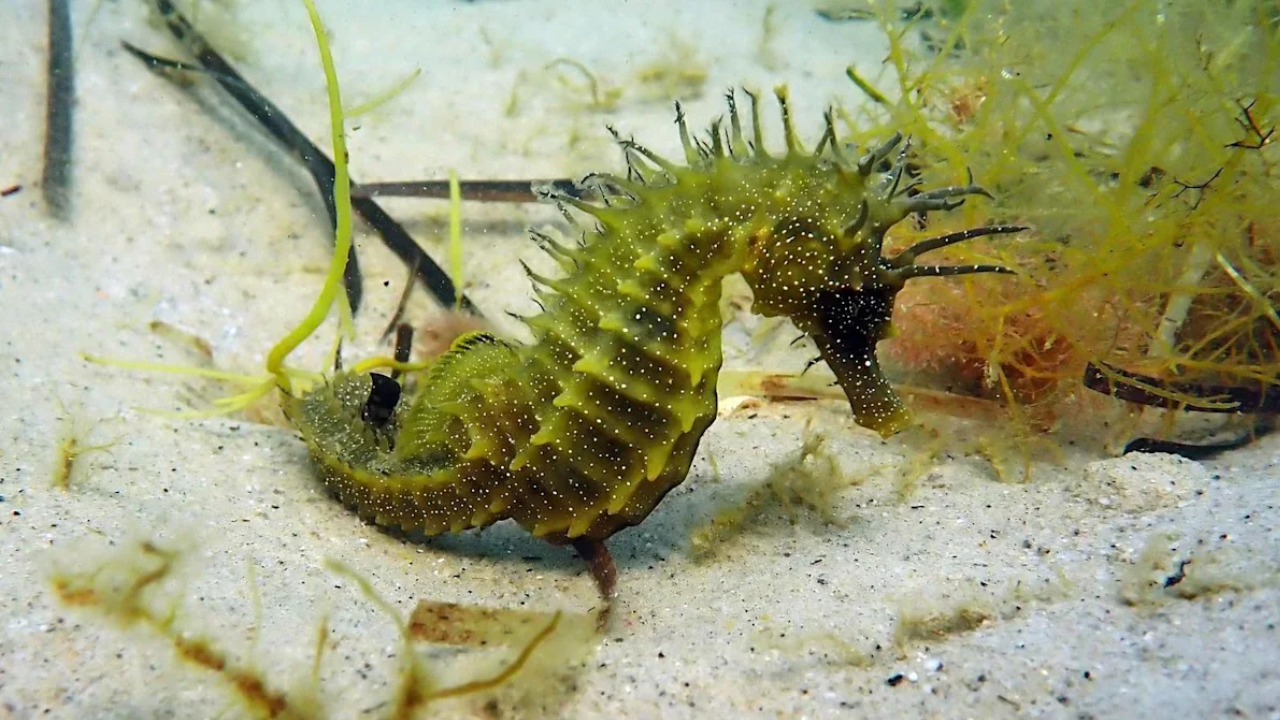
My air was hissing softly in my ears, a steady, mechanical metronome. I was hovering over a patch of eelgrass, cold and distracted, when the blades parted. It was smaller than my thumb. An upright sliver of armor, holding itself completely still in a wash that kept knocking me sideways. It had the snout of a horse, the eye of a chameleon, and a tail curled tight like a watch spring.
It looked entirely out of place, like a piece of intricate Victorian jewelry dropped into a muddy ditch.
That is the paradox of the seahorse. They are fish, yet they swim like wind-up toys, vertically, fins vibrating so fast they blur into static. They are monarchs of camouflage, vanishing against a background of brown blades and green fronds. And they are fragile in a way that defies logic.
British waters host two resident species of these delicate creatures: the short-snouted seahorse and the spiny seahorse. They are protected by law under the Wildlife and Countryside Act. You are not allowed to catch them, handle them, chase them, or disturb them.
Yet, recently, UK officials felt the urgent need to issue a sharp legal warning. Divers had been getting too close.
Cameras had been shoved into seagrass beds. Flash bulbs had popped in the faces of animals that possess no eyelids to shield them. Hands had reached out to steady a floating subject for a better angle, a closer macro shot, a fleeting moment of social media validation.
To a diver, touching a seahorse might feel harmless. It is a brush of neoprene against skin, an innocent pause in a vast ocean.
To the seahorse, it is an earthquake.
Consider what happens inside the body of a stressed fish when a giant rubber-clad shadow descends upon it. Their primary defense against the world is invisibility. When that fails, they swim—briefly, expensively. A seahorse does not have the stamina of a mackerel or the raw speed of a bass. Their fins are tiny. Every burst of propulsion burns through precious metabolic reserves.
When you chase a seahorse across the seabed, forcing it to flee your floating bulk, you are running it to exhaustion. In the icy waters of the UK, an exhausted animal does not recover quickly. It drops. It drifts. It becomes easy prey for crabs and wrasse.
Worse still is the handling.
Seahorses have no scales. Instead, they wear a suit of bony plates fused together beneath a thin, sensitive layer of skin. Press your thumb against that armor, and you can easily crush the delicate structures underneath. Pull a seahorse away from its anchor blade of grass to pose it on an open patch of sand for a photograph, and you strip it of its tether. In a heavy swell, a displaced seahorse cannot fight the surge. It gets tossed against rocks. It gets battered.
And then there is the breeding season.
During the summer months, these waters become a theater for one of the strangest courtships in the animal kingdom. They dance. For days, a pair will meet every morning, changing colors, twirling in slow motion, tails linked. The female transfers her eggs into a specialized pouch on the male’s abdomen, where he fertilizes them and carries them until they hatch.
It is an exhausting, delicate biological dance.
If you interrupt that choreography with a heavy camera housing or a hovering fin kick, the dance stops. The pair separates. A reproductive cycle is lost, and with it, the next generation of an already precarious population.
This is why the authorities stepped in. Not to ruin anyone's weekend hobby, but because the line between appreciation and destruction has become dangerously thin.
Underwater photography has exploded in popularity. Better cameras, cheaper housings, and widespread social media platforms have turned every recreational diver into a potential content creator. We are living through an era where experiences must be documented, shared, proven.
If you didn't post the picture, did you even see it?
That frantic need for proof has altered how we interact with the wild. It changes us from silent observers into active participants, often to the detriment of the life we claim to admire. We swim through the ocean like tourists in a museum, reaching out to touch the exhibits, forgetting that the glass wall was never there.
When the UK government issues a legal warning about disturbed seahorses, it is not just a bureaucratic reminder of fines and penalties. It is a plea for restraint.
It asks us to sit back. To watch without touching. To accept that some encounters are meant to remain private, witnessed only by the bubbles rising toward the surface and the cold current sliding past your ears.
The ocean does not care about your grid layout. It does not care about your follower count.
Down in the gloom of Studland Bay, the eelgrass continues to wave. The water remains cold, salty, and indifferent.
If you are lucky enough to drop down into that green twilight and find a seahorse tethered to its blade of grass, remember what it is. Not a prop. Not a collectible. Not a character in your personal story.
Just a ghost, holding on for dear life against a world that wants too much of it.
Leave it be. Watch it drift, and let it keep its secrets.