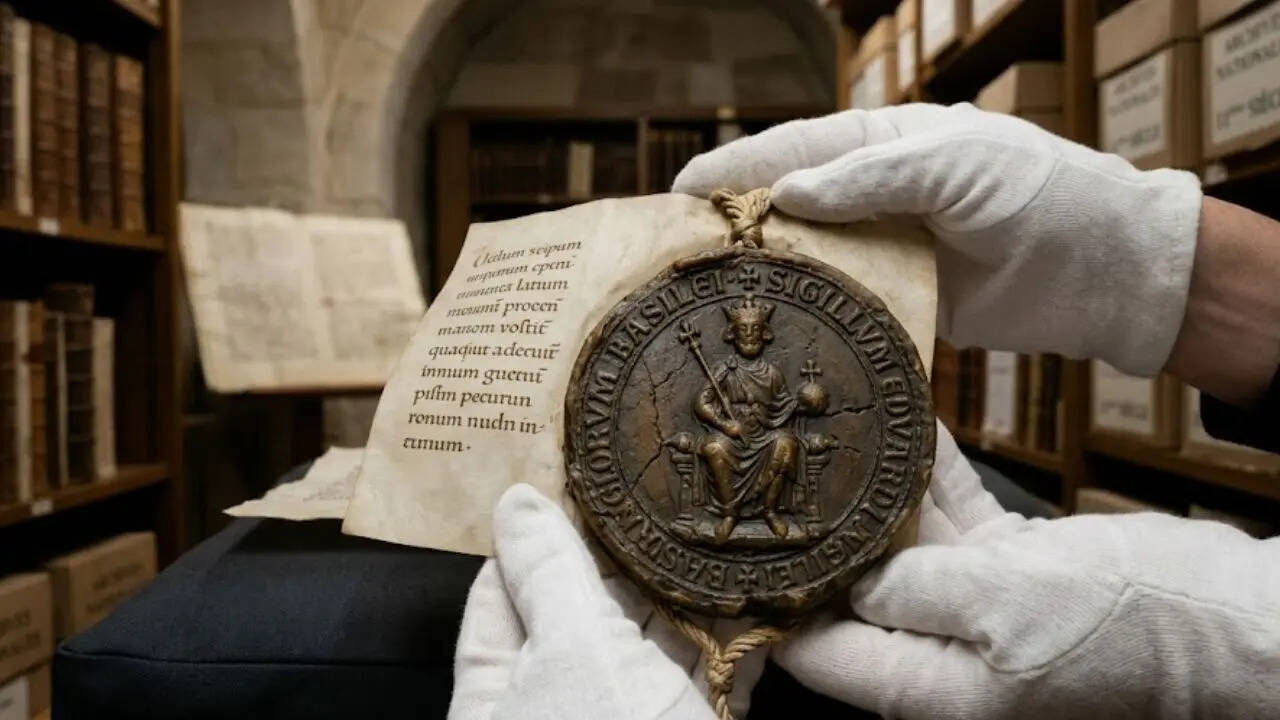
The discovery of a 1,000-year-old royal seal belonging to Edward the Confessor in a Paris auction house represents more than a localized archaeological success; it exposes a systemic failure in the archival tracking and international trade of high-value cultural assets. Found after disappearing from public and scholarly record for four decades, the wax seal—originally attached to a mid-11th-century royal writ—functions as a primary data point for the administrative expansion of the Anglo-Saxon state. Understanding the significance of this artifact requires moving beyond the "treasure hunt" narrative to examine the mechanics of medieval legal authentication, the physics of wax preservation, and the structural vulnerabilities in global provenance documentation.
The Triad of Medieval Authentication
To analyze why this specific seal holds disproportionate value compared to other 11th-century artifacts, one must evaluate the three functional pillars of the royal seal system: Legal Validity, Visual Propaganda, and Administrative Scalability.
- Legal Validity: In the pre-literate or semi-literate bureaucracy of Edward the Confessor’s reign (1042–1066), the seal served as the physical manifestation of the King’s will. The document it was attached to—a "writ"—was a short administrative instruction. The seal was the cryptographic key of its era; without it, the text carried no authority. Its presence transformed a piece of parchment into a binding legal instrument.
- Visual Propaganda: The seal design features a double-sided "Maestà" image, depicting the King enthroned with a sword and a scepter. This was a deliberate pivot from previous Carolingian-style imprints. It established a visual language of sovereignty that the Normans, following the 1066 conquest, would adopt and iterate upon for centuries.
- Administrative Scalability: The use of a hanging seal (appended to a strip of parchment) allowed for the mass production of royal commands. It was the first "standardized" interface of English government, enabling the King to project power across distance without being physically present.
Physical Materiality and Degradation Variables
The survival of a wax seal for a millennium is a statistical anomaly dictated by specific environmental constraints. Beeswax, the primary medium for these seals, is a lipid-based material subject to three primary failure modes: Thermoplastic Deformation, Oxidative Embrittlement, and Mechanical Stress.
The Paris discovery remained intact likely due to a stable micro-climate within its storage container. Beeswax has a melting point between 62°C and 64°C, but it begins to soften significantly at 30°C. In uncontrolled environments, the fine detail of the King’s face or the lettering of the legend—"Sigillum Eaduardi Anglorum Basilei"—would have blurred into an unrecognizable mass. The preservation of the legend on this specific seal indicates it was protected from humidity fluctuations, which cause the parchment fibers attached to the wax to expand and contract, eventually shearing the seal from its source document.
This "decoupling" from the original writ is the primary reason the seal was "lost." When a seal is separated from its parchment, it loses its context and becomes an unindexed object. For forty years, the seal existed as a "floating" artifact, stripped of its metadata, which allowed it to pass through markets without triggering the alarms associated with the specific 1040s land grants or judicial orders it once validated.
The Provenance Bottleneck and Market Opacity
The path from an English archive to a French auction house highlights a critical flaw in the "Chain of Custody" for cultural property. The artifact was part of a collection belonging to a 19th-century antiquarian, which later vanished from public view in the 1980s. The disappearance was not necessarily a theft, but rather a "documentation lapse" common in private estates.
Three structural factors allowed this artifact to remain hidden:
- The Indexing Deficit: Most medieval charters are indexed by their text, not their physical attachments. If a seal falls off, there is rarely a digital or physical "ID tag" linking it back to the specific shelf-mark of the document.
- Cross-Border Jurisdictional Friction: Heritage laws differ significantly between the UK and France. While the UK’s Treasure Act (1996) and the Portable Antiquities Scheme provide a framework for reporting finds, they have limited reach into private French collections formed decades ago.
- The Valuation Paradox: Small, non-metallic objects are often overlooked by high-level enforcement agencies focusing on gold or large-scale statuary. However, the information density of a royal seal is far higher than a gold coin of the same weight.
Technical Analysis of the Double Sided Maestà
The Edward the Confessor seal is the first known English seal to be consistently "pendant" and "double-sided." This shift is significant because it increased the surface area available for iconography by 100%. One side displays the King as a warrior (holding a sword), while the other displays him as a lawgiver (holding a scepter).
This duality reflects the mid-11th-century political tension between the Germanic warrior-king tradition and the emerging Romanesque ideal of the Christian magistrate. The Paris seal's sharpness allows researchers to analyze the specific engraver’s "hand," which may link this seal to the same workshop that produced the coinage dies of the period. This connection would prove that the Royal Mint and the Royal Chancery were not separate silos but integrated components of a centralized "Information Office."
Strategic Implications for Cultural Asset Management
The reappearance of the seal necessitates a shift in how museums and private collectors manage "detached" artifacts. The current model relies on reactive discovery—waiting for an item to appear at auction. A proactive model would require:
- Digital Fingerprinting: Utilizing high-resolution 3D photogrammetry to create a "topographic map" of known seals. Since no two wax imprints are identical (due to pressure variations during the sealing process), a digital twin can identify a detached seal by matching it to the "indentation footprint" left on the original parchment's tail.
- Isotopic Profiling: Analyzing the chemical composition of the beeswax and the pigments (often vermilion or resin) to determine the geographical origin of the materials. This would allow scholars to verify if the Paris seal was produced by the central itinerant chancery or a regional satellite.
- Smart Provenance Registries: Integrating blockchain-based ledgers for private collections would prevent the "40-year blackout" experienced by the Edward the Confessor seal. By tying the physical object to a non-fungible digital record, the history of ownership becomes immutable, regardless of whether the object stays in a private drawer or a public gallery.
The recovery of this seal does not merely add a gold-plated relic to a display case; it provides the missing link in the evolution of English executive power. It confirms that even as his kingdom faced the looming threat of the Norman invasion, Edward’s administration was refining the technologies of bureaucracy that would outlast the Anglo-Saxon era itself. The strategic move now is to use the Paris seal as a catalyst for a global audit of "orphaned" seals—artifacts that have been separated from their parent documents and currently sit unclassified in the world’s secondary art markets. Failure to do so ensures that significant portions of the medieval administrative record remain "lost" in plain sight.



