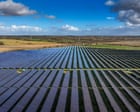
The United Kingdom’s power grid is currently undergoing a structural phase shift defined by two concurrent phenomena: the shattering of generation records and the formal move toward mega-scale infrastructure. While casual reporting focuses on the novelty of sunny weather, the real story lies in the convergence of installed capacity thresholds and the regulatory approval of the Botley West Solar Farm. This project, set to occupy roughly 1,300 hectares in Oxfordshire, represents a transition from supplementary renewable integration to baseload-displacing utility scale. The core of this transition is not merely "green energy" but the optimization of the UK's marginal cost of electricity and the mitigation of carbon-intensity volatility.
The Mechanics of Record Breaking Generation
The recent peak solar generation figures—reaching 11.3 GW—are the mathematical result of a 15% year-on-year increase in total installed capacity. These records are predictable milestones rather than anomalies. To understand why these records are falling now, one must analyze the solar output function, which is governed by three primary variables:
- Installed Photovoltaic (PV) Density: The sheer volume of panels connected to the Distribution Network Operators (DNOs) and the National Grid.
- Solar Irradiance Efficiency: The percentage of sunlight converted to electrons, which peaks during high-pressure weather systems that provide clear skies and, crucially, cooler temperatures.
- Grid Absorption Capacity: The ability of the National Grid ESO to balance intermittent solar spikes against sluggish thermal plants.
The reason records are falling in May and June rather than August is due to the inverse relationship between PV cell temperature and efficiency. As ambient temperatures rise above 25°C, the voltage output of a silicon cell drops. Therefore, high-irradiance days with moderate temperatures produce higher peak outputs than the peak of summer. The UK is currently hitting a "sweet spot" where capacity is high enough to compensate for its northern latitude, and the climate provides the necessary thermal profile for maximum cell performance.
[Image of solar panel efficiency vs temperature graph]
The Botley West Calculus: Scaling Beyond Domestic Arrays
The approval of the Botley West Solar Farm marks the arrival of the Nationally Significant Infrastructure Project (NSIP) era for UK solar. Unlike traditional local developments, Botley West targets an output of approximately 840 MW. This moves the project out of the realm of local planning and into the hands of the Secretary of State for Energy Security and Net Zero.
The logic behind such massive scaling is rooted in the Levelized Cost of Energy (LCOE). Small-scale solar (rooftop or small field) suffers from high balance-of-system costs per watt. Utility-scale projects like Botley West achieve cost parity with fossil fuels through:
- Procurement Leverage: Purchasing hundreds of thousands of bifacial modules at wholesale rates.
- Infrastructure Efficiency: A single high-voltage connection point to the National Grid reduces the per-MW cost of transformers and substations.
- Automated O&M: Operations and maintenance at this scale utilize drone thermography and automated cleaning, lowering the long-term operational expenditure (OPEX).
However, the scale of Botley West introduces a significant logistical bottleneck: Spatial Competition. Unlike offshore wind, utility solar competes directly with agricultural land and biodiversity corridors. The opposition to this project is not merely aesthetic; it is a debate over land-use priority. The strategic response from developers has been the integration of "Agrivoltaics"—raising panels to allow sheep grazing or planting wildflower meadows to bolster pollinator populations—though the efficacy of these measures in high-density arrays remains a subject of ongoing empirical study.
Grid Synchronization and the Intermittency Gap
The fundamental challenge of the UK’s solar record is not generation, but synchronization. Solar power is non-dispatchable; it produces when the sun shines, not necessarily when the kettle boils. When solar generation hits 11 GW at midday, the National Grid faces a "Minimum Demand" crisis. If solar supply exceeds total demand plus the minimum operating levels of nuclear and gas plants (which cannot be turned off instantly), the grid frequency spikes, risking blackouts.
To manage this, the UK is deploying a three-tier mitigation strategy:
1. Battery Energy Storage Systems (BESS)
BESS facilities are the essential "shock absorbers" for solar records. Large-scale lithium-ion arrays are being co-located with solar farms to soak up excess midday generation and discharge it during the evening peak. Without a corresponding increase in BESS capacity, solar records are effectively wasted energy that must be "curtailed" (paid to turn off).
2. Demand Side Response (DSR)
The grid is shifting from supply-follows-demand to demand-follows-supply. Smart meters and time-of-use tariffs (like those offered by Octopus Energy) incentivize consumers to run high-load appliances during peak solar hours. This creates a "synthetic battery" by shifting the load to match the solar peak.
3. Interconnection
The UK’s subsea cables to Norway, France, and Belgium allow for the export of excess solar energy to the continent. Conversely, these cables provide a safety net when cloud cover causes solar output to plummet.
The Economic Impact of High Solar Penetration
The surge in solar capacity is fundamentally altering the UK’s Merit Order. In electricity markets, the cheapest sources of power are used first. Solar, with a near-zero marginal cost (the sun is free), sits at the very bottom of the merit order.
When solar records are broken, gas-fired power stations—which have high marginal costs due to fuel prices—are pushed off the grid. This has two immediate economic effects:
- Wholesale Price Deflation: During peak solar hours, wholesale electricity prices can drop to zero or even turn negative.
- Carbon Intensity Reduction: The grams of $CO_2$ emitted per kilowatt-hour of electricity generated (gCO2/kWh) falls sharply. During recent records, the UK grid has seen intensities below 40gCO2/kWh, compared to an average of over 200gCO2/kWh a decade ago.
The limitation of this model is the "Cannibalization Effect." As more solar enters the market, the price of electricity during sunny hours drops further, reducing the revenue for solar farm operators. This creates a paradox where the more successful solar becomes, the less profitable individual projects may be without government-backed Contracts for Difference (CfD).
Regulatory Hurdles and the "Planning Trap"
The approval of Botley West is a victory for the centralized planning model, but it highlights the systemic friction in the UK’s development pipeline. The "Planning Trap" consists of:
- Grid Connection Queues: Some solar developers are being told they cannot connect to the grid until the mid-2030s because the physical wires (the transmission system) are at capacity.
- Localism vs. National Interest: The tension between local councils protecting the Green Belt and the national mandate for energy security.
- Environmental Impact Assessments (EIA): The rigorous, multi-year process required to prove a project won't irreparably harm local ecosystems.
For the UK to maintain its current trajectory, the planning system must evolve from a "permission-based" model to a "design-led" model, where designated zones are pre-approved for renewable development.
Strategic Forecast: The Decentralized Utility Model
The future of UK energy is not a choice between small-scale rooftop solar and massive farms like Botley West; it is a hybrid of both. We are moving toward a Decentralized Utility Model.
In this framework, the grid functions as a platform for millions of micro-generators and hundreds of massive "anchor" plants. The approval of Botley West signals that the UK government is willing to prioritize energy density and economies of scale over local land-use concerns. This is a strategic necessity if the UK is to meet its goal of a decarbonized power system by 2030.
The immediate action for stakeholders—investors, grid operators, and policy makers—is to pivot focus from "total installed MW" to "usable, stored MW." The next record to watch is not peak generation, but the record for the longest duration the UK grid can run without any gas-fired backup. This will require the integration of long-duration energy storage (LDES), such as pumped hydro or liquid air, to bridge the gap between summer records and winter deficits.
The focus must now shift toward accelerating the Transmission Acceleration Action Plan. Without massive investment in the "Supergrid"—the high-voltage backbone of the country—the solar energy captured in Oxfordshire or the deserts of the north will remain stranded, unable to reach the industrial hubs where it is needed most. The approval of Botley West is the first domino; the rest must fall at the substation level.


