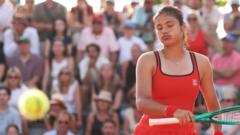
Emma Raducanu exited the French Open in the opening round because her physical preparation and tactical identity remain fundamentally misaligned with the grueling demands of slow clay. The British number one suffered a swift 6-0, 7-6 defeat to Argentina’s Solana Sierra at Roland Garros, compounding a clay-court swing that lasted a mere two matches following a post-viral illness. While casual observers look at the scoreline and question her mental resilience, the technical reality is far more clinical. Raducanu’s inability to generate cheap points on clay exposes her lack of a developmental baseline, a deficit that must be addressed immediately if she expects a grass-court resurgence at Wimbledon.
The defeat in Paris was not a failure of will. It was an exposure of geometry and physics.
The Clay Court Trap
To understand why Raducanu looked so lost during that opening 6-0 set, one must look at how her game is constructed. Raducanu is a natural hard-court player. She thrives on taking the ball early, redirection of pace, and aggressive, linear baseline striking. When she won the US Open, the fast, predictable bounce allowed her to suffocate opponents by taking time away from them.
Clay does the exact opposite. It absorbs pace, rewards heavy topspin, and demands lateral movement patterns that cannot be mastered in a single week of training.
Against Sierra, Raducanu hit zero winners in the first set. Zero.
That statistic is staggering for a former Grand Slam champion, but it highlights a deeper problem. On a slow surface, you cannot simply hit through an opponent with flat groundstrokes. If you try, the ball sits up in the hitting zone, allowing defenders to reset the point. Sierra, a natural clay-courter ranked 68th in the world, simply waited for the inevitable errors. Raducanu committed 15 unforced errors in those first 24 minutes, a direct result of trying to force aggressive outcomes on a surface that requires patience.
The Problem With Rust and Recovery
The British number one entered Paris with almost no competitive mileage on dirt. Her only warm-up match was an opening-round loss to Diane Parry in Strasbourg, a consequence of missing more than two months of the season due to a severe post-viral illness.
Stepping onto Court Patrice Dominguez with no lung capacity or match sharpness is difficult enough. Stepping onto the red dirt of Roland Garros against a specialist is a mathematical disaster. Raducanu lacked the physical engine required to sustain heavy, 12-shot rallies. When she fell behind 4-1 in the second set, it was clear that her legs were not responding to the slides and directional changes that clay demands.
Raducanu vs. Sierra: First Set Breakdown
+------------------+----------+--------+
| Metric           | Raducanu | Sierra |
+------------------+----------+--------+
| Winners          | 0        | 8      |
| Unforced Errors  | 15       | 4      |
| Service Games Won| 0        | 3      |
| Set Score        | 0        | 6      |
+------------------+----------+--------+
The Myth of the Quick Wimbledon Turnaround
The immediate consensus among tennis pundits is that this loss is a blessing in disguise, freeing Raducanu to focus entirely on the British grass-court season. This view is dangerously simplistic.
Grass is a highly specialized surface that requires low bending, exceptional footwork around the lines, and an elite serving display. While it is true that Raducanu's flat groundstrokes are far more effective on a low-bouncing lawn, the technical flaws exposed in Paris do not disappear when switching shoes.
- Serve Vulnerability: Raducanu was broken repeatedly by Sierra. Her first-serve percentage hovered in the mid-50s, and her second serve was routinely punished. On grass, a weak second serve is an invitation to be attacked immediately.
- Movement Hesitation: Recovering from post-viral fatigue means her explosive first step is missing. On grass, where the footing is inherently slick, any lack of physical confidence leads to defensive positioning.
- Tactical Panic: When a plan fails on clay, a player must grind. When a plan fails on grass, the point is over. Raducanu needs early-round victories in Nottingham or Eastbourne to re-establish her tactical rhythm before she even thinks about the second week of SW19.
The narrative that a player can simply walk away from a bruising clay defeat and magically find form on grass is a romantic fiction. It requires hard, physical conditioning that Raducanu has been unable to sustain due to her interrupted calendar.
The Structural Fix
If Raducanu wants to break the cycle of early Grand Slam exits and return to the top 20, her team must overhaul her developmental strategy. Her current coaching arrangement with Francisco Roig provides tactical depth, given his history with Rafael Nadal, but no coach can fix a broken schedule.
"It's very difficult," a tearful Raducanu admitted after her Paris exit, visibly struggling to find answers.
The answer lies in building physical durability over short-term ranking points. Raducanu played 50 matches last year, proving her body could survive a full tour schedule when healthy. The post-viral setback this season was bad luck, but the decision to rush back for Strasbourg and Paris without a physical baseline was a management error.
She must treat the upcoming grass swing not as a savior, but as a building block. Her flat backhand down the line remains an elite weapon, but it must be backed by a reliable serve that protects her from being broken four or five times a match.
The focus now shifts to the low bounces of the UK lawns. If the British number one cannot find her first serve within the next fortnight, the nightmare of Paris will simply repeat itself on the green grass of home.