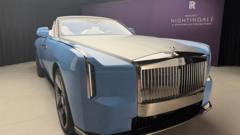
Rolls-Royce just unveiled Project Nightingale, a massive, all-electric two-seater that stretches nearly 19 feet despite having no rear seats and no combustion engine to house. While the surface-level news focuses on the return of the "drophead" convertible, the internal logic at Goodwood suggests a much more aggressive play for the brand’s survival in a post-V12 world. By limiting production to just 100 units and inviting only their most loyal spenders to the table, Rolls-Royce is effectively beta-testing the limits of electric desire before they commit to a mass-market EV SUV.
This is not a car for the average millionaire. It is a calculated move to bridge the gap between their standard offerings and the $30 million one-off "Coachbuild" commissions like the Boat Tail. By placing Nightingale in a new Coachbuild Collection tier, the brand is solving a looming problem: how do you sell "soul" when the silent, effortless power of a V12—the brand's historic North Star—is replaced by the same generic electric hum found in a Tesla?
The Architecture of Artificial Scarcity
The 100-unit cap on Project Nightingale isn't about production capacity. It is about value preservation. As high-end luxury shifts toward electrification, the traditional mechanical "heart" of the car becomes a commodity. To prevent their vehicles from being viewed as glorified appliances, Rolls-Royce is shifting the value proposition from the engine to the silhouette and the exclusivity of the "hull line."
Nightingale borrows its proportions from the experimental EX models of the 1920s, featuring a torpedo-shaped rear and a hood that seems to go on forever. This "long-nose" aesthetic was historically necessary to fit massive internal combustion engines; here, it is a pure stylistic flex. The car uses the same Architecture of Luxury platform as the Spectre, but the engineering team has stripped away the utility to focus on what they call "the serenity of open-top motoring."
Engineering the Sound of Silence
Acoustic engineering in a convertible EV is a nightmare. Without the low-frequency rumble of a gas engine to mask wind and road noise, the cockpit can become a chaotic mess of tire hum and whistling air. Rolls-Royce engineers are attempting to solve this with a multi-layered composite roof lined with cashmere.
The goal isn't total silence—which can feel unnerving in an open car—but a curated "soundscape." They want the driver to hear raindrops on the canvas and birdsong, not the high-pitched whine of an electric motor. This requires a level of insulation that adds significant weight, pushing the car's 24-inch wheels (the largest ever on a Rolls-Royce) to their structural limits.
The China Problem and Regulatory Walls
A startling detail emerged during the launch: Project Nightingale is not homologated for China. This is a rare admission of a strategic retreat from one of the world's largest luxury markets. The company cited Chinese efficiency regulations for electric vehicles, which Nightingale—likely weighing well over three tons and prioritizing aesthetics over aerodynamic hyper-efficiency—simply cannot meet.
This reveals the friction between ultra-luxury design and the cold reality of global EV mandates. While brands like Mercedes-Benz are chasing drag coefficients to squeeze every mile out of a battery, Rolls-Royce is doubling down on inefficient beauty. They are betting that their clients in the US, Europe, and the Middle East care more about the "theatre" of a 19-foot roadster than they do about kilowatt-hours per mile.
Why the Roadster is a Shield for the SUV
Behind the scenes, the Nightingale serves as a psychological palate cleanser for the brand’s next big move. Spy shots have already confirmed a massive electric SUV is in development, likely slated for a 2027 or 2028 release. That SUV will be the workhorse that keeps the lights on, but it risks diluting the brand’s "prestige" if it looks too much like a BMW iX in a tuxedo.
By launching a 1920s-inspired electric roadster first, Rolls-Royce is signaling to the market that their EV technology can be "romantic." It creates a halo effect. If the brand can convince the world that a battery-powered car can capture the "Jazz Age" spirit of Sir Henry Royce, then selling a $450,000 electric family hauler becomes a much easier lift.
The Pricing Gap
While the company hasn't slapped a public window sticker on the Nightingale, industry analysts place it in the low single-digit millions. This is a crucial "sweet spot."
- Spectre: ~$420,000 (Entry-level EV)
- Nightingale: ~$2,000,000 - $3,000,000 (The new "Collection" tier)
- Droptail/Boat Tail: $25,000,000+ (True Coachbuild)
This tiered structure allows Rolls-Royce to monetize their design talent more effectively. They are no longer just selling cars; they are selling memberships to a development cycle. The 100 owners of the Nightingale are being invited to join validation ride-alongs during hot and cold weather testing. They aren't just customers; they are investors in the brand’s transition.
The risk, of course, is that the "magic" of a Rolls-Royce has always been tied to the vibration-free, effortless surge of a V12. In the electric era, "effortless" is the baseline for every $60,000 EV. The Nightingale is an attempt to prove that luxury isn't about the motor, but about the space, the silence, and the sheer audacity of a car that uses 19 feet of road to carry only two people. If they can’t make that argument stick with a limited-run roadster, the upcoming electric SUV stands no chance in a crowded market.
Rolls-Royce is betting that for the ultra-wealthy, the sound of birdsong is worth a seven-figure premium.