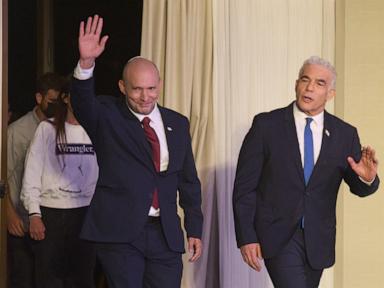
The emerging Washington-Tehran diplomatic accord fails to secure Israel's primary strategic objectives, signaling a profound shift in American foreign policy that leaves Jerusalem isolated. As President Donald Trump moves to finalize a sweeping agreement to end the direct conflict with Iran, the political foundations in Israel are fracturing. Israeli opposition leader Yair Lapid formally denounced the arrangement on Monday, calling the terms a disaster for regional stability. The fast-moving diplomacy, which trades a cessation of hostilities and sanctions relief for the reopening of the Strait of Hormuz, has exposed a widening gulf between American transactional diplomacy and Israel's existential security requirements.
The structural flaw in the current White House approach lies in its prioritization of immediate economic relief and global shipping stabilization over the permanent dismantling of hostile infrastructure. By focusing heavily on the maritime logistics of the Persian Gulf, the administration is leaving the core drivers of regional instability entirely intact.
The Illusion of Containment
The framework currently under discussion requires Iran to reopen the strategic Strait of Hormuz within 30 days and halt its enrichment of uranium above civilian levels. In return, the United States will lift its maritime blockade on Iranian ports and suspend a significant portion of the economic sanctions that have crippled Tehran's financial system.
The agreement establishes a 60-day window to negotiate the permanent disposition of Iran's highly enriched uranium stockpile.
This sequencing is dangerously backward. By conceding economic leverage upfront to secure the reopening of shipping lanes, the White House is relinquishing the precise pressure mechanisms required to force long-term Iranian compliance on ballistic missiles and regional proxy networks.
Historical precedent demonstrates that partial sanctions relief provides authoritarian regimes with an immediate financial lifeline. Tehran routinely uses such windfalls to stabilize its domestic economy while maintaining its asymmetric military capabilities. The 60-day negotiation period functions less as a diplomatic tool and more as a diplomatic pause, allowing Iran to consolidate its position without committing to verifiable disarmament.
The Nuclear Shell Game
The administration insists the deal will require Iran to turn over or destroy its existing stockpile of highly enriched uranium under International Atomic Energy Agency oversight. This requirement addresses the immediate material threat but ignores the underlying technical expertise Iran has developed.
[Initial 30 Days] -> Reopen Strait of Hormuz + Lift Port Blockade
[60-Day Window]   -> Negotiate Uranium Disposal + Long-term Nuclear Terms
[Unaddressed]     -> Ballistic Missile Programs + Regional Proxy Funding
Once a state possesses the centrifuge technology, engineering data, and structural knowledge to enrich uranium to weapons-grade levels, the physical destruction of a specific stockpile is a temporary setback rather than a permanent solution. The knowledge cannot be unlearned. Without intrusive, anytime-anywhere inspections targeting undeclared military sites, the agreement merely kicks the nuclear container down the road.
The Missile Omission
Perhaps the most glaring deficiency in the emerging framework is the complete absence of limitations on Iran’s ballistic missile program. The joint military campaign launched by the United States and Israel on February 28 explicitly aimed to eliminate this specific threat.
Leaving these production facilities untouched means the primary conventional threat to Israeli population centers remains active. Precision-guided munitions and long-range ballistic missiles will continue to roll off Iranian assembly lines, completely undermining the stated wartime objectives that justified the initial military operations.
The Collapse of Israeli Influence in Washington
The public criticism from Yair Lapid is not merely standard opposition politics. It represents a deeper systemic panic within the Israeli security establishment regarding Prime Minister Benjamin Netanyahu’s handling of the alliance with the United States.
Lapid bluntly observed that the current Israeli government has hit an all-time low in its capacity to shape decisions in Washington.
This erosion of influence is the direct result of a strategic miscalculation. Netanyahu anchored Israel's security policy to the personal calculations of a single American administration, assuming that shared military operations would translate into shared diplomatic objectives. The reality of America-First foreign policy is far more transactional. When Washington decided that the economic cost of closed shipping lanes and a prolonged regional war outweighed the strategic benefit of pursuing total regime change in Tehran, Israel was left holding an empty ledger.
"Israel is a sovereign state, we are not a vassal state and we are not a protectorate," Lapid stated during his press conference in Jerusalem.
The sharp rhetoric exposes a bitter reality. Netanyahu's reliance on American firepower has inadvertently created a dynamic where Washington dictates the terms of the peace, regardless of how those terms affect the security architecture of the Levant.
The Fragmented Opposition
The political fallout inside Israel is complicating an already volatile election year. Lapid’s recent alliance with former Prime Minister Naftali Bennett is built entirely on the premise that Netanyahu has grown old, tired, and incapable of managing the state's most critical strategic relationships.
| Political Faction | Position on Trump-Iran Deal | Strategic Alternative |
|---|---|---|
| Netanyahu Coalition | Quiet acquiescence; emphasizes retained "freedom of action" | Reliance on localized tactical strikes |
| Centrist Opposition (Lapid/Bennett) | Vocal opposition; terms it a "political disaster" | Rebuilding bilateral coordination with US |
| Right-Wing Nationalists | Fierce condemnation; argues war ended too soon | Resumption of full-scale military campaign |
This political division limits Israel's ability to present a unified front to the international community. While the right-wing elements of the cabinet demand a resumption of the war in Lebanon and direct strikes on Iranian infrastructure, the centrist opposition points out that military force without a coherent diplomatic endgame is a recipe for strategic exhaustion.
The Proxy Problem and the Northern Front
A separate but equally critical flaw in the emerging Washington framework is its treatment of Lebanon and Hezbollah. While the deal proposes a 60-day extension of the current regional ceasefire across all fronts, it contains no mechanisms for the disarmament or withdrawal of Hezbollah forces from the border region.
For Israel, a ceasefire that leaves Hezbollah’s rocket infrastructure intact along its northern border is a strategic failure. Tens of thousands of Israeli citizens remain displaced from their homes in Galilee. They cannot return under the shadow of an undefeated, heavily armed proxy force that retains the capacity to launch cross-border incursions at a moment of its choosing.
The deal treats Hezbollah as a secondary issue to be managed through deterrence rather than a primary threat to be dismantled. This distinction reveals the fundamental incompatibility between American and Israeli strategic goals. For the United States, a quiet border is sufficient to declare success and pivot toward domestic economic priorities. For Israel, a quiet border that hides a massive buildup of precision weaponry is merely a countdown to the next, more destructive conflict.
The Mirage of Expanded Accords
To sweeten the pill for Jerusalem, the White House has floated the idea of tying the Iran agreement to an expansion of the Abraham Accords, suggesting that additional Arab nations could normalize ties with Israel as part of the broader regional package.
This is a diplomatic mirage. Normalization papers cannot offset the immediate tactical threat of a resurgent, sanctions-free Iran.
Regional powers like Saudi Arabia and the United Arab Emirates navigate the geopolitical landscape based on hard assessments of power and resolve. If they perceive that the United States is withdrawing its security umbrella and cutting a deal with Tehran from a position of domestic fatigue, their incentive to align openly with an isolated Israel diminishes significantly. They are far more likely to pursue their own bilateral de-escalation tracks with Iran, further isolating Jerusalem in a reshaped Middle East.
Israel now faces a stark choice. Accepting the American-negotiated deal means endorsing an agreement that leaves its primary adversaries armed, funded, and legitimized on the international stage. Rejecting the deal and exercising the "freedom of action" that Netanyahu frequently touts would require launching unilateral military strikes against Iranian and Lebanese targets in direct defiance of a sitting American president.
The structural failure of Israeli statecraft over the last several years was the assumption that military coordination would automatically guarantee diplomatic alignment. As the final text of the Washington-Tehran deal comes together, Israel is discovering that its strategic independence was the ultimate casualty of the campaign.