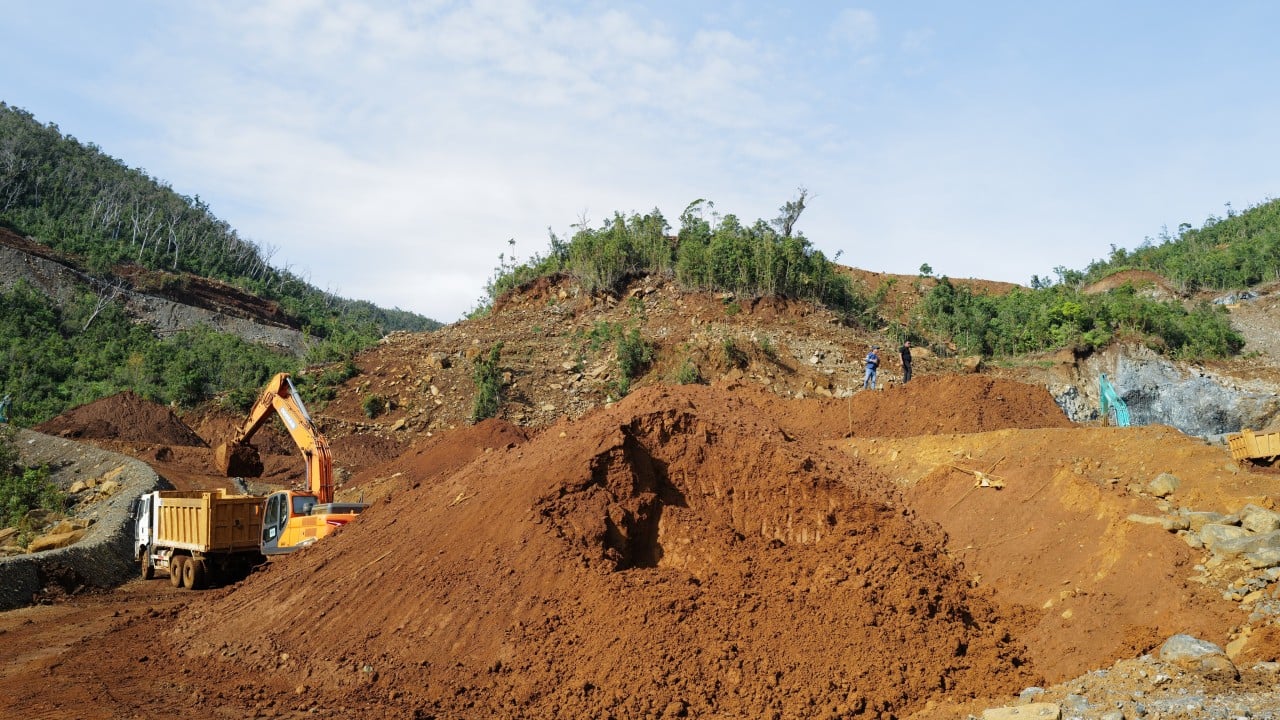
In the mountains of Palawan, the rain doesn’t just wash the earth away; it turns the world a bruised, rusted crimson. This is the color of laterite ore. To a geologist, it is a signature of nickel and cobalt. To a local miner like "Juan"—a composite of the thousands of men working these ridges—it is the grit that gets under his fingernails and the weight that pays for his children’s tuition.
Juan doesn't spend his days thinking about the diplomatic tensions in the South China Sea or the boardroom maneuvers in Tokyo. He thinks about the shovel. Yet, the dirt he moves is currently the most sought-after commodity in a global chess match. The Philippines sits on one of the world’s largest reserves of critical minerals, specifically the nickel required for the batteries in every electric vehicle (EV) humming through the streets of San Francisco or Seoul.
For decades, the story was simple: dig it up, ship it out. The Philippines acted as a raw material pantry for China’s industrial hunger. But the wind has shifted. Today, a new alliance between Manila, Washington, and Tokyo is attempting to rewrite the script. They want to transform these islands from a mere quarry into a high-tech processing hub.
The stakes are invisible but absolute.
The Metal Beneath the Skin
Modern life is built on elements most people couldn't identify on a periodic table. We are addicted to the chemistry of the rare. Nickel, copper, and cobalt are the nervous system of the green energy transition. Without them, the dream of a post-carbon world stays stuck in the garage.
Consider the current flow of trade. Currently, the Philippines is the world’s second-largest producer of nickel ore. Most of that raw, red earth is loaded onto barges and sent straight to Chinese refineries. China then processes the ore and sells the high-value finished products back to the world. It is a lopsided cycle. The Philippines keeps the environmental scars; others keep the profit.
The Biden administration, alongside Japanese Prime Minister Fumio Kishida’s government, recently signaled a massive pivot. Through the Luzon Economic Corridor—a planned network of rails and ports connecting Subic Bay, Manila, Batangas, and Clark—they are betting billions that they can break this monopoly.
It isn't just about business. It is about survival.
If the supply chain for the world’s future energy stays concentrated in a single, often adversarial hand, the risk of a "mineral chokehold" becomes a reality. Imagine a world where a diplomatic spat results in a global shortage of medical equipment batteries or grid-scale storage. That is the fear driving the US and Japan into the mountains of the Philippines.
A History Written in Rust
The Philippines has heard these promises before. In the 1970s and 80s, there were grand visions of industrialization that withered under corruption and poor infrastructure. To understand why this time feels different, you have to look at the map.
The archipelago is the front line of the Indo-Pacific. By investing in Filipino mineral processing, the US and Japan are doing more than securing battery components. They are anchoring a key ally. For the Filipino government, led by Ferdinand Marcos Jr., this is a chance to move up the value chain.
Transitioning from exporting ore to processing it is a massive leap. It requires staggering amounts of reliable energy—something the Philippines, with some of the highest electricity rates in Asia, currently lacks. This is where Japan enters the frame. Japanese expertise in high-pressure acid leaching (HPAL) technology is what makes it possible to turn low-grade Filipino ore into battery-grade chemicals.
But technology is only half the battle. The other half is the human cost.
The Cost of the Green Dream
There is a deep irony in the "green" revolution. To save the planet from carbon, we must tear into the earth. For the communities living near these mines, the talk of "critical mineral security" feels abstract when their river runs orange after a storm.
The new Western-led partnership claims it will adhere to higher environmental, social, and governance (ESG) standards than previous investors. This is the "high-road" approach. They argue that by paying more for "clean" nickel—nickel mined without destroying indigenous lands or polluting water tables—they can create a sustainable industry.
Is it possible?
The reality is messy. To build a processing plant, you need land, water, and immense amounts of power. You need a workforce that isn't just digging, but engineering. This means schools, vocational training, and long-term stability. If the US and Japan treat this as a short-term extraction project to spite China, it will fail. If they treat it as a foundational investment in a nation’s future, they might just succeed.
The Friction of Geometry and Geography
The Luzon Economic Corridor is a bold geometric plan. It seeks to link the former American naval base at Subic Bay with the commercial heart of Manila and the industrial ports of Batangas. This is more than a road; it is a vascular system for a new economy.
By moving minerals from the southern islands like Mindanao and Palawan up to a centralized processing zone in Luzon, the Philippines could finally capture the "value-added" dollars that usually flee overseas. Think of it like this: instead of selling the flour, you are finally building the bakery.
But the friction is everywhere.
Logistics in the Philippines are notoriously difficult. Moving goods between seven thousand islands is a nightmare of bureaucracy and aging vessels. China, meanwhile, isn't simply going to walk away. They are already deeply embedded in the Filipino mining sector. They have the infrastructure, the proximity, and a decades-long head start.
The competition is no longer just about who can buy the most ore. It is about who can build the best future for the person standing in the red dust.
The Mirror of the Future
When we look at the Philippines, we are looking at a mirror of the next century. The transition to clean energy will be the largest reallocation of wealth and power since the Industrial Revolution. In that era, coal and oil dictated which nations thrived and which were exploited. In this era, it is the minerals.
The Filipino people are caught in the middle of a "Gold Rush" for the 21st century.
The success of the US-Japan-Philippines triad depends on whether the benefits reach Juan in Palawan. If the local communities see their lives improved—better schools, cleaner water, and jobs that don't involve breaking their backs for pennies—the alliance will hold. If it becomes another story of foreign powers extracting wealth and leaving behind a hollowed-out landscape, the pendulum will swing back toward whichever power offers the quickest check.
The red dust doesn't care about geopolitics. It only knows that it is being moved. As the barges sit in the harbors, waiting to be filled, the world watches to see if the Philippines can finally harness the treasure beneath its feet to build a house of its own.
The air in the mining camps is thick with heat and the metallic tang of the earth. In the distance, the silhouette of a massive Japanese-funded cargo ship breaks the horizon. It represents a gamble. A gamble that minerals can be more than a curse of geography. A gamble that three nations, separated by vast oceans and complex histories, can find a common language in the chemistry of the future.
The earth is being turned. What grows from it next will define the Pacific for a hundred years.