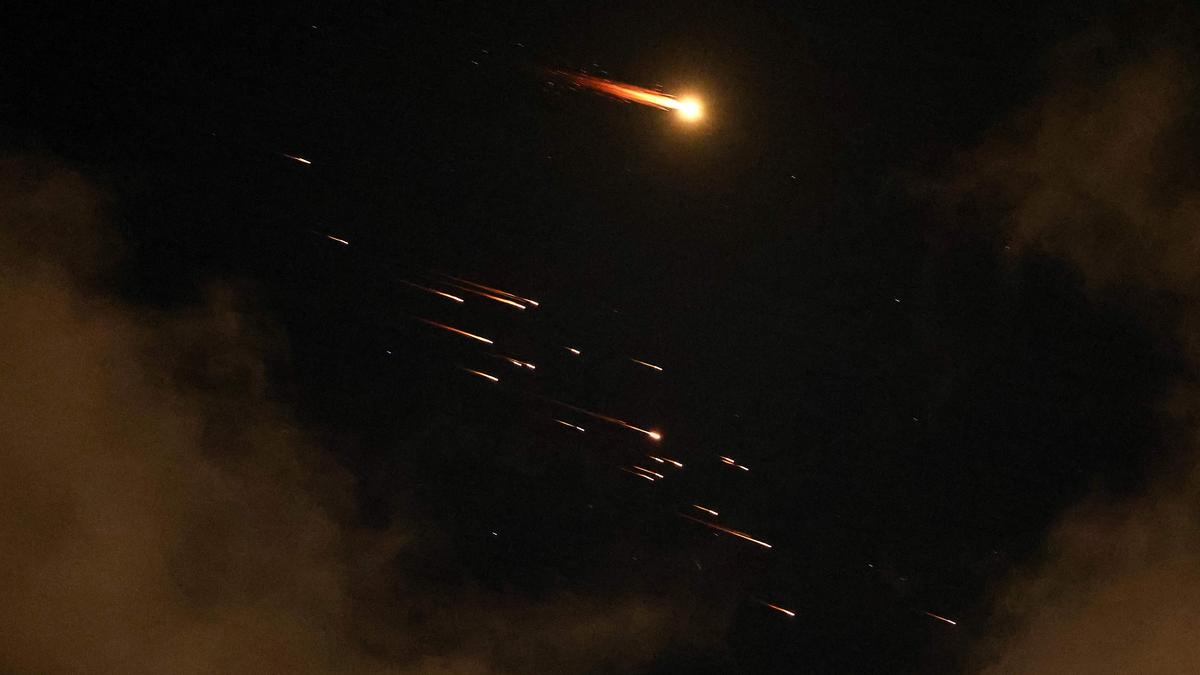
The recent exchange of kinetic fire between Iran and Israel represents a fundamental breakdown in the traditional "balance of terror." When Iran launches ballistic missiles directly from its sovereign territory toward Israeli population centers, the conflict transitions from a gray-zone proxy war into a high-intensity state-on-state confrontation. This escalation occurs within a vacuum of Western leadership, specifically as the United States executive branch oscillates between military posturing and diplomatic restraint. To understand the strategic implications, one must analyze the intersection of missile ballistics, integrated air defense capacity, and the geopolitical calculus of "calibrated response."
The Ballistic Calculus of Integrated Defense
The effectiveness of an Iranian missile strike is not measured solely by impacts or casualties, but by the depletion rate of the defender's interceptor inventory. Israel utilizes a multi-tiered defense architecture, consisting of Iron Dome (short-range), David’s Sling (medium-range), and the Arrow-2 and Arrow-3 systems (exo-atmospheric).
The operational bottleneck is the cost-to-kill ratio. While an Iranian liquid-fuel ballistic missile may cost between $100,000 and $300,000 to manufacture, an Arrow-3 interceptor costs roughly $2 million to $3.5 million. Iran’s strategy relies on "saturation thresholds," where the sheer volume of incoming projectiles forces the defender to prioritize targets, potentially allowing slower or less sophisticated munitions to penetrate the shield.
This kinetic exchange highlights three specific failure points in regional stability:
- Deterrence Erosion: The shift from proxy-led attrition (Hezbollah/Hamas) to direct state-led strikes indicates that Iran no longer views Israeli or American "red lines" as credible inhibitors to direct action.
- Interceptor Depletion: Continuous volleys serve a long-term strategic goal of exhausting the supply of high-end interceptors, which are produced at a slower rate than the missiles they are designed to stop.
- Intelligence Latency: The interval between launch and impact—roughly 12 minutes for a ballistic missile from Western Iran to Central Israel—leaves zero margin for diplomatic intervention.
The Geopolitical Cost Function of U.S. Hesitation
The United States’ role in this specific flashpoint is characterized by "strategic ambiguity" that has inadvertently become "strategic paralysis." When the Trump administration or any subsequent executive pauses a counter-offensive or delays a military response, it changes the adversary's risk-reward matrix.
In game theory, this is a repeated game where the "Tit-for-Tat" strategy is the most effective way to maintain a Nash Equilibrium. If one player (Iran) initiates an aggressive move and the other player (the U.S./Israel) fails to respond with equal or greater force, the aggressor perceives a "cooperation" signal. This lowers the perceived cost of future strikes. The "pause" mentioned in recent reports acts as a tactical reset for Iran, allowing them to assess the performance of their guidance systems and the reaction times of the U.S. Central Command (CENTCOM) without facing immediate structural consequences.
The Three Pillars of Regional Instability
The current conflict is supported by three structural pillars that prevent a return to the status quo:
The Hegemonic Ambition Pillar
Iran’s long-term objective is the expulsion of U.S. influence from the Middle East. Direct missile strikes serve as a demonstration of "sovereign capability," signaling to regional neighbors (Jordan, Saudi Arabia, the UAE) that the American security umbrella is porous. This is an exercise in psychological warfare designed to force a realignment of regional alliances.
The Domestic Survival Pillar
For the Iranian leadership, external conflict serves as a pressure valve for internal dissent. By framing the conflict as a defense against "Zionist aggression," the regime attempts to consolidate its conservative base and justify the continued expansion of the Islamic Revolutionary Guard Corps (IRGC) budget at the expense of the civilian economy.
The Technological Proliferation Pillar
The transfer of missile technology to non-state actors has created a "nested escalation" loop. Even if Iran pauses its direct strikes, its proxies retain the capability to maintain high-intensity pressure. This creates a situation where Israel must fight a multi-front war, stretching its logistics and manpower to a breaking point.
Operational Realities of Missile Interception
Interception is not a binary "hit or miss" outcome; it is a statistical probability managed by the Battle Management Center (BMC). The BMC must calculate the projected impact point of every detected launch. If a missile is calculated to land in an uninhabited desert or the sea, the system will often choose not to engage to conserve expensive interceptors.
This leads to a "false perception of failure" among the public when missiles are seen landing, while in reality, it is a disciplined preservation of assets. However, as Iranian guidance systems improve—specifically with the introduction of maneuverable re-entry vehicles (MaRVs)—the ability of the BMC to predict impact points with 100% certainty diminishes, forcing a higher expenditure of interceptors per incoming threat.
The Economic Attrition Model
Warfare in 2026 is an industrial competition. The primary constraint on Israeli and American military action is no longer political will, but the industrial base's ability to produce complex electronics and solid-rocket motors.
- Lead Times: The production cycle for a single Patriot (MIM-104) or Arrow interceptor exceeds 18 months.
- Supply Chain Vulnerability: Reliance on rare earth minerals and specialized semiconductors creates a strategic bottleneck that adversaries can exploit through economic warfare or maritime blockades.
- Asymmetric Scaling: It is significantly easier and cheaper to scale a missile production line (low-tech airframes) than an interceptor production line (high-tech seekers and divert-and-attitude control systems).
Tactical Shifts in the Levant
While the world focuses on the "big sky" ballistic exchange, the ground reality in the Levant is shifting toward high-frequency, low-altitude attrition. The use of "suicide drones" (one-way attack UAVs) provides Iran with a low-cost method to probe air defense gaps. These drones fly at altitudes and speeds that make them difficult for traditional radar to distinguish from birds or civilian aircraft.
By launching a "swarm" consisting of drones, cruise missiles, and ballistic missiles simultaneously, Iran attempts to overwhelm the processing power of the Aegis and Green Pine radar systems. This "layered attack" is the most significant tactical evolution in the conflict, as it requires the defender to manage multiple different physics problems at once: high-speed vertical threats and low-speed horizontal threats.
Identifying the Strategic Bottleneck
The fundamental bottleneck in the current crisis is the lack of a "de-escalation off-ramp" that does not involve a loss of face for either side. In traditional diplomacy, a neutral third party would mediate. In the current landscape, the United States is viewed as a primary combatant, and China/Russia are viewed as opportunistic observers who benefit from U.S. resource diversion.
The risk of a "miscalculation event"—where a missile accidentally hits a high-value target such as a hospital, a nuclear facility, or a major government building—remains the highest it has been since 1973. Such an event would bypass all diplomatic pauses and trigger a "Total War" protocol, leading to the systematic targeting of Iranian oil infrastructure (Kharg Island) and nuclear enrichment sites (Natanz/Fordow).
The Strategic Path Forward
The objective reality is that "containment" has failed. The policy of managing the conflict through limited strikes and economic sanctions has reached its terminal point. To regain the strategic initiative, a shift from defensive posture to structural deterrence is required.
This necessitates a three-pronged operational pivot:
- Hardened Logistics: Transitioning from "Just-in-Time" to "Just-in-Case" munitions stockpiling, requiring a massive expansion of domestic interceptor production.
- Kinetic Proactivity: Shifting the focus from intercepting missiles in flight to destroying launchers and manufacturing hubs at the point of origin. This moves the "cost of war" back onto the aggressor’s territory.
- Regional Integration: Formalizing an "Abraham Accords" military wing where regional intelligence is shared in real-time to create a deep-sensing network that covers the entire Iranian flight path.
The current "pause" should not be viewed as a cessation of hostilities, but as a period of tactical reloading. For any state actor involved, the priority must be the aggressive disruption of the adversary's kill-chain before the next saturation window opens. Failure to act during this window ensures that the next exchange will be larger, more sophisticated, and significantly more lethal.