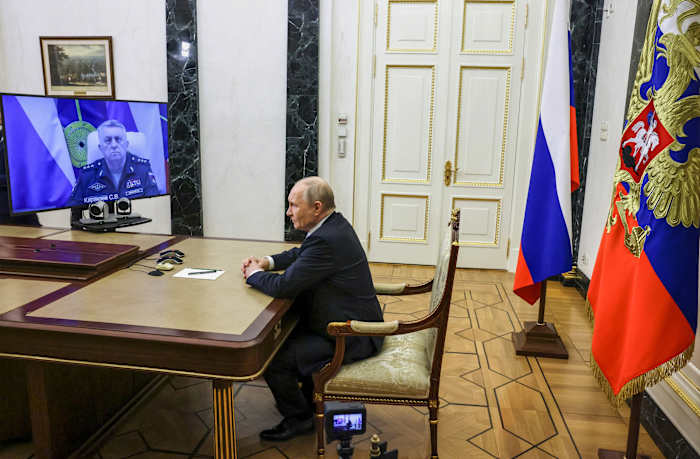
Vladimir Putin just sent a massive, fiery message to the West. He stood before the cameras to praise the successful test launch of the RS-28 Sarmat, a beast of a machine that the Russian military claims is the most powerful ballistic missile on the planet. It’s not just about the hardware, though. It’s about the timing and the terrifying intent behind it. When the Kremlin describes a weapon as having "no analogues" anywhere in the world, they want you to feel a specific kind of chill. They want to make sure every NATO planner is staring at a map today, recalculating the math of survival.
This isn’t just another routine military exercise. The Sarmat, often dubbed "Satan II" by Western analysts, represents a massive leap in Russia's strategic nuclear triad. It’s designed to replace the aging Soviet-era Voyevoda missiles. Putin isn’t hiding his pride. He says this weapon will make those who try to threaten Russia "think twice." That’s not a subtle hint. It’s a direct challenge to the current global order.
Why the Sarmat missile changes the nuclear math
The technical specs of the Sarmat are enough to give any defense analyst a headache. It’s a liquid-fueled heavy intercontinental ballistic missile (ICBM). It weighs over 200 tonnes. More importantly, it can carry a payload of about 10 tonnes. That’s enough room for 10 to 15 MIRV warheads (Multiple Independently Targetable Reentry Vehicles). Think about that for a second. One single missile launch could theoretically target a dozen different cities or military bases simultaneously.
It doesn’t just fly in a predictable arc. The Sarmat is built to bypass modern missile defense systems. It can fly over the North Pole or the South Pole, attacking from directions where current radar arrays aren't even looking. It has a short boost phase. This means it reaches high altitudes faster, making it much harder for satellite infrared sensors to track it during the most vulnerable part of its flight.
Russia claims it can also carry the Avangard hypersonic glide vehicle. If that’s true, we’re talking about a warhead that travels at 27 times the speed of sound. You don't "intercept" something moving that fast with current technology. You just watch it happen. This is why Putin is so confident. He believes he has found the ultimate "shield" and "sword" combo that renders Western anti-missile investments obsolete.
The message behind the fire
Don't let the technical jargon distract you from the theater of it all. This test happened while Russia is deeply mired in the conflict in Ukraine. Western sanctions are biting hard. International isolation is at an all-time high. Putin needs a win, and he needs a big, loud, scary one.
The launch from the Plesetsk cosmodrome in northern Russia was a carefully choreographed performance. It was meant for two audiences. First, the Russian public needs to see that their country is still a superpower, regardless of what the ruble is doing or what the Western media says. Second, it’s a warning to Washington and Brussels. It says "Stay out of our way, or the consequences will be unlike anything you've seen in history."
We’ve seen this playbook before. Sabers get rattled whenever the Kremlin feels backed into a corner. But the Sarmat is a very big saber. It represents decades of research and billions of rubles that Russia didn't really have to spare. They prioritized this because they know that in a world of shifting alliances, nuclear dominance is the only card that can't be trumped.
Fact checking the most powerful claim
Is it actually the world’s most powerful missile? That depends on how you define power. If you’re talking about throw-weight and the number of warheads, the Sarmat is certainly a contender for the top spot. The U.S. Minuteman III is aging and carries fewer warheads. The upcoming LGM-35A Sentinel is still in development.
But military power isn't just about the biggest boom. It's about reliability, accuracy, and the ability to actually use the thing without starting the end of the world. The Sarmat is a "first-strike" or "massive retaliation" weapon. It’s a blunt instrument. While it’s technically impressive, its existence doesn't necessarily mean Russia’s military is more effective in a conventional sense. As we’ve seen in recent years, high-tech missiles don't always translate to victory on the ground.
Critics point out that Russia has a history of exaggerating the readiness of its "super-weapons." Remember the Burevestnik nuclear-powered cruise missile? Or the Poseidon underwater drone? Many of these projects have faced years of delays and failed tests. The Sarmat test was successful, yes, but it doesn't mean a fleet of them is ready to launch tomorrow. There’s a long road between a test flight and full operational deployment.
What happens to global treaties now
The arrival of the Sarmat puts another nail in the coffin of international arms control. We’re living in a time where the New START treaty is on life support. Both the U.S. and Russia are looking at their nuclear stockpiles and wondering if the old rules still apply. When one side introduces a weapon specifically designed to evade the other's defenses, the "balance of power" becomes a very wobbly thing.
This creates a new arms race. The U.S. is already pouring money into hypersonic research to catch up. China is rapidly expanding its silo fields. We’re moving away from the era of "Mutual Assured Destruction" (MAD) and into something much more unpredictable. In the old days, everyone knew the rules. Now, with hypersonic gliders and pole-skirting ICBMs, the warning times are shorter and the room for error is basically zero.
Reality check for the West
So, should you be worried? Honestly, the Sarmat doesn't fundamentally change the fact that a nuclear war between superpowers is a lose-lose scenario. Whether Russia hits a target with an old Voyevoda or a shiny new Sarmat, the result is the same. The "power" Putin is hailing is largely psychological.
It’s a tool of coercion. It’s meant to make leaders in London, Paris, and D.C. hesitate when they consider sending more heavy weaponry to Ukraine or tightening the economic screws on Moscow. It’s a reminder that Russia still sits on the world's largest nuclear arsenal.
The real danger isn't the missile itself, but the chance of a miscalculation. As these weapons get faster and more complex, the window for human decision-making shrinks. We are putting our survival in the hands of automated systems and stressed-out commanders.
Understanding the strategic impact
The Sarmat test is a signal that Russia is doubling down on its "fortress" mentality. They are signaling that they will not be integrated into the Western security architecture. Instead, they’re building their own, centered around overwhelming force.
- Range: Estimated at 18,000 kilometers, effectively covering the entire planet.
- Speed: Capable of hypersonic speeds during the terminal phase.
- Payload: Flexible enough to carry conventional warheads or a mix of nuclear decoys.
- Deployment: Expected to be stationed in the Uzhur and Dombarovsky regions.
Don't expect the rhetoric to cool down anytime soon. Putin has tied his political legacy to the "restoration" of Russian greatness, and the Sarmat is the crown jewel of that effort. It’s a high-stakes gamble. By showing off his most dangerous toy, he's trying to force the world to respect Russia through fear.
Keep an eye on the upcoming deployment schedules. The transition from testing to active duty is where the real tension lies. If Russia begins mass-producing these and placing them in silos, the West will be forced to respond with its own "no-analogue" tech. We’re back in the thick of a Cold War style buildup, only this time, the tech moves much faster than the diplomats. Pay attention to satellite imagery reports and intelligence leaks regarding the Uzhur missile division. Those will be the first signs that the Sarmat has moved from a propaganda tool to a functional part of the Russian nuclear triad.