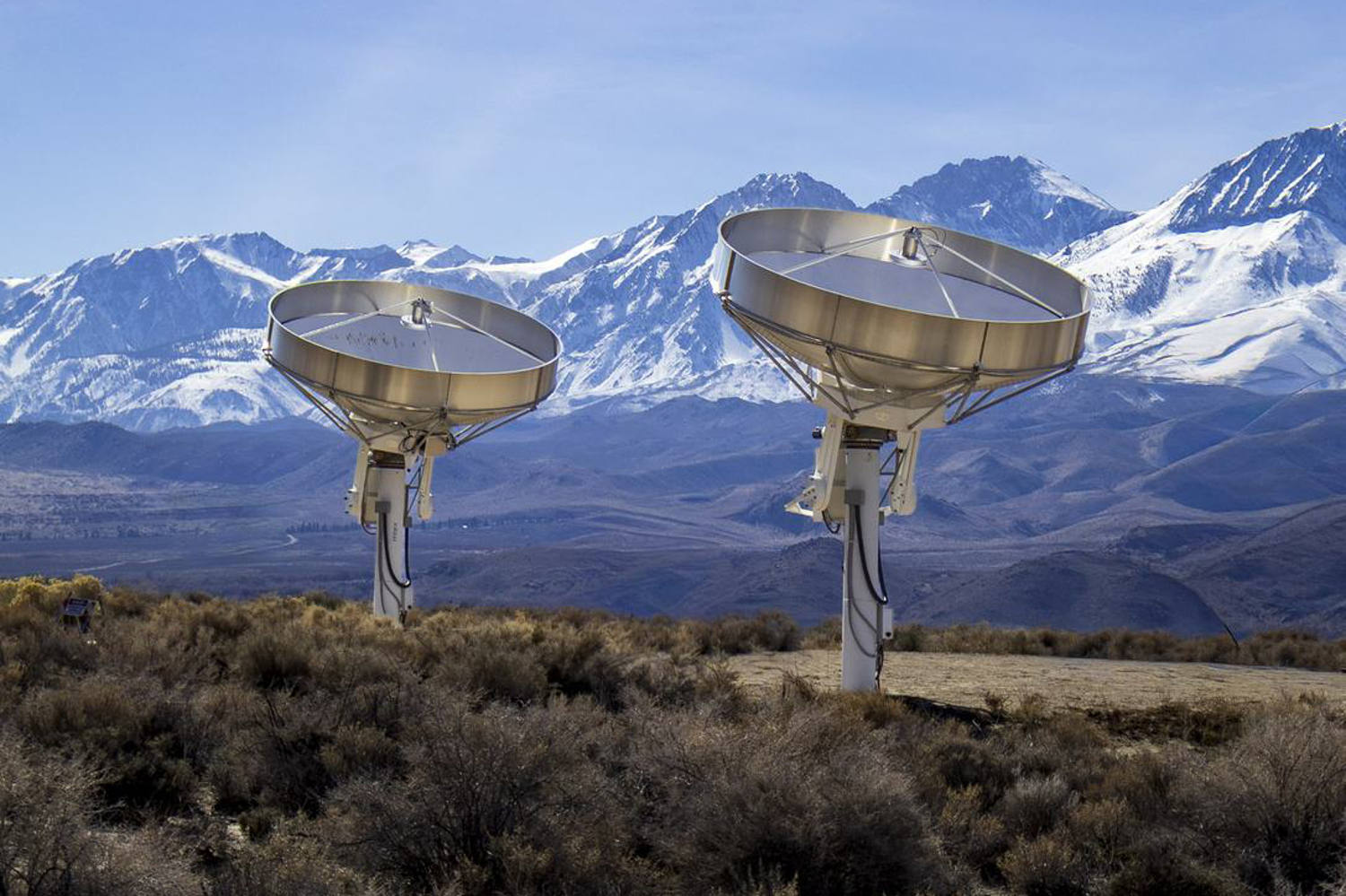
Astronomical data collection has long been constrained by a punishing trade-off: instruments could either stare deeply into a narrow patch of the sky or scan wide fields with severely degraded sensitivity. The Deep Synoptic Array (DSA), a $200 million observatory funded by Schmidt Sciences and led by Caltech, bypasses this fundamental limitation through a structural shift in hardware and computational economics. Planned for construction in Spring Valley, Nevada, the array utilizes 1,650 steerable, 6.15-meter parabolic antennas distributed across a 19-by-15-kilometer footprint. By deploying a massive grid of small, mass-manufactured collectors coupled with real-time digital signal processing, the project optimizes the cost-to-collecting-area ratio while increasing sky survey speeds by two orders of magnitude over current global baselines.
The Cost Function of Interferometry: Overcoming the Cryogenic Bottleneck
Traditional high-sensitivity radio astronomy relies on massive, single-dish telescopes or small networks of large dishes, such as the 27 antennas of the Very Large Array (VLA) in New Mexico. Historically, achieving low noise figures meant cooling the radio receivers to cryogenic temperatures, typically using liquid helium loops. This requirement imposes an economic floor of roughly $100,000 per receiver housing, rendering arrays composed of thousands of antennas financially unviable. For another perspective, see: this related article.
The DSA eliminates the cryogenic requirement through a component-level material shift. The 1,650 antennas are equipped with room-temperature receivers utilizing ambient indium phosphide (InP) transistors. These semiconductor devices maintain exceptionally low thermal noise profiles without active cooling, dropping the per-unit receiver cost down to a fraction of traditional systems. This cost reduction alters the capital expenditure equation of radio interferometry:
- Collecting Area Scalability: The total collecting surface scales linearly with the number of dishes ($N$). By using 1,650 small dishes, the array amasses a collective surface area of 49,000 square meters—roughly equivalent to the active collecting area of the historical Arecibo observatory—at a highly optimized capital cost.
- Baselines and Resolution: The spatial resolution of an array depends on its maximum baseline, which is the physical distance between its furthest elements. Spreading 1,650 dishes over a 19-by-15-kilometer domain yields millions of unique antenna pairs (baselines), generating highly detailed spatial reconstructions of the sky.
Data Volatility and the Real-Time Radio Camera Architecture
The primary operational challenge of a 1,650-element array is the combinatorial explosion of data. Traditional interferometers record raw voltage streams from each antenna, storing the data to be correlated and imaged later. For an array of this scale, the raw data volume matches total current US internet traffic, generating approximately 100 exabytes of information over the course of a comprehensive survey. Similar reporting on this trend has been shared by MIT Technology Review.
Storing 100 exabytes would require a multi-billion-dollar infrastructure comprising roughly 5 million enterprise hard drives. To prevent this data storage bottleneck from materializing, the DSA architecture employs an aggressive, real-time data reduction strategy termed the "radio camera."
The instrument routes the raw signal from all 1,650 antennas directly into a specialized supercomputing cluster driven by graphics processing units (GPUs). These processors execute spatial correlation and Fourier transforms instantly, converting the volatile raw voltage streams into structured frequency-domain images. The underlying data pipelines filter the information into distinct outputs:
- Broadband Channels: 10 highly aggregated intensity channels spanning the full 0.7–2 GHz bandwidth.
- Polarization Channels: 605 fine-resolution channels (2.15 MHz each) tracking polarization vectors to map cosmic magnetic fields.
- Galactic Hydrogen Channels: 2,048 highly narrow channels focused around the 1,420 MHz neutral hydrogen ($HI$) spectral line, delivering a Doppler velocity resolution of 0.22 km/s to map internal galactic kinematics.
- Extragalactic Hydrogen Channels: 4,096 channels optimized for observing nearby galaxies up to 100 megaparsecs away, operating at an 8 kHz spectral resolution (1.8 km/s Doppler resolution).
Because the supercomputer synthesizes these final images on the fly, the raw 100 exabytes of data are consumed, processed, and discarded. Only the lightweight, science-ready images are retained, reducing the physical storage footprint to manageable, commercial scales.
Supply Chain Innovation and RFI Isolation
Maximizing the signal-to-noise ratio requires addressing both hardware fabrication costs and environmental noise. To minimize construction overhead, Caltech engineers deviated from bespoke aerospace manufacturing, partnering with commercial cake-pan manufacturer Fat Daddio’s. The mass-production metal stamping techniques used for consumer baking products were adapted to fabricate thousands of uniform feed horns—the critical metal components that channel gathered electromagnetic waves into the InP transistors.
Equally critical is the mitigation of Radio Frequency Interference (RFI) from terrestrial technology like cellular networks and radar. The choice of Spring Valley, Nevada, provides distinct geographic and environmental isolation mechanisms:
- Topographical Shielding: The high-elevation mountain ranges surrounding the remote desert valley act as passive physical barriers, blocking ground-based RFI from nearby regional population centers.
- Soil Transmitters: The local soil composition allows for the efficient direct burial of the extensive fiber-optic network required to sync the 1,650 dishes to the central supercomputer without requiring heavy protective conduit, accelerating civil engineering timelines.
Operational Allocation and Cross-Observatory Integration
When science operations begin in 2029, the array's observation time will be divided into a fixed structural matrix to maximize scientific yield across multiple disciplines.
[Sky Survey: 65%] --------> 16 Full-Sky Passes Over 5 Years
[Pulsar Timing: 25%] ------> Gravitational Wave Detection (NANOGrav)
[Targeted Fields: 10%] ----> Multi-Messenger Sync with Rubin Observatory
A clear majority of the telescope's capacity—65%—is dedicated to an ongoing all-sky survey. The array will scan the entire visible sky from its northern hemisphere vantage point 16 distinct times over its initial five-year campaign. While all historical radio telescopes combined have documented roughly 20 million distinct radio sources, the DSA is engineered to match that 20-million figure within its first 24 hours of operation, ultimately cataloging an estimated 1 billion new radio sources.
A 25% allocation is reserved for high-cadence pulsar timing. By monitoring the ultra-precise rotation periods of stable pulsars (highly magnetized neutron stars), the array acts as a light-year-scale arm of a gravitational wave detector. This data will feed directly into the NANOGrav collaboration to isolate ultra-low-frequency, nanoHertz gravitational waves caused by supermassive black hole mergers.
The remaining 10% of operational time is allocated to daily deep-field imaging. These exposures are specifically designed to overlap geographically and temporally with the deep fields of Chile's Vera C. Rubin Observatory. This configuration enables immediate multi-messenger cross-correlation: when the Rubin Observatory flags a transient optical event, such as a supernova or a tidal disruption event, the DSA provides immediate, real-time radio data of the same coordinate space.
The Open-Access Data Mandate
A final structural departure from standard scientific infrastructure is the complete elimination of proprietary data periods. Traditional observatories grant the principal investigators who proposed an observation exclusive access to the data for 6 to 12 months to publish findings before making it public.
The DSA bypasses this phase entirely. Every image generated by the GPU supercomputer is published immediately to a global public registry. This open-architecture framework shifts the analytical burden from a single university team to the global scientific community. By delivering fully calibrated, science-ready data to the public in real time, the project relies on decentralized global networks to scale data analysis, ensuring that the processing of 1 billion new radio sources is not bottlenecked by localized institutional capacity.