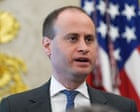
The media is hyperventilating over Donald Trump sliding staff secretary Will Scharf into the White House counsel seat. Pundits are reading the tea leaves, wringing their hands over loyalists, and acting as if swapping out David Warrington for a former federal prosecutor and personal defense attorney is some sort of constitutional earthquake.
They have completely missed the plot.
Focusing on the resume of the guy holding the White House counsel title is amateur hour. I have watched administrations burn millions in legal fees and administrative capital chasing the wrong bureaucratic shadows. The lazy consensus in Washington insists that putting a fiercely loyal litigator into the West Wing's top legal office transforms the office into a weapon.
Here is the contrarian truth: The White House counsel does not dictate executive power. Executive power dictates what the counsel does. Scharf is not being brought in to invent new legal theories out of thin air. He is there because the machinery of the modern executive branch requires an operational bottleneck that actually knows how to clear paper without getting bogged down in institutional paralysis.
The Myth of the Autonomous West Wing Lawyer
Every four years, Beltway journalists rediscover the White House counsel and treat the position like a grand vizier role. They write breathless profiles about how this individual will either "rein in" a president or "unleash" an agenda. Both narratives are fairy tales concocted by people who have never managed a high-stakes corporate legal department, let alone the executive branch of the United States.
Imagine a scenario where a corporate board hires a notoriously aggressive defense litigator as general counsel. Does that hire suddenly change the commercial appetite of the corporation? Of course not. The business does what it intended to do; the lawyer simply figures out the legally viable velocity to get it done.
Scharf’s background is being scrutinized for all the wrong reasons. Commentators point to his stint as a federal prosecutor, his work on high-profile Supreme Court defense teams, and his public-facing role handling executive orders. They view these markers as proof of impending institutional warfare. They treat his loyalty as an anomaly.
In reality, loyalty in a West Wing lawyer is table stakes. No president appoints a chief legal adviser to act as an internal independent counsel. The structural design of the executive branch demands absolute alignment between the Oval Office and the legal team. If a president wants a counsel who will fight, they hire a fighter. But the fight isn't generated by the lawyer; it is generated by the political mandate the voters handed the administration in the first place.
Why Staff Secretary Experience Trumps Pure Litigation Chops
The most underappreciated aspect of Scharf’s transition from staff secretary to White House counsel is not his courtroom resume. It is his paperwork resume.
If you want to understand how Washington actually breaks down, look at the flow of paper. The staff secretary controls the paper. Every memo, every executive order, every policy option that lands on the Resolute Desk has to squeeze through that office. Most political observers think governing is about grand speeches and dramatic television moments. It is actually about administrative logistics.
When a lawyer spends months as staff secretary, they learn the internal plumbing of the federal bureaucracy. They see where departments try to drag their feet, where career civil servants bury initiatives in red tape, and how executive orders get structurally sabotaged by poor drafting before the ink even dries.
Scharf understands the mechanics of statecraft because he has been the guy running the assembly line. Moving him from staff secretary to White House counsel is an operational upgrade in execution speed, not a philosophical shift in direction. Warrington did a steady job managing the legal defense, but Scharf brings an intimate familiarity with how executive directives are manufactured from scratch.
The Midterm Shadow and the Real Test
The timing of this shuffle—occurring as the horizon darkens toward high-stakes midterm elections—is what truly has the opposition party panicking. The conventional wisdom states that Scharf is being positioned to build a fortress against expected congressional investigations, subpoenas, and oversight battles should the legislative balance shift.
This analysis relies on a fundamental misunderstanding of modern congressional theater.
Investigations do not require a specific type of White House counsel to happen, and they cannot be stopped by a clever lawyer once the political momentum shifts. Committees launch probes because of political leverage, not because the White House counsel forgot to file a motion. Scharf’s job won't be to magically make oversight disappear. His job will be to ensure that the administration’s own initiatives are legally bulletproof before they face judicial review, minimizing the vulnerabilities that opportunistic prosecutors and hostile lawmakers love to exploit.
The legal battles facing any modern executive are not won by dramatic courtroom soliloquies. They are won in the quiet, unglamorous trenches of administrative law, regulatory compliance, and procedural precision.
Stop looking at the personnel change as a declaration of war. Look at it as an administrative tightening of the bolts. Scharf knows the machinery, he knows the principal, and he knows how to translate political will into executive output without letting the deep state run out the clock.
The question isn't whether Scharf is too partisan for the job. The question is whether the federal bureaucracy can move fast enough to outrun him.


