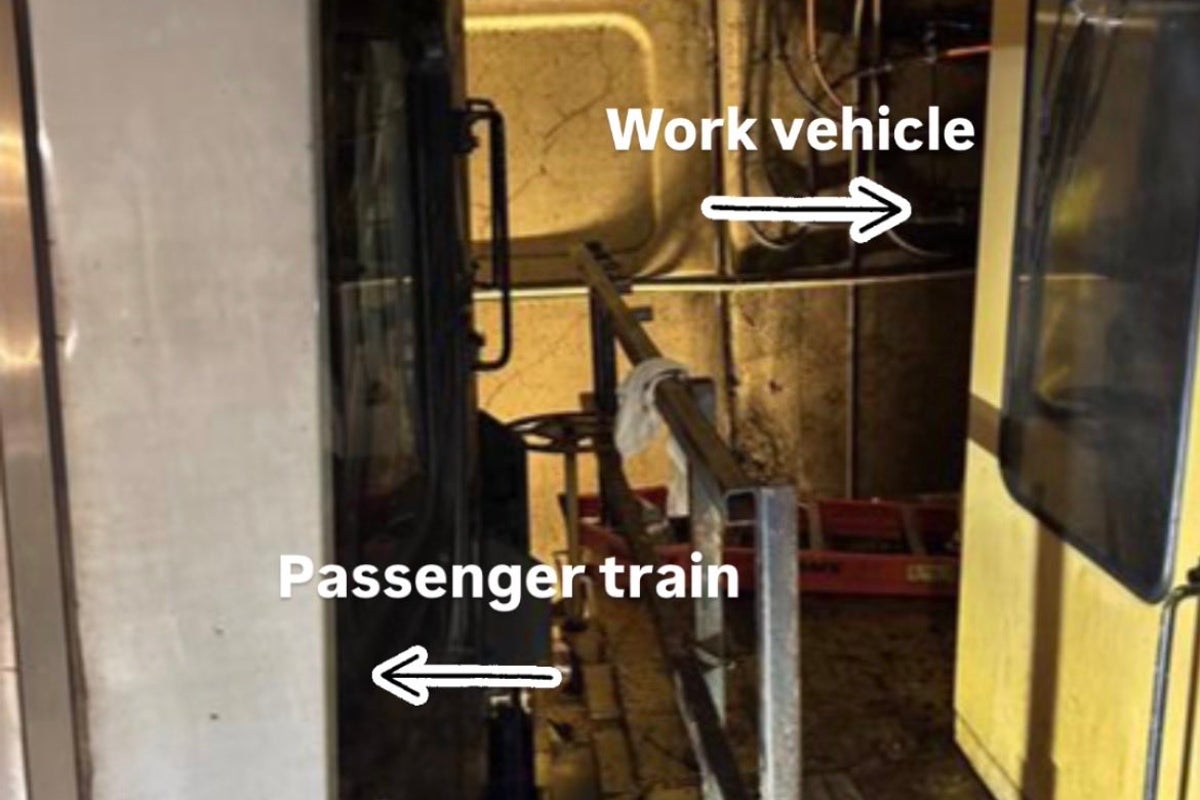
The coffee was still hot. That is the detail that sticks in the mind of those who commute through the subterranean arteries of Washington D.C. It is a ritual of plastic lids and cardboard sleeves, a caffeinated armor against the gray dampness of a Tuesday morning. At 9:02 AM, the Red Line train was just another steel vessel carrying a thousand different private universes—interns rehearsing elevator pitches, lobbyists checking timestamps, and tourists clutching crinkled maps.
Then, the world tilted.
Violence in a subway car is not like the movies. There is no slow-motion grace. There is only the sudden, physics-defying roar of kinetic energy meeting a stationary object. At the Metro Center station, the heart of the city’s transit system, two trains occupied the same space at the same time. The impact was a bone-deep shudder that traveled from the tracks, through the chassis, and into the spines of everyone on board.
Eleven people transitioned from "passengers" to "patients" in the span of a heartbeat.
Consider a hypothetical rider named Elena. She isn't real, but she represents the collective pulse of those eleven. Elena was looking at her phone, scrolling through a grocery list, when the floor disappeared. The sound wasn't a bang; it was a screech of metal on metal so high-pitched it felt like it was happening inside her skull. The lights flickered, gasped, and died. In the sudden, suffocating darkness, the smell hit first: ozone, burnt rubber, and the metallic tang of stirred-up dust.
The Anatomy of the Impact
When two massive trains collide, even at the relatively low speeds used during station approaches, the energy transfer is immense. The force doesn't just push the cars; it crumples them. Seats bolted to the floor become projectiles. Handrails, designed for stability, become hazards.
The initial reports from the scene were fragments of chaos. First responders descended into the tunnels, their flashlights cutting through the thick, hazy air. They found people dazed, sitting on the gritty floor of the platform, some holding their heads, others staring at their trembling hands.
The injuries weren't just physical. Yes, there were broken bones, lacerations from shattered glass, and the dull ache of whiplash. But the deeper injury was the shattering of the unspoken contract we all sign when we step onto a train. We trust the signals. We trust the operators. We trust that the millions of tons of steel moving through the dark are governed by an infallible logic.
That logic failed at Metro Center.
The Red Line has a history that haunts it. Long-time residents remember 2009, the year the scars became permanent. Every time a bumper hits a hitch, or a signal malfunctions, the city holds its breath. This collision wasn't a catastrophe on that scale, but for the eleven people being loaded into ambulances, the distinction was irrelevant. Their Tuesday had become a demarcation point: the time before the crash, and the time after.
The Invisible Stakes of the Daily Grind
Washington D.C. is a city built on the illusion of control. We believe that if we follow the rules, the system will hold. The Metro is the literal foundation of that belief. It is the great equalizer, where the Senator sits across from the janitor, both of them vibrating at the same frequency as the train hums toward the next station.
When that system breaks, the ripple effect moves faster than any train. By 10:00 AM, the city was in a gridlock of anxiety. Thousands of people were stranded, forced onto the surface streets where the rain turned the pavement into a slick, black mirror. But the logistical nightmare was secondary to the emotional one.
Why did the train not stop?
It is a question that points to the fragile intersection of human error and mechanical limits. Modern transit systems are marvels of automation, yet they rely on a precarious balance. A single sensor, a momentary lapse in focus, or a weathered brake pad can turn a routine commute into a headline. The investigation will eventually produce a thick report full of diagrams and timestamps. It will talk about "stopping distances" and "signal overlap." It will use the language of engineering to explain a moment of pure, human terror.
The Weight of Eleven
Eleven injured. In the grand ledger of urban statistics, it is a small number. It isn't a massacre. It isn't a national tragedy. But statistics are a way to avoid looking at the individual.
One of the eleven might have been a father who can no longer pick up his toddler because of a slipped disc. Another might be a student who now feels a surge of panic every time a door slams shut. The trauma of a subway crash is a slow-release chemical. It lingers in the way a person grips the pole a little tighter the next time they ride, or the way they instinctively look toward the front of the car, searching for a danger they can't see.
The emergency crews at Metro Center worked with a practiced, somber efficiency. They triaged the wounded under the harsh fluorescent lights of the station, a stark contrast to the subterranean gloom of the tracks. The stretcher wheels rattled over the tiles, a sound that usually signals a medical emergency, but here, it sounded like an indictment.
The city moved on, because cities have no choice. By evening, the yellow tape was gone. The trains were moving again, albeit with the cautious, stuttering pace of a wounded animal. The commuters returned, filing down the escalators into the throat of the city. They looked at their phones. They gripped their coffee.
But they were listening.
They were listening for that specific pitch of metal on metal. They were looking at the person next to them, wondering if they, too, were calculating the distance to the nearest exit. We live our lives in these shared, fragile spaces, connected by nothing more than a destination and a ticket.
The crash at Metro Center wasn't just a failure of equipment. It was a reminder of our own physical vulnerability in a world that demands we be cogs in a machine. We are not cogs. We are skin and bone, memory and fear. And when the machine stops, we are the ones who feel the impact.
The lights in the tunnel continue to flicker as the trains pass, casting long, distorted shadows against the grime-streaked walls. The system is back online. The schedule is being met. Yet, somewhere in the city, eleven people are sitting in quiet rooms, still feeling the phantom vibration of a collision that wasn't supposed to happen. They are the living evidence that at the center of every "standard" news story, there is a heart that is still trying to find its rhythm again.