Stop obsessing over the stopwatch.
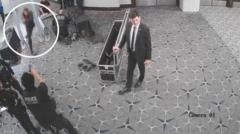
The media is currently hyper-fixated on a four-second window. They see a grainy video of a gunman charging through a perimeter and they think they’ve found the "smoking gun" of a security breach. They scream about reaction times. They demand to know why a human being didn't intervene in the span of a literal heartbeat.
They are asking the wrong questions because they don't understand how modern protection actually works—or why it fails.
Focusing on the four seconds the gunman spent sprinting is like blaming the iceberg for being cold instead of blaming the captain for sailing into a known ice field. By the time that individual started running, the "security" had already vanished. It wasn't a lapse in reflexes. It was a total collapse of systemic architecture.
The Fallacy of the Human Shield
The public has this cinematic, romanticized idea of protection: a stoic agent diving in front of a bullet or spotting a threat across a crowded field with hawk-like precision.
It’s garbage.
In real-world high-threat environments, if you are relying on a human to out-react a kinetic threat in under five seconds, you have already lost. The human nervous system has a hard floor. Between the OODA loop (Observe, Orient, Decide, Act) and the physiological dump of adrenaline, a four-second window is a margin of error, not a tactical opportunity.
When you see footage of a breach occurring that quickly, you aren't looking at a failure of the people on the ground. You are looking at a failure of Spatial Geometry.
Security isn't about being fast. It’s about making the environment so inconvenient that speed becomes irrelevant. If a gunman has a clear path to charge for four seconds without hitting a physical barrier, a redirected flow, or a technical sensor, the perimeter was never there. It was a suggestion.
The Perimeter is a Lie
Most "secure" events rely on what I call the Screening Illusion.
You see the magnetometers. You see the bag checks. You see the guys in suits. You feel safe because you went through a funnel. But modern threats don’t care about the funnel. They exploit the "Grey Space"—the areas that are technically outside the primary zone but offer a direct line of sight or a physical path to the target.
The competitor articles focus on the gunman’s "charge." They want to talk about how he moved.
I want to talk about the Dead Zones.
Every security plan has them. They are the gaps between jurisdictions. The local police think the feds have it; the feds assume the private detail has the roof; the private detail assumes the local guys are sweeping the perimeter. In that friction, a "four-second sprint" becomes an eternity because nobody owns that specific patch of dirt.
If you want to stop a breach, you don't train guards to run faster. You eliminate the straight lines. You disrupt the sightlines. You use physical infrastructure—bollards, fencing, staggered entry points—to ensure that even a world-class sprinter couldn't reach a critical point in under thirty seconds.
If a threat can reach the target in four seconds, your "perimeter" was actually a welcome mat.
The High Cost of Security Theater
We spend billions on the appearance of safety.
I’ve sat in rooms where executives and officials prioritize the "look" of a secure event over the actual physics of protection. They want the guards to look intimidating, but they don't want to pay for the advanced acoustic sensors or the persistent drone surveillance that would actually flag a runner before he even starts his sprint.
We are currently trapped in a cycle of Reactive Outrage.
- A breach happens.
- We watch a video of it.
- We blame the person who didn't move fast enough.
- We buy more of the same "security" that failed in the first place.
It is a feedback loop of incompetence. The "New Footage" being passed around right now is being used to justify more boots on the ground. But more boots wouldn't have changed those four seconds. More boots just means more people standing around in the wrong place.
The real fix is invisible. It’s data-driven. It’s about Predictive Flow Analysis.
Why Technology Failed the Human Element
We live in an era where we can track a package to our doorstep with meter-level accuracy, yet we somehow can’t monitor a high-value perimeter for a man with a rifle?
The failure isn't a lack of tech. It’s a lack of Integration.
The cameras were likely recording—hence the footage—but was anyone watching them in real-time with an AI overlay capable of detecting "anomalous kinetic movement"? Probably not. Most security feeds are monitored by a guy earning slightly above minimum wage who is staring at sixteen different screens.
The human eye is remarkably bad at spotting a single person moving in a crowd until it’s too late. We are wired to notice patterns, and a gunman is a "black swan" event that breaks the pattern.
If you aren't using automated thermal detection or LiDAR to create a digital "tripwire" around a protected asset, you are effectively using 19th-century tactics to solve a 21st-century problem. The four-second charge is a testament to our refusal to move past the "Guard at the Gate" mentality.
The Hard Truth About "Absolute" Safety
Here is the part no one wants to admit: You cannot 100% secure a public figure in an open environment.
The math is against you. The attacker only has to be right once, for four seconds. The defense has to be right every second of every day.
When the media analyzes these videos, they treat security like a game that can be "won" if we just try harder. It’s a lie. Security is a game of Risk Mitigation, and we are currently mitigating the wrong risks.
We worry about the shooter’s speed. We should be worrying about our own Bureaucratic Inertia.
The reason that gunman got those four seconds wasn't because he was fast. It was because the system was slow. The communication was fractured. The planning was arrogant. And the execution was focused on the crowd instead of the gaps.
Stop Watching the Clock
If you’re still counting the seconds on that video, you’ve been tricked.
The gunman didn't "charge through security." He walked through a hole that was left open by people who thought a badge and a gun were a substitute for a comprehensive, integrated defense strategy.
The next time a breach happens—and it will—don't look at the runner. Look at the ground he covered. Look at the lack of barriers. Look at the silence of the alarms that should have been screaming before he took his first step.
The four seconds are a distraction. The failure happened months before the first shot was fired.
Fix the architecture or stop pretending you’re protected.