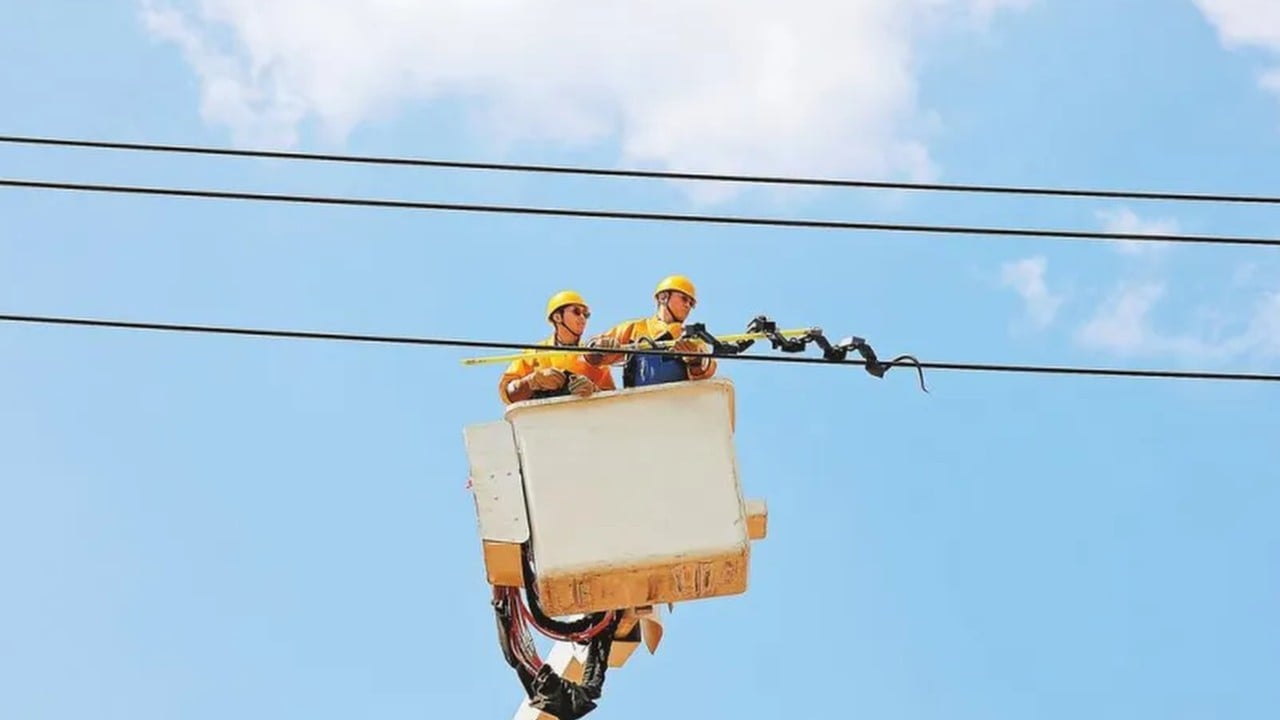
The wind outside Qinghai province screams at 40 miles per hour, carrying a bite chilled by the high-altitude plains. If you look up at the high-voltage transmission lines cutting across the gray sky, you might see something that makes your blood run cold. It looks like a snake. It is thick, dark, and moves with a sinister, undulating crawl directly along the live wire.
In the old days, a sighting like that meant a catastrophic failure was seconds away. A real python or cobra bridging the gap between a live wire and a grounding structure creates an electrical arc. The result is a blinding flash, a shower of molten metal, and an immediate blackout for thousands of homes. You might also find this related story interesting: The Trillion Dollar Bet on Preemptive Pathogen Defense and Why It Might Fail.
But this creature is different. It does not smoke, it does not burn, and it does not fall.
It is made of carbon fiber and articulating aluminum segments. It is a robot, deliberately designed to mimic one of nature's most feared predators, and it is currently saving the lives of the human workers who used to have to climb up there to meet it. As highlighted in recent coverage by ZDNet, the results are notable.
The Terror of the High Wire
To understand why engineers built a mechanical reptile, you have to understand the nightmare of grid maintenance.
Imagine standing on a metal lattice tower 150 feet in the air. The wind is trying to rip you off the steel. Beneath your boots, hundreds of thousands of volts hum with a deep, vibrating bass note that you can feel in your teeth. Your job is to crawl out onto a conductor line thin as a wrist to check for tiny cracks, burn marks from lightning strikes, or debris tangled in the lines.
One misstep, one sudden gust, or one moment of fatigue is fatal. Even with safety harnesses, the physical toll on human line workers is immense.
For decades, power companies faced a brutal mathematical reality. Power grids are expanding at an unprecedented rate to support electric vehicles and massive data centers. At the same time, the workforce willing to climb these towers is shrinking. The younger generation looks at the high-wire act and opts for safer, ground-based careers.
The grid was growing vulnerable. Debris—plastic bags, kites, agricultural netting—frequently blows onto the lines. Left alone, this debris catches moisture, creates short circuits, and triggers massive blackouts. Power companies needed a solution that could traverse miles of treacherous, thin wire without falling, slipping, or needing a break.
They tried wheeled drones. They tried traditional quadcopters. But wind currents near high-voltage lines are notoriously unstable, easily knocking standard drones out of the sky and causing expensive crashes.
Then, roboticists looked at the trees. They looked at snakes.
Why the Serpent Wins
A snake does not fall off a branch because its entire body is a mechanism for distributing weight and maintaining friction. It wraps, grips, and flows.
The robotic snake developed for Chinese power grids utilizes this exact principle of biological mechanics. It does not balance on top of the wire like a tightrope walker. Instead, it wraps its segmented body around the line. This design lowers its center of gravity, making it virtually immune to the high winds that plague traditional drones.
If a 50-mile-per-hour gust hits the line, the robot simply tightens its grip.
As it moves, internal electric motors orchestrate a wave-like motion through its joints, propelling it forward smoothly over spacers, dampeners, and bolts that would stop a wheeled vehicle in its tracks. It is equipped with high-definition thermal cameras and lidar. As it slithers down the line, it scans the aluminum strands for microscopic fractures that the human eye would miss, streaming real-time diagnostic data to a crew sitting safely in a van half a mile away.
But its most vital trick is how it handles the very thing it was sent to clear: debris.
When a traditional maintenance crew finds a plastic tarp melted onto a power line, they often have to shut down power to that sector, cost millions of dollars in lost productivity, and send a worker up with specialized tools. The snake robot approaches the debris, activates a small, high-precision thermal cutter or localized flame emitter built into its nose, and cleanly burns the plastic away without damaging the underlying aluminum-conductor steel-reinforced cable.
The power stays on. The human worker stays on the ground.
The Friction of Acceptance
When these machines were first deployed in provinces like Gansu and Line worker crews did not celebrate immediately. There is a deeply ingrained pride among line workers—a sense of brotherhood forged in high-altitude danger. To them, the introduction of a slithering machine felt like an insult to their bravery, or worse, a prelude to layoffs.
Consider the perspective of a veteran lineman. He spent twenty years braving the elements, trusting his life to his harness and his partner. Then, a truck rolls up, engineers unpack a box, and a mechanical viper climbs the tower, doing his morning inspection routine in a fraction of the time.
The resistance was real. But it faded the first time a major winter storm hit.
During severe ice storms, power lines grow heavy with frozen rain. The weight can snap towers like toothpicks. Traditionally, workers had to use long poles to manually beat the ice off the lines, a freezing, exhausting, and highly perilous task.
During one deployment, the robotic snake was sent up an icy line. By vibrating its segmented body at specific frequencies and using its weight to flex the cable rhythmically, it shattered the ice casing safely, clearing miles of line while the human crew watched from the heated cab of their truck, drinking coffee.
That was the turning point. The machine was not a replacement; it was a shield.
A New Ecology of Infrastructure
The sight of a mechanical reptile cruising through the sky is undeniably jarring. It taps into an ancient human phobia, subverting it into a tool for modern survival.
We live in a world dependent on a massive, invisible web of copper and aluminum. We expect the lights to turn on, the refrigerators to run, and the hospitals to function without ever considering the sheer physical violence of the environment those wires must endure.
The grid is aging, the weather is becoming more extreme, and our hunger for electricity is insatiable. The solutions to keeping this world running cannot rely solely on the heroism of humans willing to risk their lives in the clouds.
Next time you drive past a row of massive steel pylons stretching across the horizon, take a closer look at the wires. If you see a long, dark shape winding its way along the metal, do not look away in fear. Watch it work. It is a sign that the future of human safety relies on the most unexpected shapes, quietly keeping the darkness at bay. One slither at a time.