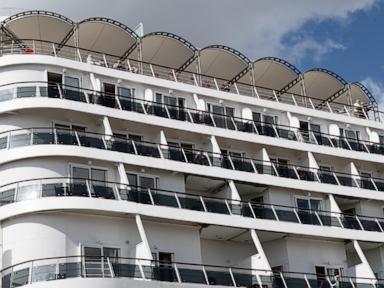
The salt air usually smells like a beginning. For the nearly three thousand souls aboard the MSC Virtuosa, a brand-new vessel still radiating the scent of fresh carpet and polished brass, the approach to the French port of Le Havre should have been a triumphant moment. It was a maiden voyage, a tentative step back into the world after the long, suffocating silence of global lockdowns. But the air on deck was thick with a different kind of tension.
Rumors on a ship travel faster than the current. Somewhere in the lower decks, or perhaps in the luxury suites, the virus had hitched a ride. Not as a screaming emergency, but as a ghost.
Seventy-two people. That was the number. Seventy-two passengers and crew members had tested positive for COVID-19. In the early days of the pandemic, this would have been the start of a nightmare—a ship turned into a floating prison, circling ports that refused to open their gates, while those inside watched the shoreline through portholes like shipwrecked castaways. We remember those images. They are burned into our collective memory of 2020.
But this time, the story changed.
The Decision at the Dock
Consider the local prefect in Le Havre. They are faced with a choice that balances the rigid safety of a nation against the individual liberty of thousands of travelers. Under the old rules, the Virtuosa would have been flagged red. It would have been ordered to stay at sea, a quarantined island of steel. Instead, a new protocol whispered a different set of instructions.
France decided to let them walk.
Specifically, the authorities allowed every passenger who tested negative or remained asymptomatic to disembark. They didn't just let them off; they let them go home. It was a quiet, bureaucratic revolution. It signaled an end to the era of the "plague ship" narrative and the start of a more calculated, risk-tolerant reality.
For a traveler like "Marc"—a hypothetical father who saved for two years to take his family on this inaugural sailing—the moment the gangway lowered was not just a logistical step. It was a reprieve. Imagine the weight lifting as he realizes he won't be trapped in a twelve-by-twelve cabin with two restless children for a fortnight. He walks onto French soil, breathes the air of Normandy, and heads toward his car.
The stakes, however, remain invisible and high. While Marc feels the joy of freedom, the public health officials are playing a game of sophisticated probability.
The Math of the Ghost
The virus is no longer a monolithic threat; it is a variable. By allowing asymptomatic passengers to leave, France acknowledged a fundamental shift in how we manage the intersection of commerce and health. The ship had become a microcosm of the world at large. If we can walk through a grocery store where the person in the next aisle might be an unknowing carrier, why should a ship be treated as a medieval leper colony?
This logic is grounded in the high vaccination rates among the Virtuosa’s passengers. The vaccine didn't create a bubble of invincibility, but it did change the consequence of infection. It turned a potential tragedy into a series of data points.
However, we must sit with the discomfort of this decision. There is a specific kind of anxiety that comes with "controlled exposure." To let seventy-two infected people stay on board while the rest mingle and then depart requires a level of trust in ventilation systems, masking protocols, and the honesty of travelers that we didn't have two years ago.
The ship’s operator, MSC Cruises, had to demonstrate that their "Blue Ribbon" protocol was more than just a marketing brochure. They had to prove that they could isolate the seventy-two without turning the entire vessel into a Petri dish. They used infrared temperature scanners, mandatory swabs before boarding, and high-efficiency particulate air (HEPA) filters. These are the silent guardians of modern travel. They are the reason the gangway stayed down.
The Human Cost of Caution
We often talk about health in terms of biology, but there is a health of the spirit that is ravaged by uncertainty. The travelers on the Virtuosa weren't just fleeing a virus; they were seeking a return to the rhythm of life.
When the French authorities gave the green light, they were making a statement about the "new normal" that actually feels, for the first time, somewhat normal. They allowed the passengers to take trains, buses, and taxis to their final destinations. They trusted the negative test results of the majority, even though we know that incubation periods can be fickle.
It is a gamble. Every time a hatch opens, it is a gamble.
But the alternative—the total freezing of movement—has a cost that is rarely measured in spreadsheets. It is measured in the bankruptcy of travel agencies, the loss of seasonal jobs in port cities, and the crushing psychological weight of a world that has forgotten how to move.
Consider the crew. Often forgotten in these headlines, the crew of a cruise ship lives in a state of perpetual "on-call" anxiety. For them, a ship in quarantine is a workplace turned into a cage. The decision in Le Havre meant they could keep their jobs, their schedules, and their dignity. It meant the ship wasn't a failure; it was a success of management.
The Invisible Border
We are living through the dismantling of the hard border. Not the border between countries, but the border between "safe" and "unsafe." The Virtuosa incident proves that we are moving toward a gray zone.
In this gray zone, we accept that the virus is a passenger. We stop trying to sink the ship to kill the stowaway. Instead, we identify the stowaway, put them in a room, and let the rest of the voyage continue.
It feels fragile. It feels like we are walking on thin ice, waiting for the crack that sends us back into lockdown. But as the passengers of the Virtuosa spread out across the French countryside and beyond, they carry with them more than just their luggage. They carry the precedent.
They are the test subjects of a world that has decided to live again.
There were no sirens in Le Havre that day. There were no hazmat suits on the pier. There was only the sound of rolling suitcases on pavement and the sight of people heading toward the horizon. It was a boring exit. And in the world of global travel, after years of chaos, "boring" is the most beautiful word in the language.
The Virtuosa will sail again. Other ships will follow. There will be more positive tests, more isolated cabins, and more decisions made in the quiet offices of port authorities. We have traded the absolute safety of the fortress for the calculated risks of the open road.
As the sun sets over the English Channel, the ship sits at the dock, a massive monument to our refusal to stay still. The seventy-two remain in their quarters, watching the light fade, while the thousands who were spared disappear into the night, back to their homes, their lives, and their next adventures. The virus is there, hidden and silent, but the gates are open.
The shore is no longer a forbidden land. It is simply the place where the journey continues.


