The air inside the concrete bunker smells of ozone and recycled breath. It is a sterile, metallic scent that clings to the back of your throat. Somewhere above, the tropical humidity of Fujian province is thick enough to swallow a person whole, but down here, everything is clipped, dry, and terrifyingly precise.
A young technician, let's call him Chen, watches a screen that monitors the invisible. He isn't looking for ships or planes today. He is looking for the ghost of a sun.
Recent reports from the Eastern Theatre Command of the People’s Liberation Army (PLA) describe a shift in the atmospheric tension of the Taiwan Strait. While the world watches the hardware—the destroyers, the fighter jets, the ballistic missiles—the real story is happening in the drills that simulate the end of the world. The PLA has begun rigorous simulations of a "nuclear environment." This isn't just about the blast. It is about the aftermath. It is about the moments when the lights go out and the radio speaks only in static.
The Mathematics of the Unthinkable
War is usually a game of addition. More tanks. More boots. More hulls in the water. But a nuclear environment is an exercise in subtraction.
When a tactical nuclear strike occurs, the first thing it steals is the truth. The electromagnetic pulse (EMP) fries the delicate circuitry of modern command and control. GPS fails. Secure datalinks vanish. The high-tech "kill chains" that military planners spend decades perfecting turn into expensive scrap metal in a microsecond.
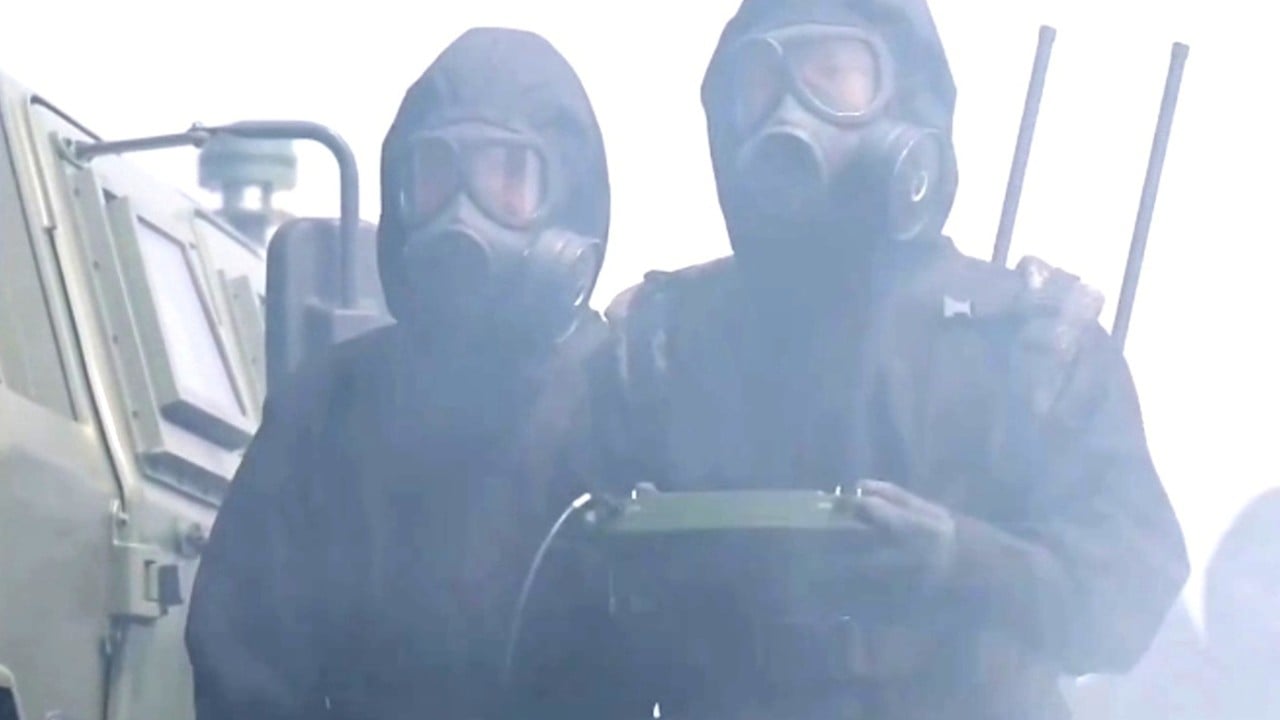
Consider the "invisible stakes" of a soldier standing on a coastline facing the Pacific. In these recent simulations, PLA troops are practiced in donning protective gear within seconds, but the gear is the easy part. The hard part is the isolation. If you are a commander in a field unit and your screen goes black, you are suddenly back in 1914. You have no eyes in the sky. You have no voice from Beijing. You have only the men to your left and right and a map that might already be obsolete.
The drills focusing on the Taiwan Strait and the waters near Japan aren't just muscle-flexing. They are a psychological hardening. The PLA is betting that in a conflict, the side that can maintain its composure when the digital world dies is the side that wins. They are training for the silence.
The Shadow Over the Strait
The geography here is a trap. The Taiwan Strait is a narrow ribbon of water, a hundred miles of choppy grey-blue that separates two worlds. To the north, the Japanese archipelago curves like a defensive wall. To the south, the South China Sea opens into a vast, contested expanse.
When China simulates a response to a nuclear attack in this specific theater, they are sending a message that transcends standard deterrence. They are acknowledging a grim reality: any conflict involving the "First Island Chain" carries a non-zero risk of escalation.
Imagine the technical complexity. A unit must move through a "contaminated" zone. This requires specialized decontamination vehicles that spray a chemical mist over armored columns. Every joint in a soldier's suit must be airtight. Every breath is filtered. The sweat pools in your boots, and the world looks warped through a polycarbonate visor.
But the physical grit is secondary to the logistical nightmare. In a nuclear-degraded environment, the very sensors used to track an enemy—radar, infrared, sonar—become erratic. The air itself is ionized. The PLA is testing sensors that can peer through this interference, trying to find a way to keep their "eyes" open when everyone else is blinded.
The Human Toll of the Simulation
We often talk about "strategic assets" as if they are pieces on a board. They aren't. They are people like Chen, who have families in cities like Xiamen or Taipei or Okinawa.
During these drills, the soldiers are taught to operate under "extreme psychological stress." What does that actually mean? It means simulating the loss of contact with home. It means the simulation of a chain of command that has been decapitated.
In one hypothetical scenario used in these training modules, a brigade finds itself cut off from the main force. The "nuclear environment" has rendered long-range communication impossible. The commander must decide whether to hold his position, retreat, or push forward based on a set of pre-delegated orders that may no longer apply to the changing battlefield.
This is the "dark logic" of modern warfare. The more advanced we become, the more vulnerable we are to the most primitive of forces. A single high-altitude burst could send the world’s most advanced digital military back to using signal flags and runners.
The Japanese Connection
Why include the Japanese theater in these simulations?
Japan sits on the edge of this tension, hosting some of the most critical U.S. military installations in the Pacific. By simulating a nuclear response that encompasses the waters near Japan, the PLA is practicing for a "total theater" scenario. They are looking at the logistics of moving supplies and troops under a radioactive umbrella that covers the entire region.
This isn't just about China and Taiwan. It’s about the reach of the fallout—both literal and political. Japan’s recent moves to increase its defense spending and its deepening ties with the U.S. have changed the calculus. The PLA's simulations are a mirror to that change. They are preparing for a world where the buffer zones have evaporated.
The Engineering of Survival
The technology being tested isn't just about bombs. It’s about resilience.
- Hardened Communications: The development of low-frequency radio systems and quantum-encrypted links that might survive the initial shock of an EMP.
- Rapid Decontamination: Vehicles that can scrub a division of tanks in minutes rather than hours, keeping the momentum of an advance alive.
- Autonomous Decision Making: AI-driven systems that can give local commanders "best-guess" tactical advice when they can no longer reach headquarters.
These are the "robust" systems the military journals talk about. But "robust" is a cold word for something that is essentially a life-support system for a civilization at war.
The Weight of the Invisible
There is a specific kind of fear that comes with nuclear preparation. It is different from the fear of a bullet or a conventional bomb. It is the fear of the invisible. Radiation doesn't scream. It doesn't whistle as it falls. It simply arrives.
When the PLA conducts these drills, they are training their soldiers to ignore the most basic human instinct: the urge to run from an invisible killer. They are being taught to stay, to fight, and to function in a world that has become fundamentally hostile to human biology.
The "human element" here is the sheer audacity of the preparation. It is the belief that a military can be coached to survive the unsurvivable.
Beyond the Dry Reports
If you read the official press releases, they speak of "enhancing combat readiness" and "validating joint operations capabilities." These are sanitized phrases. They mask the reality of what is being practiced.
They are practicing for the day the sun rises twice.
They are practicing for the moment when the digital map disappears and all that is left is a compass and a gas mask.
The real story isn't the number of missiles or the tonnage of the ships. The real story is the man in the bunker, watching a needle move on a Geiger counter, wondering if the world he left behind this morning still exists.
As the exercises in the Taiwan Strait continue, the complexity grows. We see the integration of drone swarms that can operate in high-radiation zones. We see the deployment of mobile hospitals designed to treat thousands of "acute radiation syndrome" cases at once.
Each drill is a brick in a wall of deterrence. But it is also a reminder of how thin the ice is. We have built a world of incredible connectivity, a global "synergy" of trade and data. And yet, the most powerful militaries on earth are currently spending their best hours learning how to live in the ruins of that connectivity.
The silence that follows a siren is the loudest sound in the world. In the concrete bunkers and on the grey decks of the destroyers in the Strait, they are learning how to speak to each other in that silence. They are learning how to move when the world stops.
The ships are visible. The planes are loud. But it is the quiet, methodical preparation for the end of technology that tells us exactly where we stand.
A soldier reaches out to touch the cold steel of a hatch. Outside, the simulation continues. The sky is clear, the water is calm, and for now, the sun only rises once a day. But the suit is ready. The filter is clean. The silence is waiting.