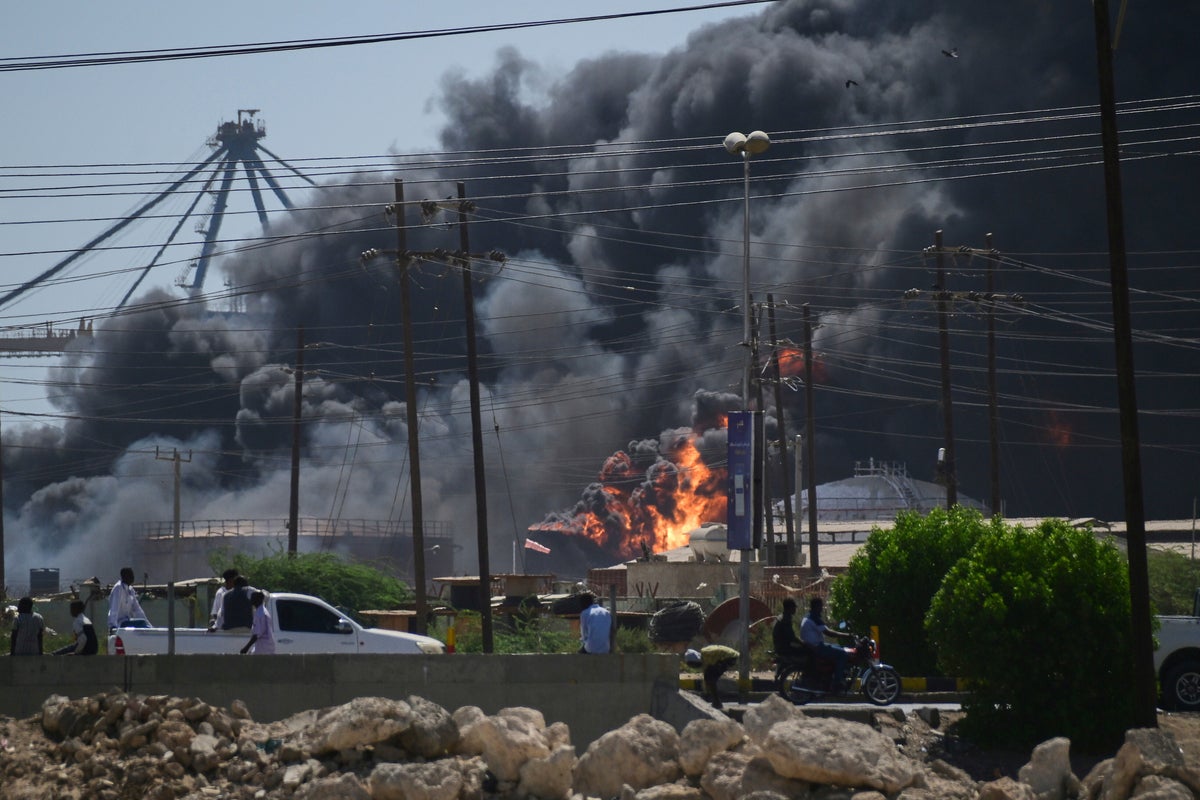
The sound of a city dying is not always a scream. Sometimes, it is the rhythmic, mechanical clicking of a suitcase wheel snagging on a cracked sidewalk in Khartoum. It is the dry rustle of a plastic tarp being pulled over a family’s last remaining possessions in a camp near the Chad border. Most of all, it is the sound of a phone notification that never arrives because the world has stopped looking.
Sudan has entered its fourth year of a civil war that has become a ghost. While global cameras are pulled toward the flashpoints of Gaza and Ukraine, a nation of 48 million people is being erased in the dark. This is not a "clash of generals" or a "regional instability." It is the systematic dismantling of a culture, a middle class, and a future.
The Arithmetic of Agony
Consider Amna. She is not a statistic, though the UN would record her as one of the 10 million people displaced since the fighting broke out between the Sudanese Armed Forces (SAF) and the Rapid Support Forces (RSF).
Amna used to teach chemistry. She had a bookshelf filled with worn paperbacks and a balcony where she grew jasmine. When the shells first hit Omdurman, she thought it would last a week. She stayed until the water ran out. She stayed until the soldiers started using her neighbors’ living rooms as sniper nests.
She fled with a backpack. Now, four years later, she sits in a dust-choked settlement where the only thing in abundance is time. Her hands, once stained with ink and chalk, are now rough from hauling jerrycans of grey water. She represents the "abandoned" conflict—a woman who survived the bullets only to be slowly suffocated by the world’s indifference.
The numbers are staggering, yet they feel hollow when spoken aloud. Over 15,000 dead, though the real count is likely triple that. Famine is no longer a threat; it is a resident. In parts of Darfur and Khartoum, people are eating boiled leaves and ground-up seeds meant for livestock.
Why We Look Away
Human empathy is a finite resource, or so the psychologists tell us. We are wired to focus on the singular tragedy, the clear villain, and the story with a recognizable ending. Sudan offers none of these comforts.
The conflict is messy. It is a labyrinth of shifting alliances, ethnic militias, and external actors shipping drones and fuel across porous borders. Because there is no easy "hero" narrative, the international community has collectively decided to change the channel.
But the cost of looking away is measurable in human life. When a crisis is labeled "abandoned," the funding dries up. Aid convoys are blocked not just by gunmen, but by a lack of fuel and logistical support that only global pressure can provide. Hospitals in Sudan are now skeletal remains. Surgeons operate by the light of burner phones. Antibiotics are traded like gold.
The Architecture of a Forgotten War
The war didn't start with a single shot; it started with a betrayal. After the 2019 revolution, when young people stood in the streets of Khartoum singing for "Freedom, Peace, and Justice," there was a brief, shimmering moment where Sudan looked like it might break the cycle of military rule.
Then, the two men who held the guns—General Abdel Fattah al-Burhan and Mohamed Hamdan "Hemedti" Dagalo—turned those guns on each other.
The geography of the violence is intentional. It targets the breadbaskets. It targets the universities. It targets the very infrastructure required for a state to exist. By the time the world decides to pay attention again, there may be no state left to save.
Imagine a house where the roof has been removed. At first, you try to live normally. You sweep the floors; you cook dinner. But then the rain comes. Then the wind. Eventually, the walls crumble because they were never meant to stand alone against the elements. Sudan is that house. The "elements" are the RSF's scorched-earth tactics in Darfur and the SAF’s indiscriminate aerial bombardments.
The Invisible Stakes
Why should someone in London, New York, or Tokyo care about a power struggle in the Sahel?
Beyond the moral obligation—the simple, heavy fact that a child in El Fasher feels hunger exactly as a child in Paris does—there is a pragmatic terror. Sudan sits at the crossroads of Africa and the Arab world. Its collapse is not a contained event. It is a boulder dropped into a still pond.
The ripples take the form of mass migration that will strain the borders of Europe and neighboring African states for decades. They take the form of a vacuum where extremist groups can thrive. When a state fails on this scale, it creates a black hole that sucks in the stability of everything around it.
Yet, the 2024 humanitarian appeal for Sudan remained less than half-funded for most of the year. We are witnessing a controlled demolition of human dignity, and the global response has been a shrug.
The Memory of Jasmine
Back in the camps, the sun sets with a bruised purple hue. The heat of the day lingers in the sand.
Amna still talks to the other displaced women about the jasmine on her balcony. She describes the scent so vividly that for a moment, the smell of woodsmoke and open sewers fades away. This is the most dangerous part of an abandoned war: the slow erosion of the memory of peace.
When a conflict enters its fourth year, the children born into it start to believe that the sound of a drone is as natural as the sound of a bird. They forget that electricity was once a constant, not a miracle. They forget that school was a place you went to learn, not a place you hid from shrapnel.
The officials who warn that Sudan is "abandoned" are not using a metaphor. They are describing a literal desertion.
We have moved on to newer tragedies, fresher headlines, and more "relevant" geopolitical chess matches. Meanwhile, the Sudanese people are performing the impossible task of surviving a world that has already written them off.
They are still there. They are waiting for the clicking of those suitcase wheels to stop, and for the world to finally, painfully, turn its head back toward the dust.
The tragedy isn't just that the war is happening. The tragedy is that we have made it boring.