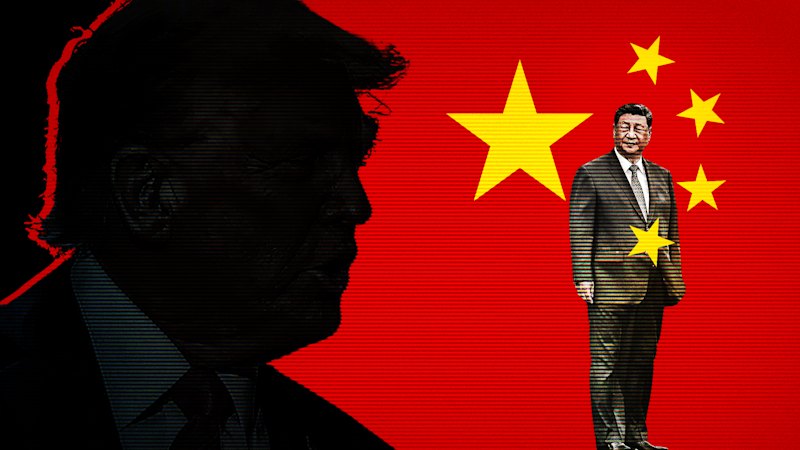
The rhetorical pivot of Donald Trump toward high-level praise for Chinese leadership represents a calculated deployment of asymmetric diplomatic signaling, designed to disrupt established geopolitical expectations. While traditional media interprets these "gushing" statements through a personality-driven lens, a structural analysis reveals a three-part strategy: the creation of a personal rapport buffer, the tactical devaluation of institutional red tape, and the signaled preference for direct executive negotiation over multilateral bureaucracy. This approach treats international relations as a sequence of high-stakes closings rather than a continuous management of shared values.
Understanding the mechanics of this shift requires deconstructing the specific variables that dictate the current US-China trade and security relationship. The standard binary of "hawk vs. dove" is insufficient. Instead, we must look at the Cost Function of Diplomatic Friction.
The Architecture of Personalist Diplomacy
Traditional diplomacy operates on a foundation of "institutional permanence," where career bureaucrats manage relationships via long-term treaties and standardized protocols. The Trump model replaces this with Personalist Diplomacy, characterized by the deliberate elevation of the individual leader above the state apparatus. By praising the Chinese President in a manner that bypasses state department grievances, Trump creates a "top-down" pressure valve.
The logic follows a specific sequence:
- De-escalation of Public Hostility: Using superlative language ("strong," "brilliant," "great guy") reduces the political cost of China returning to the negotiating table.
- Creation of Leverage via Unpredictability: By oscillating between extreme tariffs and extreme praise, the US creates a volatile environment where the Chinese leadership cannot rely on historical patterns to predict US moves.
- Personal Reciprocity Expectations: The praise functions as a non-binding down payment on future concessions. It frames the relationship as a private deal between "strongmen," which appeals to the internal power structures of the CCP.
The Variables of the Trade Bottleneck
The praise observed during the "trees" incident serves as a psychological lubricant for the high-friction issues of trade. When we quantify the US-China trade relationship, we find three core bottlenecks that verbal flattery attempts to circumvent:
- The Technology Transfer Penalty: US firms operating in China face an implicit tax in the form of intellectual property (IP) sharing. Praise from the executive branch acts as a temporary distraction while negotiations on IP enforcement continue in the background.
- The Subsidy Gap: The Chinese state-owned enterprise (SOE) model creates a market distortion that standard WTO rules are ill-equipped to handle.
- Currency Elasticity: US policy often seeks to pressure the Yuan's valuation. Softening the public rhetoric allows for "face-saving" adjustments in Beijing that would be politically impossible if under public attack.
Strategic Ambiguity as a Market Tool
The use of "gushing" language is not a sign of weakness but an application of Strategic Ambiguity. When the President speaks positively about a competitor while simultaneously maintaining a tariff regime, it creates a state of cognitive dissonance for both domestic markets and foreign adversaries.
This creates a specific market reaction:
- Volatilty Compression: Markets often interpret positive personal remarks as a sign of imminent stability, even if the underlying structural conflicts remain unresolved.
- Reduced Risk Premiums: For short-term capital flows, the "tiptoe among the trees" signals that the risk of immediate, catastrophic conflict (such as a total trade embargo) is low.
However, the limitation of this strategy is its low institutional durability. Because the rapport is built on a personal rather than a legal basis, the "stability" evaporates the moment the individual leader exits the frame. This creates a "Key Man Risk" at the level of global geopolitics.
The Three Pillars of the Sino-American Power Dynamic
To understand why Trump "gushes" at specific intervals, one must analyze the three pillars that support the current power dynamic. The rhetoric is the "software" running on a "hardware" of hard power and economic dependency.
Pillar 1: Interdependence Aggravation
The US and Chinese economies are locked in a state of Symmetric Dependence. China requires US consumer markets to maintain high employment levels (critical for social stability), while the US requires Chinese manufacturing capacity and its role as a primary purchaser of US debt. When Trump praises the Chinese leadership, he is acknowledging this interdependence while signaling that the terms of the arrangement are the only thing up for debate, not the existence of the arrangement itself.
Pillar 2: The Security Dilemma Buffer
Every positive comment serves to mitigate the Security Dilemma—the phenomenon where one state’s efforts to increase its security are perceived as a threat by others. By using hyper-positive language, the US executive branch attempts to decouple trade aggression (tariffs) from military aggression. The goal is to signal: "We are coming for your trade surplus, but we are not coming for your regime."
Pillar 3: Domestic Political Arbitrage
There is a calculation involving the domestic audience. By appearing "friendly" with a powerful adversary, the leader can claim the role of the "Great Negotiator" who can tame threats through sheer force of personality. This creates a political shield against accusations of warmongering while maintaining the ability to execute aggressive economic policies.
The Cost Function of Verbal Concessions
While the "cost" of words is low, the Opportunity Cost of this strategy is significant. There are three primary risks associated with this rhetorical style:
- Allied Erosion: US allies in the Indo-Pacific (Japan, South Korea, Australia) rely on consistent, predictable US signals to justify their own defensive postures. When the US President "gushes" over a shared competitor, it creates a "Reliability Gap," potentially driving allies to hedge their bets and move closer to Beijing.
- Institutional Atrophy: When the executive branch operates outside the State Department and the NSC, those institutions lose their "coercive credibility." Foreign actors begin to ignore US diplomats, knowing that the only opinion that matters is the President's latest public statement.
- The Credibility Trap: If the praise is not followed by a tangible deal, it eventually loses its utility as a lubricant. The "praise-to-result" ratio must remain high enough to convince the adversary that the rhetoric is a precursor to a win-win scenario, rather than a stall tactic.
Analyzing the "Trees" Event: A Case Study in Optic Control
The specific setting of the "trees" walk was not accidental. In diplomatic theater, the environment dictates the density of the dialogue. A formal boardroom requires a minute-by-minute agenda; a "walk in the trees" allows for Low-Density Communication.
In this setting, the objective is "Vibe Alignment" rather than "Policy Resolution." By praising the scenery and the leader, Trump was engaging in a ritual of Non-Threatening Presence. This is a classic negotiation tactic: establish a "Yes" momentum on trivial matters (the weather, the trees, the host's strength) to create a psychological predisposition for larger "Yeses" in the future.
Data Points in the Rhetoric
If we quantify the frequency of "strong" vs. "fair" in Trump’s China-related speeches, we see a shift toward descriptors of power. This is a deliberate choice. In the world of transactional realism, Power is the primary currency. By calling the Chinese leader "strong," Trump is validating the currency that he himself wishes to trade in. It is an acknowledgment of a shared worldview where might and economic leverage supersede international law.
The Mechanics of the "Great Power" Feedback Loop
The relationship operates as a feedback loop where rhetoric influences market sentiment, which in turn influences the political capital available for further negotiation.
- Positive Rhetoric -> Market Optimism -> High Political Capital.
- Tariff Escalation -> Market Anxiety -> Political Pressure to Settle.
The "gushing" phase is the "cool down" period of the loop. It is necessary to prevent the anxiety from becoming a systemic crisis that would hurt the US economy as much as the Chinese.
The Strategic Path Forward
The "gushing" observed is not a deviation from a hardline China policy; it is an integral component of its execution. For stakeholders and analysts, the move is to discount the superlative nature of the language and focus on the Underlying Leverage Points.
The strategic play here is a Dual-Track Engagement:
- Maximum Verbal Flexibility: Maintain a high-frequency, positive public dialogue to keep the Chinese leadership engaged and prevent an "isolationist cornering" that leads to kinetic conflict.
- Maximum Economic Rigidity: Continue the systemic decoupling of critical supply chains and the enforcement of IP standards, using the "positive relationship" as a shield against accusations of bad faith.
The objective is to reach a New Equilibrium where the US maintains its technological edge and reduces its trade deficit without triggering a full-scale collapse of the global order. The "trees" incident was a demonstration of the "software" update required to keep the "hardware" of the US economy running while the terms of the Sino-American contract are aggressively renegotiated. Success will be measured not by the warmth of the rhetoric, but by the shift in the net balance of trade and the security of the Pacific theater over the next 24 months. Organizations must prepare for a "high-volatility, low-conflict" environment where words are used as bait and tariffs are used as the hook.