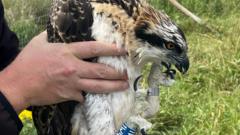
Silence weighs differently when you are waiting for a ghost.
For decades, the upper stretches of the valley held only memories. Older residents would point upward toward the weathered skeletons of ancient pines and tell stories of a shadow that used to span six feet of raw power. They spoke of the fish-hawk, the apex fisherman of the freshwater reaches, hunting with a folded-wing stoop that left nothing to chance. But the sky grew empty. Pesticides, human encroachment, and the quiet erosion of wild spaces turned those stories into folklore.
We forgot what it sounded like when the wind was split by wings that had survived millions of years of evolutionary trial.
Until this spring.
The Long Wait in the Blind
Dawn arrives slowly through a lens coated in condensation. At five in the morning, the temperature bites hard enough to turn breath into white smoke. Inside the canvas observation blind, three miles from the nearest paved road, movement is a luxury no one affords. Every twitch risks snapping a dry twig. Every breath is measured.
Conservation officer Martin Vance checks his binoculars for the fourth time in ten minutes. He has tracked these specific birds for five years, watching pairs circle above the reservoir during migration seasons only to vanish north, treating this territory as a temporary highway rather than a home.
"They don't make promises," Martin whispers, his voice barely disturbing the dust motes dancing in a shaft of pale sunlight. "You earn every inch with them."
(Note: Martin Vance is a composite character based on field ornithologists and wildlife wardens who monitor raptor reintroduction programs across northern wetlands.)
The nest itself is a fortress of stripped branches, sitting precariously sixty feet above the ground in a dead oak. To a casual observer, it looks like a random accumulation of storm debris. To an osprey, it is a cradle.
Last autumn, a pair—banded as juveniles hundreds of miles apart—began hauling timber to this exact spot. They didn't care about property lines or county designations. They cared about the visibility, the proximity to the shallow waters of the reserve, and the absolute absence of noise. For months, they worked in tandem, weaving heavy oak boughs and lining the cup with soft marsh grasses.
Then came the incubation watch. Thirty-seven days of unyielding vigilance. Through torrential downpours that turned the reserve trails into sticky mud, and sudden spring frosts that froze the edges of the lake, one adult remained glued to the clutch. The shift changes happened in absolute silence, a silent choreography executed in the gray light of dawn and the dying embers of dusk.
The First Crack
Biology is rarely romantic when viewed up close. It is gritty, exhausting, and governed by cold imperatives. Yet, humanity insists on finding poetry in survival.
On a Tuesday morning in late May, the field monitor's spotting scope caught something microscopic. A tiny, pale gray tip of a beak pushing against the interior of a mottled brown shell.
In the blind, the reaction was instantaneous, though entirely soundless. A sharp intake of breath. A fist gently punching the air.
(Hypothetically, if you were standing at the base of that ancient oak with an audio recorder, you would hear nothing human. You would hear only the wind groaning through the canopy, the aggressive chatter of red-winged blackbirds defending their turf, and then, faint and high-pitched, the reedy squeak of a life entering a world that nearly forgot it.)
Hatching is not a movie scene. It is a grueling, hours-long battle against calcium and physics. The chick, weighing no more than a few ounces, rests, pushes, rests, and pushes again. Its survival depends entirely on the adults above it—not just for warmth, but for the precise delivery of fresh, scaled protein the moment its eyes open to the light.
By afternoon, the shell gave way entirely.
What the Return Means
Numbers matter. Statistics anchor the emotion. When conservationists report that ospreys have hatched at a nature reserve for the first time in recorded history, they are citing a metric of ecological recovery.
Consider the context. Fifty years ago, synthetic chemicals like DDT decimated raptor populations across the globe. By thinning eggshells to the point of collapse, humanity inadvertently pressed pause on the ancient lineage of these birds. The recovery has been a masterclass in patience. Legislation banned the poison. Wetlands were designated, protected, and left alone. Water quality slowly crept upward from toxic to life-sustaining.
Yet, numbers fail to capture the visceral weight of a comeback.
When an apex predator returns to a landscape, it sends a ripple through the entire biological network. The fish populations must be healthy enough to support a family of voracious hunters. The water must run clean enough for those fish to thrive. The trees must be strong enough to bear the immense weight of successive generations of nests.
The osprey is not just a bird. It is an environmental report card written in feathers and yellow eyes.
And for the people who live near the reserve, the hatching is something else entirely. It is a reconciliation. It proves that despite centuries of asphalt, engine roar, and industrial sprawl, the wild places can still heal if given the one thing we are so rarely willing to offer: space.
The Shadow Over the Water
Back at the blind, the sun clears the tree line, burning off the mist that hugs the surface of the reserve.
High above, the male osprey cuts through the crisp morning air. In his talons, he clutches a freshly caught trout, still glistening with lake water, carried head-first to reduce wind resistance. He banks sharply, wings tilted at an exact angle of aerodynamic efficiency, and circles the nest twice.
His mate rises slightly from the cup of the nest, wings spread wide to shield the fragile, wet life huddled beneath her breast. She utters a high, piercing whistle—a call of welcome, a claim of territory, a sound that hasn't echoed across these waters in the lifetime of anyone living within ten miles.
The fish is transferred. The shadow passes over the water.
Down below, the marsh settles back into its rhythm, quiet, enduring, and suddenly full of tomorrow.