The air inside a political briefing room is usually thick with the scent of recycled oxygen and industrial-strength coffee. It is a place of scripted perfection, where every syllable is weighed on a jeweler’s scale before it is allowed to pass a politician's lips. Leaders spend thousands of hours training their brains to be filters, catching the stray thoughts and the honest impulses before they can do any damage.
Then comes the moment the filter fails. Learn more on a related subject: this related article.
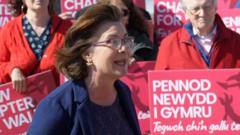
During a recent campaign event, Eluned Morgan, the First Minister of Wales and leader of Welsh Labour, stood before a microphone. She was there to rally the troops, to sharpen the divide between her party and the opposition, and to cement her vision for the country’s future. But the brain is a fickle instrument. In a flurry of enthusiasm, the words didn't just stumble—they flipped. Instead of the expected call to arms for her own party, she urged the crowd to "Vote Plaid Cymru."
Silence follows a moment like that. It is the kind of silence that feels heavy, pressing against the eardrums of everyone in the room. In that split second, the polished veneer of high-level politics cracked, revealing the messy, exhausted human beneath the title. Additional journalism by USA Today explores similar perspectives on this issue.
The Anatomy of a Verbal Tripwire
To understand why a three-word slip matters, you have to look at the pressure cooker of Welsh devolution. Politics in Wales isn't just about policy; it is about identity. Welsh Labour and Plaid Cymru are locked in a permanent, intimate dance. They are rivals who often share a bed of coalition or cooperation, yet they must constantly convince the public that they are fundamentally different.
When Morgan told voters to support the very party she is paid to defeat, it wasn't just a "gaffe." It was a glitch in the Matrix.
Psychologists call this a "lapsus linguae"—a slip of the tongue. We often joke about them being Freudian, suggesting that our deepest, darkest desires are leaking out. But usually, the truth is much more mundane. It is fatigue. It is the result of a mind that has said the word "vote" ten thousand times in a week and "Plaid Cymru" five thousand times in debate. The neural pathways get crossed.
Consider the life of a party leader during an election cycle. Your day starts at 5:00 AM with a briefing pack the size of a telephone book. You spend sixteen hours moving from train stations to community centers to television studios. You are constantly thinking about what your opponent is saying so you can counter it. You are living in their head as much as your own. Eventually, their name becomes as familiar as your own.
Morgan realized the error almost instantly. She laughed it off, corrected herself, and the room moved on. But the digital world never moves on.
The Ghost in the Machine
In the age of the viral clip, a mistake is no longer a fleeting moment. It is a permanent artifact. Within minutes, the footage was sliced, diced, and distributed across social media. To her supporters, it was a funny, relatable human error—a "we've all been there" moment that made a distant leader seem approachable. To her detractors, it was a gift-wrapped symbol of a party that has lost its way, so confused by its own rhetoric that it doesn't even know who it is representing anymore.
This is the invisible stake of modern leadership. You are expected to be a machine, but the moment you act like one, people complain that you are robotic and out of touch. Yet, the moment you show a flash of human fallibility, that fallibility is weaponized.
Think about a surgeon. If a surgeon slips and makes a small, non-fatal incision in the wrong place, there is a protocol for correction. In politics, there is no protocol for a slip of the tongue other than the "spin." The opposition parties, particularly Plaid Cymru themselves, didn't need to do much. They simply sat back and watched the clip do the work for them. For a party that prides itself on being the "National Party of Wales," having the Labour First Minister inadvertently endorse them is the kind of organic marketing money cannot buy.
The Weight of the Word
Language is the only tool a politician truly owns. They don't build bridges with their hands or heal patients with stethoscopes. They move the world through the air they push out of their lungs.
When that tool breaks, even for a heartbeat, it creates a vacuum. In that vacuum, voters start to project their own anxieties. Is the leadership exhausted? Is the message getting stale? Does the rivalry between these two parties actually matter if the lines can be blurred so easily by a tired mind?
Wales is at a crossroads. With issues ranging from the reform of the NHS to the complexities of the 20mph speed limit debates, the stakes for the Senedd have never been higher. The people aren't just looking for policy; they are looking for competence. They want to know that the person behind the wheel is awake, alert, and knows exactly which direction they are heading.
A gaffe like this acts as a Rorschach test for the electorate. If you trust Eluned Morgan, you see a hard-working woman who had a long day. If you don't, you see a metaphor for a government in decline.
The Human Cost of Constant Performance
There is a certain cruelty in how we consume political news. we demand that our leaders be perfect avatars of our ideologies, forgetting that they are subject to the same biological limitations we are. They get brain fog. They get distracted by a flashing light in the back of the room. They trip over the names of their own children, let alone their political rivals.
By focusing purely on the "gaffe," we miss the broader story of what leadership in the 2020s actually looks like. It is a grueling, relentless performance where one wrong breath can derail a month of planning. Morgan’s slip wasn't a policy failure. it wasn't a scandal involving taxpayer money or a breach of ethics. It was a verbal typo.
But in the theater of the Senedd, the script is everything.
The First Minister will likely laugh this off in her next few interviews. She will lean into the humor of it, perhaps even making a self-deprecating joke to disarm the critics. That is the standard playbook. Yet, as she stands at the next podium, watching the red light of the camera flicker to life, there will be a new shadow of doubt in the back of her mind. She will double-check every noun. She will hesitate for a fraction of a second before saying her own party's name.
That hesitation is where the real damage lives. Not in the mistake itself, but in the caution that follows it. A leader who is afraid to speak is a leader who cannot inspire.
The microphone remains on. The cameras are still rolling. And somewhere in a small town in the Valleys, a voter is watching that clip on a loop, wondering if the people in charge are as tired of the script as everyone else is.
Politics is a game of inches, and sometimes, those inches are measured by the distance between the roof of the mouth and the tip of the tongue. One wrong move, and the entire narrative shifts. One wrong word, and the rival's banners are inadvertently raised by your own hand.
The podium is a lonely place when the words stop listening to you.