The sun bounced off the tarmac at Sunan International Airport, catching the precise crease of thousands of identical synchronized flags. On the tarmac, a sea of people moved as a single organism, their cheers perfectly timed, their faces fixed in expressions of pure, unadulterated ecstasy.
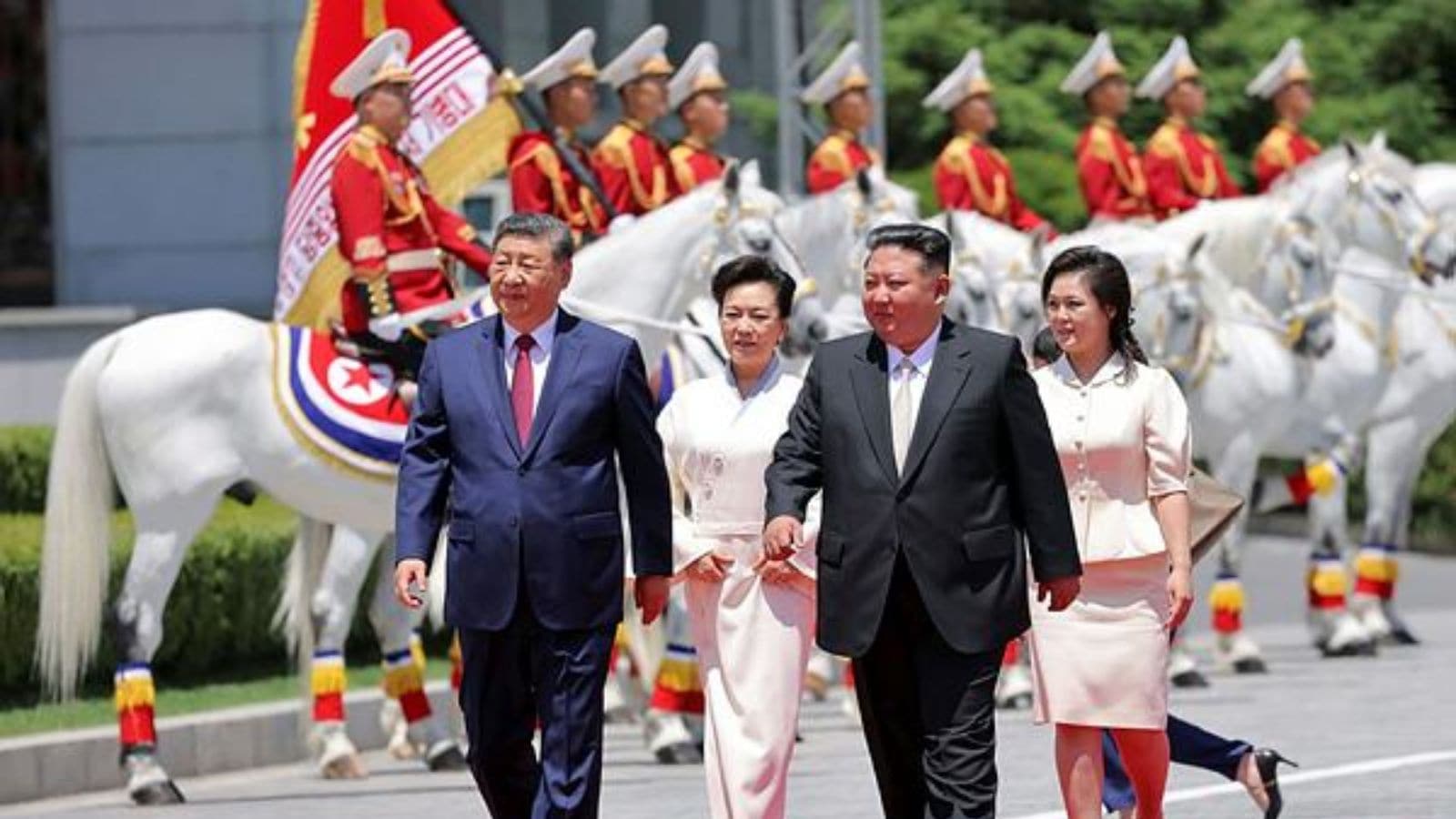
If you watched the state broadcast, you saw a triumph of brotherhood. You saw Xi Jinping, the leader of the world’s rising superpower, stepping off his plane to be embraced by Kim Jong Un. It was the first time a Chinese president had set foot in Pyongyang in seven long years. The cameras captured the grand banquets, the mass gymnastics performance titled "Invincible Socialism," and the two men smiling like old friends at a Sunday barbecue.
But look past the primary colors of the propaganda posters. Look at the edges of the frame.
Diplomacy at this level is rarely about friendship. It is about gravity. For seven years, the orbit between Beijing and Pyongyang had grown dangerously wobbly. When Xi Jinping decided to finally cross the Yalu River, he was not executing a standard diplomatic visit. He was recalibrating the balance of power in Asia, using the absolute theater of North Korean hospitality to send a chillingly quiet message to a listening world.
To understand why this moment mattered so deeply, you have to look at it through the eyes of someone standing in the crowds. Imagine a hypothetical local guide named Min-ho. He has spent weeks practicing the exact angle of his flag wave. His throat is raw from chanting. He knows that if his smile slips for even a second, the consequences could ripple through his entire family. For Min-ho, the arrival of the Chinese delegation is not a political abstract. It is a physical weight. He sees the massive black limousines rolling through the immaculate streets of Pyongyang, and he knows that the food on his table, the electricity in his home, and the very stability of his daily existence depend entirely on the calculations happening inside those moving glass windows.
The Cold Shoulder and the Sudden Thaw
The relationship had been frozen in ice.
For years, Kim Jong Un had been testing missiles and detonating nuclear devices right in China’s backyard. Beijing was furious. China prizes stability above almost all else; unpredictable neighbors throwing tantrums with atomic weaponry is the exact opposite of stability. Xi had supported United Nations sanctions against Pyongyang. He had tightened the economic screws. The two leaders had never met. The traditional alliance, once described by Mao Zedong as being as close as "lips and teeth," felt thoroughly decayed.
Then, everything shifted.
The United States entered the equation with a sledgehammer. Washington and Beijing found themselves locked in a bruising, unpredictable trade war. Simultaneously, Donald Trump sat down with Kim Jong Un in Singapore and Hanoi, dangling the possibility of a historic deal.
Beijing watched this sudden courtship with growing alarm. The nightmare scenario for Chinese strategists has always been a unified, democratic Korean peninsula aligned with the United States, placing American troops directly on the Chinese border. If Kim Jong Un was going to play the Americans against the Chinese, Xi Jinping needed to remind everyone who held the real leverage.
Consider the timing. Xi’s plane touched down in Pyongyang just one week before he was scheduled to meet the American president at the G20 summit.
It was a masterclass in leverage.
By hugging Kim Jong Un in front of the global media, Xi was subtly reminding Washington of a fundamental geopolitical truth: you cannot solve the North Korean problem without China. The message did not need to be shouted. It was written in the synchronized movements of a hundred thousand cheering citizens.
The Secret Currency of Pyongyang
What does a superpower buy when it visits a hermit kingdom?
It does not buy goods. North Korea’s economy is fractured, isolated, and heavily restricted by international law. Instead, China buys insurance.
During the lavish banquets, away from the clinking glasses of rice wine, the real currency being traded was reassurance. Kim Jong Un needed to know that if his high-stakes negotiations with the West completely collapsed, China would still ensure his regime did not starve. Xi Jinping needed to know that North Korea would not provoke a catastrophic military conflict that could destabilize the entire region.
For the average observer, the details of these talks can feel dry, buried under layers of diplomatic jargon and stale communiqués about "regional peace." But the reality is visceral.
Think about the sheer logistics of keeping a city like Pyongyang alive. The oil that runs the buses, the grain that fills the state distribution centers, the specialized materials that keep the factories humming—much of it flows through a singular pipeline of Chinese goodwill. When that pipeline constricts, the entire nation feels the pressure. When it opens, a collective sigh of relief echoes through the elite corridors of the capital.
Xi’s visit was the valve opening. It was a public declaration that despite the anger over nuclear tests, despite the sanctions, Beijing would not allow the North Korean state to collapse.
The Performance of Power
The sheer scale of the reception was designed to stagger the senses. There were mass games involving tens of thousands of performers flipping colored cards in perfect unison to create giant portraits of Xi Jinping’s face. There were military bands playing Chinese revolutionary songs.
It is easy to dismiss this as mere pageantry, a bizarre relic of a bygone era. That is a mistake.
In authoritarian systems, pageantry is policy. The intense, flawless coordination required to pull off such a spectacle is a demonstration of absolute state control. It tells the visitor: We are disciplined. We are unified. We are a force that cannot be easily broken or ignored.
For Kim Jong Un, hosting the leader of the world’s most populous nation on his own turf was a massive domestic victory. It validated his strategy. It proved to his own generals and citizens that despite international isolation, North Korea remained a critical player on the global stage, courted by giants.
But the warmth was conditional.
Behind the smiles, the power dynamic remained brutally unequal. China accounts for more than ninety percent of North Korea’s total trade. It is a relationship of total asymmetry. Xi Jinping did not travel to Pyongyang as an equal partner; he traveled as a patron visiting a client, ensuring the boundaries of the relationship were clearly understood.
The Echoes in the Silence
The true impact of those two days in Pyongyang cannot be measured by the joint statements released to the press. It is measured in the silence that followed.
The visit effectively drew a line in the sand. It signaled to the West that any attempt to force a regime change or completely isolate North Korea would be met with quiet, firm resistance from Beijing. It gave Kim Jong Un the strategic breathing room he desperately needed to navigate his volatile relationship with the rest of the world.
As the Chinese delegation’s plane lifted off from the Sunan tarmac, heading back toward Beijing, the flags were put away. The crowds dispersed into the quiet, gray realities of everyday life in Pyongyang. The grand banners celebrating an unbreakable bond began to gather dust in state storage facilities.
The theater was over. The reality remained.
Two nations, bound by geography and history, locked in an uneasy embrace. They do not necessarily trust each other. They do not necessarily share the same vision for the future. But in the grand, cold chess game of global politics, they realize that for now, they are entirely stuck with one another.