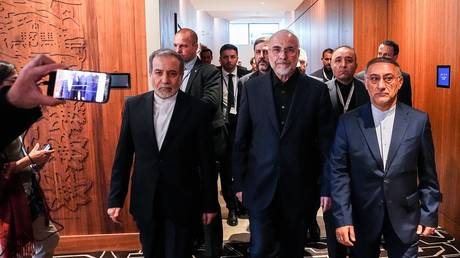
The rain in Geneva does not fall; it hangs. It drifts across Lake Geneva like a damp sheet, blurring the sharp edges of the stone facades and dampening the sound of the diplomatic sedans pulling up to the back entrances of neutral hotels.
Inside one of these hotels, a heavy oak door clicks shut. The sound is tiny, but it echoes in the silence of a room where two men, representing two nations that have spent decades speaking only in threats, sit down at opposite ends of a long table. There are no cameras. No flags stand in the corner to signal a breakthrough. There is only the scratching of pens on legal pads, the low hum of the heating system, and the invisible weight of millions of lives hanging on a comma.
For forty-four years, the relationship between the United States and Iran has been a story told in fire and static. It is a narrative of economic sanctions, cyber warfare, and regional proxies—a geopolitical chess match played with live ammunition. But when the grandstanding stops, the reality of diplomacy is shockingly mundane. It is a matter of schedules, translation delays, and the grueling work of finding words that allow both sides to claim victory without losing face.
To understand what is happening in Switzerland right now, you have to look past the official press releases. You have to look at the people who actually sit in those chairs.
The Geography of Neutrality
Switzerland has made a industry out of silence. For over a century, its hotels and conference rooms have served as the world’s decompression chambers. When two nations cannot be seen talking to each other without triggering a political crisis at home, they go to the Swiss.
Consider a hypothetical diplomat named Thomas. He is a senior State Department official who has spent the last decade studying the intricacies of Iranian domestic politics. He knows the names of the negotiators across the table, their family histories, and the internal rivalries that dictate their every move. Thomas has not slept more than four hours a night in three weeks. His coffee is cold. His notes are cross-referenced with intelligence briefs that change by the hour.
Across from him sits someone very much like him, let us call him Javad. Javad answers to a completely different set of masters in Tehran, but he faces the exact same pressure. A single misspoken word, a gesture that appears too accommodating, and his career—or worse—is over.
They are trapped together in a paradox. To the public, they are avatars of opposing ideologies. In reality, they are two tired professionals trying to solve a puzzle where the pieces are made of glass.
The core of the current discussions is not a mystery. It centers on the wreckage of the 2015 nuclear deal, the Joint Comprehensive Plan of Action. When the United States walked away from that agreement in 2018, it set off a chain reaction. Washington re-imposed crushing economic sanctions; Tehran responded by spinning up its centrifuges, pushing its uranium enrichment closer to weapons-grade levels than ever before.
But a spreadsheet showing enrichment percentages does not capture the human cost.
The Weight of the Ledger
Geopolitics is a grand abstraction until it hits the kitchen table. The sanctions that Washington uses as leverage are designed to starve a regime of resources, but their primary impact is felt by ordinary people.
Imagine a pharmacy in Isfahan. A grandmother stands at the counter, holding a prescription for a specialized cancer medication. The drug is not technically banned by American sanctions—humanitarian goods are exempt on paper—but because international banks are terrified of falling afoul of US financial regulations, no one will process the payment. The medicine is not on the shelf. The pharmacist shakes his head.
That is the hidden currency of these talks. Every point of leverage used by American negotiators is paid for in the daily anxieties of ninety million Iranians who are watching their currency collapse and their futures evaporate.
Conversely, the American negotiators carry a different kind of ledger. They remember the drone strikes on base camps in the region. They look at the intelligence reports detailing the transfer of drones and missiles to conflict zones across the Middle East. They are hyper-aware of the political reality back in Washington, where any deal that looks "soft" on Iran will be instantly weaponized by domestic opponents.
The stakes are not academic. If these talks fail entirely, the alternative is not a status quo; it is a slide toward a conflict that could reshape the entire region.
The Mechanics of the Whisper
How do you talk to an enemy when you are forbidden from speaking?
For years, the United States and Iran relied on "proxy diplomacy." The Swiss embassy in Tehran acted as the mail carrier, translating official messages and passing them across the chasm. But mail takes time, and nuances are lost in translation.
The current meetings in Switzerland represent a shift toward what diplomats call "proximity talks." The two delegations do not necessarily sit in the same room from dawn until dusk. Instead, they occupy separate suites in the same building. Swiss officials act as human shuttles, carrying a proposal from the American room, walking down a carpeted corridor, and delivering it to the Iranian room.
It is a slow, agonizing process.
"Diplomacy is the art of letting someone else have your way." — Daniele Vare
🔗 Read more: The Strait of Hormuz Blockade is a Geopolitical Myth
The Swiss facilitators are looking for the overlapping circles in a Venn diagram that currently looks like two separate pages. The Americans want a verifiable freeze on enrichment and a cessation of regional aggression. The Iranians want an immediate, permanent lifting of sanctions and a guarantee that a future US administration will not tear up the agreement again—a guarantee that no American negotiator can legally provide.
The real breakthrough, if it comes, usually happens in the margins. It happens when two aides run into each other in the hallway near the restrooms and speak for forty seconds without their notes. It happens when a translation error is corrected over a plate of sandwiches left in the corridor.
The Price of the Silence
There is a profound loneliness to this kind of work. The men and women in those rooms cannot call their spouses to talk about their day. They cannot vent their frustrations to friends. They are operating in a vacuum where every word is recorded, analyzed, and weaponized.
The public impatience with these talks is understandable. From the outside, it looks like endless bureaucracy, a traveling circus of well-paid officials staying in luxury hotels while the world burns. People want decisive action. They want victory or they want total separation.
But total separation is an illusion in an interconnected world. The fallout from a collapse in these talks does not stay in the Middle East. It affects global oil prices, shipping lanes in the Bab al-Mandab, and cyber security networks in Ohio.
The work being done in Switzerland is unglamorous because peace is unglamorous. It is made of fine print, boring meetings, and compromise that leaves everyone slightly dissatisfied.
As the evening settles over Geneva, the lights stay on in the hotel suites. The rain continues to smear the glass of the tall windows. In the hallway, a Swiss staff member clears away a tray of half-eaten dinners.
Inside the main room, someone pushes a chair back. The scrape of wood against stone is loud in the quiet room. A document is passed across the table. It is not a treaty. It is just a list of times for tomorrow’s meetings.
The negotiators look at each other for a long moment, nodding once before turning away to prepare for another twelve hours of arguing over the placement of a single word.


