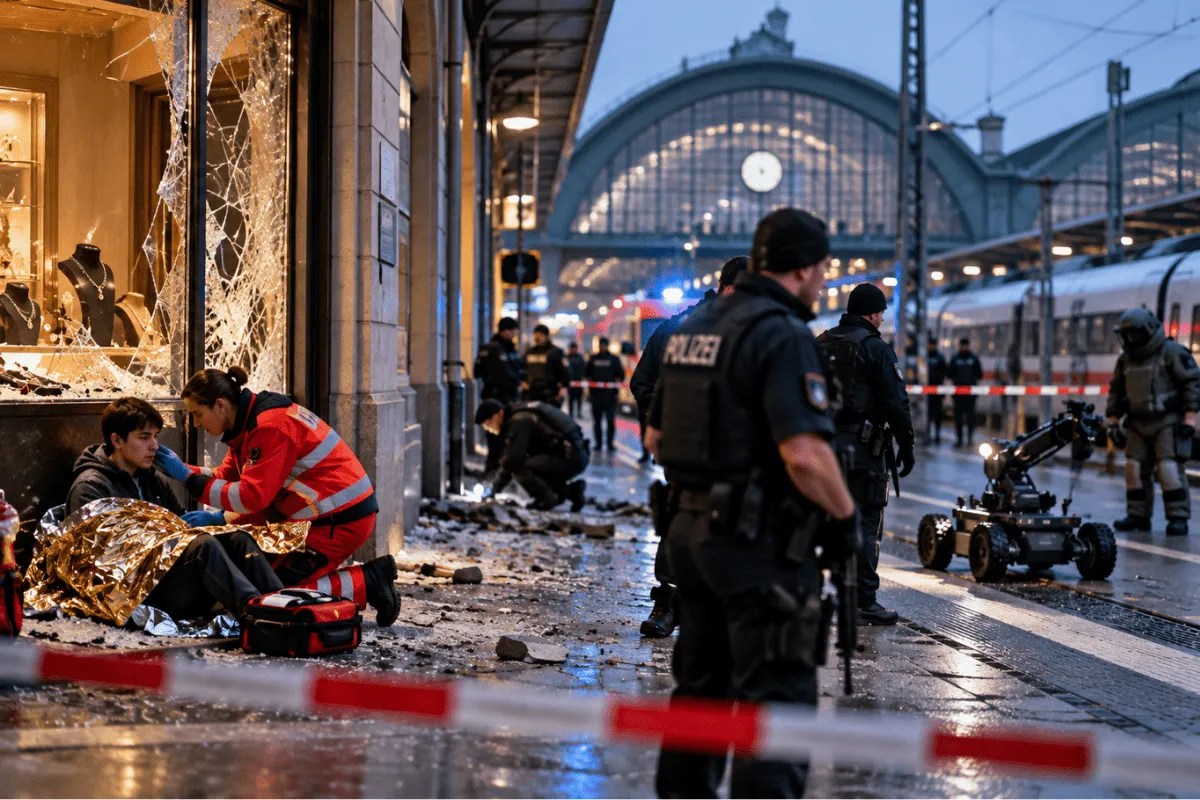
The morning air in Germany usually arrives with a predictable, steady pulse. Commuters clutch paper cups of lukewarm coffee, eyes fixed on glowing departure boards, listening to the familiar, rhythmic hum of trains sliding along polished steel tracks. It is a symphony of mundane routine.
Then came the sound. You might also find this related article insightful: Why Blaming Mother Nature For The Nepal Tibet Floods Misses The Real Architect Of Destruction.
Not a roar, but a sharp, violent crack that tore through the concrete corridors of a railway station. Suddenly, the ordinary world vanished.
Silence followed. The heavy kind. The kind that settles over a crowd right before the screaming starts. As extensively documented in recent reports by Reuters, the results are widespread.
Beneath the jagged edges of a shattered world, two lives changed forever. Two Ukrainian citizens, displaced by a war they thought they had outrun by thousands of miles, found themselves caught in a new kind of terror. They were just waiting. Waiting for a train. Waiting for a normal life. Instead, they became casualties of a sudden, violent eruption on a quiet platform.
Panic rippled outward. Police sirens pierced the gray morning, flashing red and blue against the soot-stained walls. Security cordons went up in frantic yellow lines. Trains, the lifeblood of European transit, ground to an immediate, screeching halt. Thousands of travelers were left stranded in limbo, staring at blank screens while authorities scrambled to answer a terrifying question: What was that object left sitting quietly in the shadows?
Fear is a strange thing. It travels faster than any locomotive.
When a suspicious object is discovered near a railway artery, the entire system holds its breath. Rail networks are built on trust. You step onto a platform, you hand over your ticket, and you surrender your safety to an intricate web of engineers, conductors, and security protocols. You trust that the steel will hold. You trust that the stranger standing next to you is just trying to get to work.
When that trust breaks, the infrastructure fractures with it.
Emergency squads moved in with measured, terrifying precision. Bomb disposal units approached the unidentified object with heavy-footed caution. Every second stretched like a rubber band, threatening to snap. For the two injured Ukrainians, the seconds must have felt like hours. Having already fled the relentless bombardments of their homeland, seeking sanctuary in the heart of Europe, the irony of the blast is heavy enough to crush bone.
War does not always respect borders. Sometimes, it follows you in the whispers of anxiety, or worse, in the sudden flash of a localized explosion in a peaceful city.
(Note: While the specific psychological weight experienced by the victims in this scenario reflects the broader, shared trauma of millions displaced across Europe, the core event remains an active, alarming security investigation on German soil.)
As investigators combed through the debris, transit authorities locked down the surrounding grid. Commuters flooded the station concourses, checking phones, calling loved ones, trapped in a wave of uncertainty. Why this station? Why now? Was it a targeted act, a reckless message, or the terrifying byproduct of something far more chaotic?
The answers did not come easily. Investigations into transit security breaches move with agonizing slowness, bound by forensics, camera footage, and the painstaking collection of chemical traces. But the immediate fallout was instantaneous.
Consider what happens next when a nation's transit system stumbles. Millions of daily commutes disrupted. Supply chains hiccuping. A collective anxiety settling over public spaces that were, just moments before, entirely unremarkable. We design our modern cities for efficiency, packing thousands of people into tight, high-speed corridors. We trade privacy and open space for convenience. But moments like this remind us of the fragile bargain we strike every single day.
We ride together. Which means, occasionally, we bleed together.
The smoke cleared from the platform. The flashing lights eventually faded into the afternoon drizzle. The trains would eventually run again, the tracks cleared, the structural damage repaired with fresh concrete and steel. But the psychological landscape of that station changed permanently.
Every traveler who walks past that specific platform from now on will walk a little faster. They will look down at the corners of benches with a sharper eye. They will remember the two injured souls whose morning routine turned into a nightmare.
Security protocols will tighten. New cameras will be installed. Guard patrols will multiply. Yet, the deeper scar remains invisible, etched into the collective consciousness of a continent trying desperately to keep its balance on a moving train.
The rails stretch out across the horizon, cutting through fields and cities, binding nations together in a web of motion and commerce. But tonight, those tracks look a little colder, and the destination feels just a bit further away.