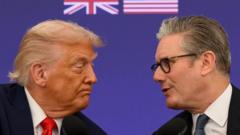
The idea that Keir Starmer and Donald Trump could ever be "bros" was always a bit of a stretch. One is a cautious, detail-obsessed human rights lawyer. The other is a political hurricane who trusts his gut and values personal loyalty above almost everything else. While Downing Street spent most of 2025 trying to play it cool, the reality in April 2026 is impossible to ignore. The relationship isn't just under strain—it’s effectively broken.
You don't have to look far for the proof. Just last week, Trump took a public swipe at Starmer during an Easter event, mocking the Prime Minister’s "weak" leadership and literally imitating his voice. Trump’s gripe? Starmer didn't want to blindly follow the U.S. into a military escalation in Iran without consulting his team. For a guy like Trump, "consulting the team" is just code for being indecisive. He wants "yes" men, and Starmer isn't built that way.
The Chagos Islands collapse and the Diego Garcia problem
If you want to see exactly where the wheels fell off, look at the Chagos Islands. For months, the Labour government tried to finalize a deal to hand sovereignty of the archipelago to Mauritius while securing the future of the Diego Garcia military base. It seemed like a win-win for international law and security.
Then Trump stepped in.
Despite the State Department initially backing the move, Trump flipped the script, calling the deal a "big mistake." Suddenly, Starmer had to pause the entire thing because he couldn't get U.S. support. It’s a humiliating climbdown for Number 10. It shows that even when Starmer plays by the rules, Trump is happy to flip the table just because he can.
The U.K. is now paying £101 million a year to lease a base on islands it was trying to give away, all while the deal sits in limbo. It’s the kind of diplomatic mess that makes a "special relationship" feel more like a one-sided headache.
Why the Iran war changed everything
The biggest wedge isn't actually territory; it's war. The conflict in the Middle East has forced both leaders to show their cards. Trump wanted the U.K. to dive in headfirst, using British bases for strikes on Iran. Starmer said no. He chose de-escalation and diplomacy over the "shoot first, ask questions later" approach coming from the White House.
Trump didn't take it well. He’s since called the U.K.’s aircraft carriers "old and broken-down." Honestly, it’s petty. But in the world of high-stakes geopolitics, these insults matter. They signal to the rest of the world that the U.S. and the U.K. aren't on the same page.
- Starmer's priority: Economic stability and keeping energy prices from spiraling.
- Trump's priority: Projecting absolute military strength and "America First" dominance.
These two goals are currently rubbing against each other like tectonic plates. Starmer is "fed up" with U.K. energy bills being held hostage by global conflicts, while Trump sees any hesitation as a betrayal of the alliance.
Economic friction and the tariff threat
Beyond the military stuff, there’s the money. Trump’s second term has been defined by his love for tariffs. He’s already floated the idea of massive import taxes on European goods, and the U.K. isn't getting a free pass.
Starmer’s government is desperately trying to rebuild ties with the EU single market because they know they can’t rely on a U.S. trade deal that might never happen. The "charm offensive" that started at Mar-a-Lago in late 2024 has officially hit a wall. When Starmer offered Trump a second state visit and tea with King Charles, he thought he could manage the ego. He was wrong.
Trump doesn't care about pageantry as much as he cares about winning. If the U.K. doesn't fall in line on trade or defense, the "special relationship" is just a phrase in a history book.
Managing the fallout at home
Domestically, Starmer is in a tough spot. The Conservatives and Reform UK are watching every move. If he gets too close to Trump, he loses his own party. If he fights too much, he risks the U.K. economy.
It’s a balancing act that’s becoming impossible to maintain. You can’t be a "friend" to someone who publicly mocks you for being "too weak" to make a decision. The vibe in Westminster has shifted from "let’s make this work" to "how do we survive this?"
If you're looking for a silver lining, there isn't much of one. The U.K. is moving closer to Canada, Australia, and Europe to hedge its bets. It’s a sensible move. You don't stay in a one-sided bromance when the other guy is already looking for the exit.
Stop expecting a grand reconciliation. The Starmer-Trump era is going to be defined by friction, not friendship. The best the U.K. can do now is shore up its own defenses and wait for the storm to pass.
- Pivot to Europe: Accelerate the "reset" with the EU to mitigate the impact of U.S. tariffs.
- Diversify Defense: Strengthen ties with the "AUKUS" partners and the "five eyes" while reducing reliance on immediate U.S. military approval.
- Hold the Line: Maintain the refusal to engage in unnecessary Middle East escalations, even if it means more insults from the White House.



